

Stories by @mr95
4,807 stories
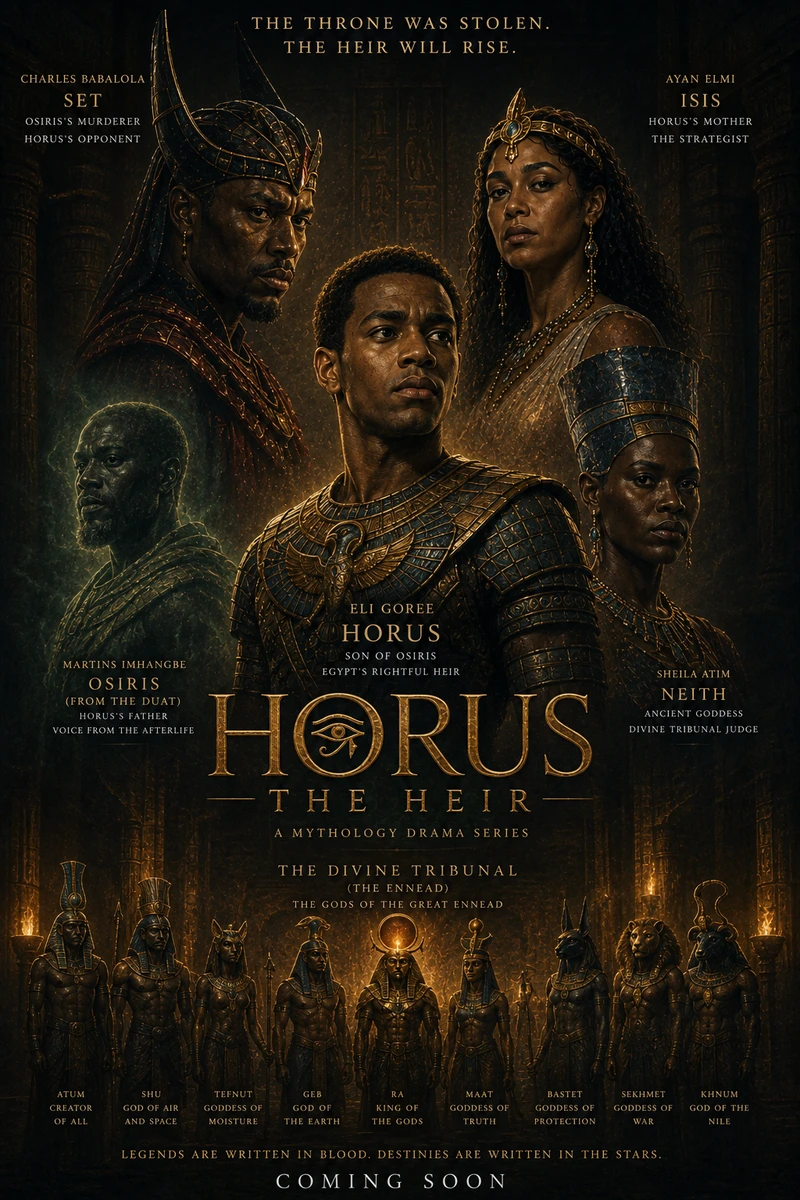
Horus: The Heir
The story of Horus — Osiris and Isis's son, raised in hiding in the papyrus marshes of the Nile Delta, emerging to contest Egypt's throne against his uncle Set. The Contendings of Horus and Set is one of Egyptian mythology's most extensive and formally complex texts — a legal and divine contest that lasts eighty years according to some sources, involving Ra, Thoth, the divine tribunal, multiple trials and battles, and the eventual recognition of Horus as Egypt's rightful king. The series treats the Contendings with full fidelity to the ancient texts while giving each divine being the psychological depth the story deserves. Set's perspective is not ignored — his argument that a warrior-king is better than a child with an inherited claim is not without logic, which the series takes seriously. But the Egyptian sources are clear: Horus prevails because his claim is just, and justice is the fundamental principle of the Egyptian cosmos.

Osiris and Isis: The First Death
The Nile Chronicles' most emotionally rich installment — the story of Osiris and Isis, which is the central myth of Egyptian religion, the foundation of the afterlife tradition, and one of the ancient world's greatest love stories. Osiris, first king of Egypt, murdered and dismembered by Set, reassembled and resurrected by Isis, becoming lord of the Duat. The series treats this not as simple tragedy but as the myth that explains why death can be transcended, why resurrection is possible, and why love — specifically Isis's love — is the most powerful force in the Egyptian cosmos. Two seasons cover the full myth: Season 1 is Osiris's reign, his murder by Set, and Isis's search across Egypt to recover his pieces. Season 2 is the resurrection, the birth of Horus, Osiris's choice to rule the Duat rather than return to the living world, and the establishment of the afterlife as humanity's great promise.
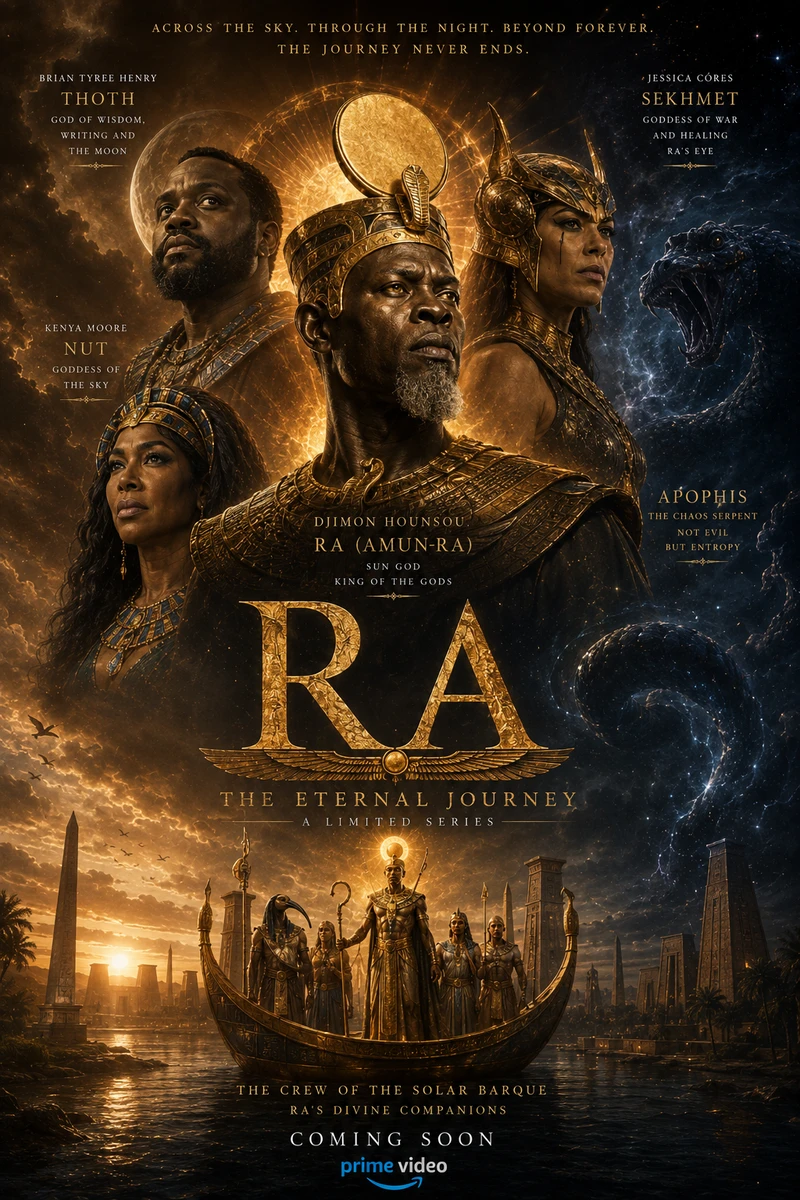
Ra: The Eternal Journey
The Nile Chronicles opens with its most cosmically ambitious installment — the daily journey of Ra, the sun god, whose solar barque crosses the sky by day and descends through the twelve hours of the Duat by night, battling Apophis (the serpent of chaos) to ensure the sun rises again. The series treats Ra not as a simple solar deity but as the most exhausted, most committed divine being in Egyptian mythology — he has made this journey every single day since creation and will make it every day until the end of the cosmos, because if he fails, everything ends. This is not dramatized as glory. It is portrayed as the specific, profound weight of the most necessary work imaginable. The series also covers Ra's original kingship over gods and men, his aging (in the myth where humanity plots against him as he grows old), and the creation of Sekhmet from his Eye — one of Egyptian mythology's most morally complex stories.

Ragnarök: The Twilight
The Norse Chronicles culminates in Ragnarök — the twilight of the gods, the end of the world as the Norse sources describe it, and the most emotionally devastating finale ever conceived for a mythology series. The series follows the Fimbulwinter (three years of winter without summer), the breaking of Loki's bonds, the gathering of the forces of chaos, and the final battle at Vígríðr. Every major character from across the six series returns. The key mythological battles are all honored: Odin versus Fenrir, Thor versus Jörmungandr, Freyr versus Surtr (without his sword, which he gave away for love). Crucially, the series also shows the Eddic promise: the world is reborn after Ragnarök. Baldr and Höðr return from the dead. A new, green world emerges from the waters. Hel's role in the ending is the series' most significant final statement — she releases the dead of Niflheim for the final battle, not from malice but from the understanding that the boundary she has maintained is dissolving, and she will hold it with dignity until the last possible moment.
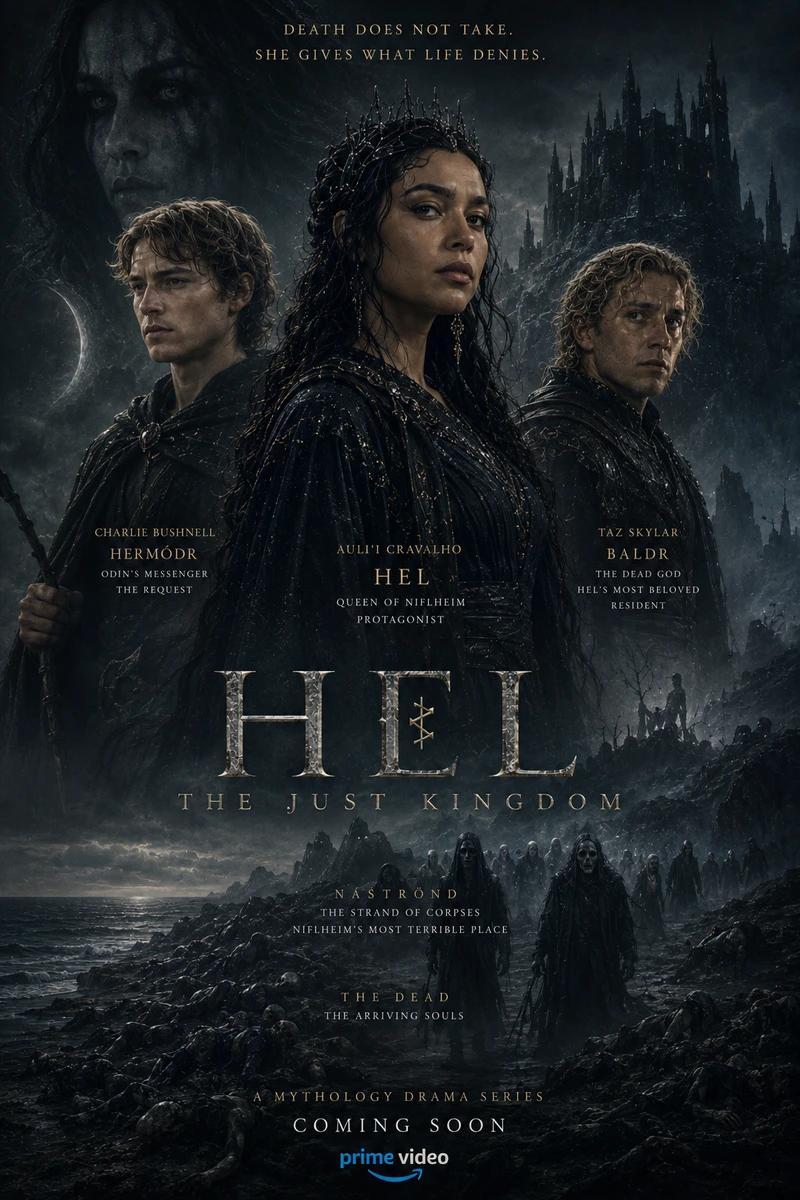
Hel: The Just Kingdom
The Norse Chronicles' most important corrective and its most emotionally resonant installment — the definitive portrait of Hel as she actually appears in Norse sources. Hel is appointed by Odin to govern Niflheim, the realm of those who die of old age, sickness, and accident. She accepts this appointment with the quiet gravity that characterizes everything she does. Her realm is not a punishment — it is the destination of most of humanity, and she governs it with scrupulous fairness. The series shows a single year in Hel's governance: the souls she receives, the judgments she makes, the specific loneliness of being the boundary between living and dead. The great mythological event of the series is Hermóðr's mission to recover Baldr — the only living being who comes to Niflheim to ask for something back. Hel's response to his request is the series' most morally complex moment: she does not refuse out of malice but out of the specific integrity of her governance.

Loki: The Shapes of Things
The Norse Chronicles' most psychologically complex installment — a series that finally treats Loki with the full ambiguity the Eddas actually give him. Loki is not evil at the series' start. He is contradictory — simultaneously the Æsir's most useful companion and the source of their greatest disasters, not from malice but from a nature that cannot hold a single shape for long enough to be trustworthy. Two seasons track Loki across the great Loki myths: his various shape-changes and their consequences, the birth of his three extraordinary children (Hel, Jörmungandr, Fenrir) and Odin's consequential decision about each of them, his increasing estrangement from the Æsir as his disasters outweigh his helps, and finally Baldr's death — the mythological event that makes Loki's binding inevitable. The series neither excuses Loki nor condemns him. It simply shows a being whose nature made tragedy inevitable, and asks whether that makes it his fault.
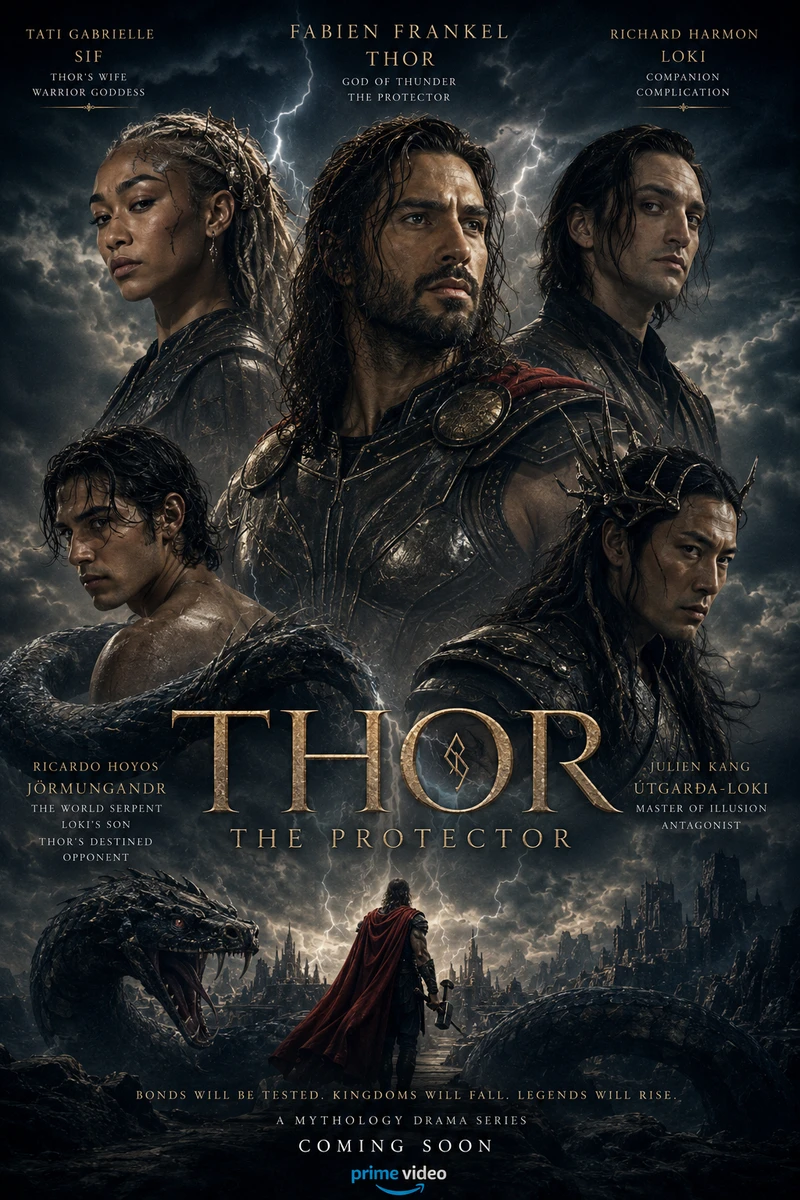
Thor: The Protector
A three-season series following Thor across the great Norse myths — not as a simple warrior but as a complex divine protector whose strength is the most obvious thing about him and whose humanity (in the sense of genuine feeling) is the most important. Three seasons track the major Thor myths: Season 1 covers the theft of Mjölnir and Thor's disguise as a bride (the Þrymskviða), his expeditions to Utgard, and his first encounters with Jörmungandr. Season 2 covers the building of Asgard's walls and the consequences of Loki's schemes. Season 3 is the most emotionally demanding — Thor's growing awareness of Ragnarök and the specific grief of a god who cannot protect the people he loves against fate itself. The romance across all three seasons is with Sif — a relationship the series treats as genuine partnership rather than simply divine marriage.
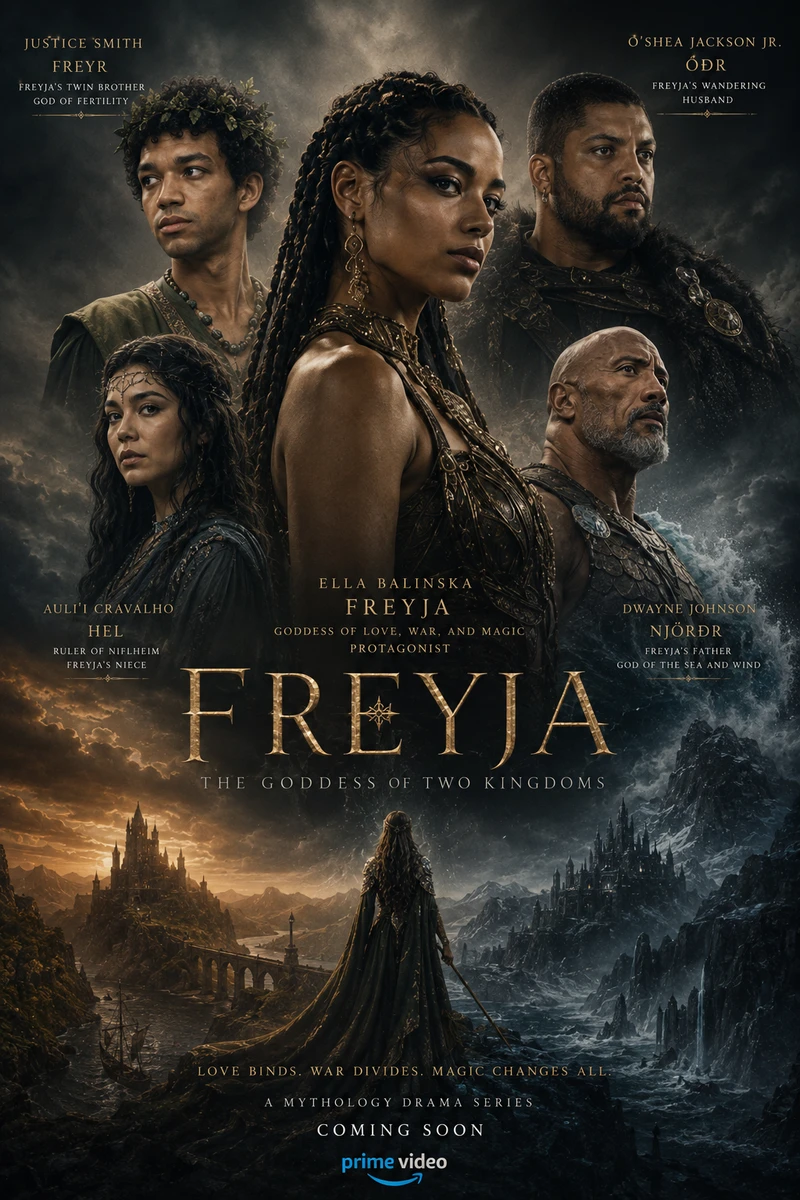
Freyja: The Goddess of Two Kingdoms
A character-centered limited series placing Freyja at the universe's center — exploring a goddess whose domain is far more complex than popular culture acknowledges. Freyja rules love, beauty, fertility, war, death, and seiðr magic simultaneously, and the series argues that these are not contradictions but a unified vision of female divine power. The series explores multiple storylines across its two seasons: the First Aesir-Vanir War and its resolution through hostage exchange (Freyja, Freyr, and Njörðr given to the Æsir, Hœnir and Mimir given to the Vanir); Freyja's search for her missing husband Óðr across the Nine Worlds (crying golden tears that become the gold in the earth); her teaching of seiðr magic to Odin; and her role as commander of the Valkyries who choose half the battle-slain. Season 2 deepens into her relationship with Hel — her niece, Loki's daughter — which is one of the universe's most unexpected and moving secondary relationships.
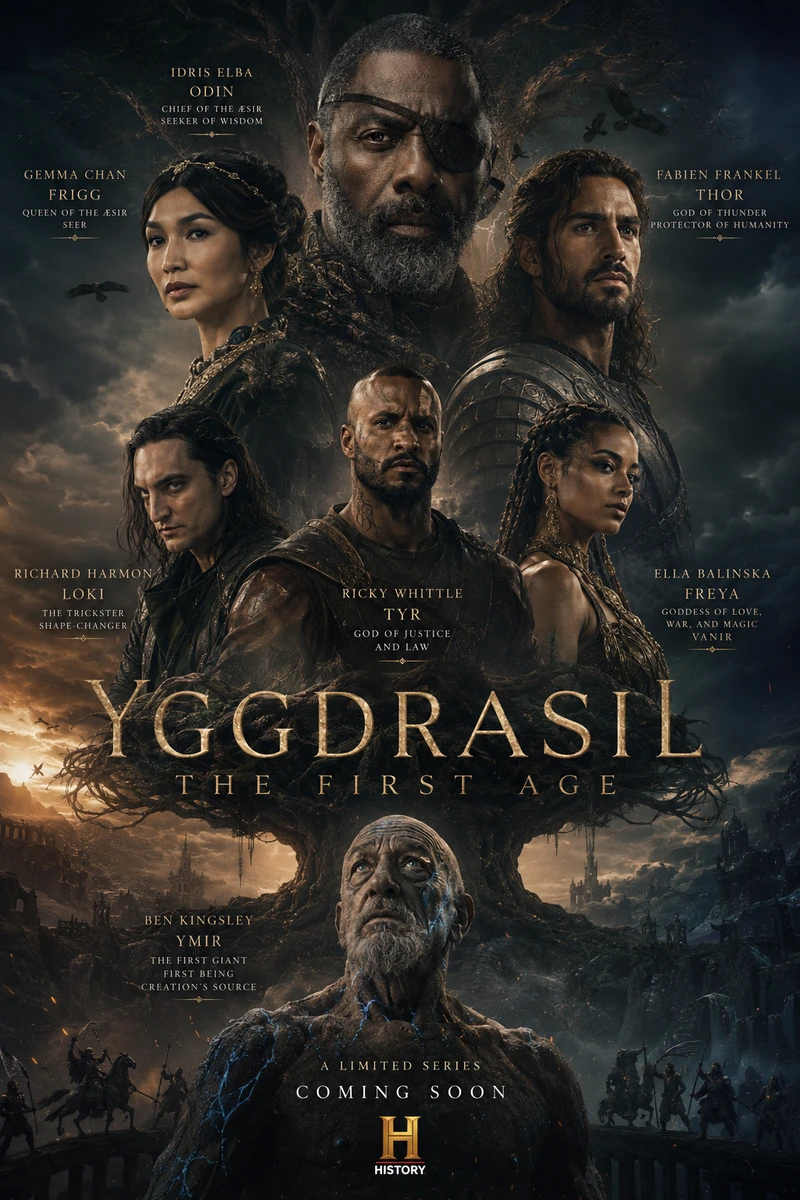
Yggdrasil: The First Age
The Norse Chronicles opens at the cosmogony itself — the creation of the Nine Worlds from the void of Ginnungagap. This series is the universe's most formally ambitious installment, structured as a mythic epic rather than a conventional narrative. It covers the emergence of Ymir (the first giant), the creation of the gods, the construction of the Nine Worlds from Ymir's body, the forging of the World Tree Yggdrasil, and the first age of the gods — including Odin's self-sacrifice on the World Tree to gain the runes, the first war between the Æsir and Vanir, and the establishment of the Nine Worlds' governance. The series treats Norse cosmology with absolute fidelity to the Eddas while giving each divine being the psychological depth of a fully realized character. Special attention is paid to the portrayal of Odin: not as a simple all-father but as a profoundly mortal god who makes difficult choices with full knowledge of Ragnarök approaching.

Sovereign
Set in a fictional African-inspired kingdom at a moment of political transformation — the old system of military governance giving way to constitutional reform — Sovereign follows General Amara, 30, who has spent twelve years winning wars for her kingdom and is appointed by the dying king as regent in the transition period. She is the most effective military leader in a generation and has no idea how to govern without fighting. Three seasons track her transformation from general to sovereign, her political education across the specific terrain of democratic reform, and her relationship with Emeka — the constitutional scholar whose vision of what the kingdom could be is the destination Amara is being asked to lead everyone toward.

Obsidian
Valentina Cruz, 28, spent six years as Los Angeles's most sophisticated art thief — never taking anything with a legitimate original owner, always targeting stolen works being laundered through legitimate sales. The FBI's art crime unit finally catches her on a procedural error she made deliberately, because she wants a deal: her expertise in exchange for a sanctioned role tracking the network that taught her everything. Two seasons track Valentina inside the FBI task force, her relationship with lead agent James Park developing across the specific tension of someone who is simultaneously consultant and suspect.

Isabela
Set in a magical world inspired by Colombian myth, Isabela follows Isabela Madrigal, 19, a young woman with the gift of making things grow — plants, flowers, crops — who leaves her village after her gift accidentally destroys something irreplaceable. Her journey across a magical continent to find the person who can help her understand her gift becomes a two-season bildungsroman about power, responsibility, and what it means to make something beautiful when you know it can also destroy.

Luna
Luna Vega, 17, is a Mexican-American teenager in Los Angeles who discovers at fourteen that she can manipulate shadow — not darkness itself, but the shadows that objects cast, which she can detach, shape, and move. She has spent three years hiding this ability. Three seasons track her from hiding to understanding to choosing: Season 1 is her encountering others with similar gifts; Season 2 is the government agency that wants to study (and control) those gifts; Season 3 is the decision about what to do with power you didn't ask for and cannot return.

The Diplomat
Ayşe Kaya, 31, is assigned as Turkey's cultural attaché in London — officially a prestigious posting, actually a consequence of her refusal to sign off on a dossier she believed was falsified. In London, she builds a network of contacts and intelligence while pursuing the diplomatic work officially assigned to her, uncovering a financial network that connects three European governments and two Turkish institutions. The romance with British intelligence officer Robert Ashby develops across two seasons with the specific tension of professional opposition.

The Surgeon
Dr. Clara Webb, 31, is the finest neurosurgeon at her institution — and the most interpersonally catastrophic colleague anyone has ever worked with. Not cruel — simply unable to modulate social interaction in ways that don't include complete honesty, which in a hospital environment is equally devastating. Two seasons track Clara across a case that tests every limit of her technical capability (Season 1) and a personal crisis that requires her to access emotional resources she has never developed (Season 2). The romance with Dr. James Okafor — an anaesthesiologist whose patience is architectural and whose sense of humor is the only thing that makes Clara's honesty survivable — develops with the specific rhythm of two people whose professional compatibility runs six months ahead of their personal one.

La Reina
Elena Zavala, 48, is elected Mexico's first female president following a campaign built on anti-corruption and judicial reform. Three seasons track her administration: Season 1 is the first year — the machinery of government, the specific resistance of institutions to reform, the personal cost of the presidency. Season 2 is the political crisis — a cartel escalation that forces Elena to choose between military response and negotiated settlement in ways that divide her coalition. Season 3 is the reckoning — a corruption investigation that reaches people she trusted completely. The romance across all three seasons is with her chief of staff Rodrigo — a twelve-year professional relationship that the presidency finally makes impossible to keep entirely professional.

The Speed of Light
Dr. Amara Osei, 32 (biological age) / 46 (calendar age), is a physicist who volunteered for a fourteen-year deep space mission at eighteen. Due to relativistic time dilation, she experienced only four years of time while Earth experienced fourteen. She returns to a planet where her parents have aged, her friends have built lives, and the scientific community has moved on — while she is twenty-two years old with a doctorate and a lifetime of isolation. The film is a quiet, devastating science fiction character study about the alienation of returning. The romance with her former colleague Dr. Marcus Webb — who was her age when she left and is now forty, and who waited without intending to — is the film's central emotional engine.

Glass Hour
Carmen Vega, 27, is a conservator at a major Los Angeles museum — her speciality is the restoration of damaged paintings, the meticulous work of recovering what was there before the damage. She is brilliant at it because the work requires the specific patience of someone who can sit with something broken for months without rushing to fix it. When the museum acquires a newly discovered 17th-century Mexican painting with an unusual provenance, Carmen's restoration work uncovers a hidden image beneath the surface — and a story that connects, impossibly, to her own family history. The film is a slow-burn psychological drama about the relationship between what is visible and what is hidden, with the painting serving as both mystery and mirror.

The Voice in the Wall
A period musical drama set in early 1960s New York, The Voice in the Wall follows Sofia Reyes, 22, a Colombian-American singer who arrived in New York at eighteen and has spent four years navigating the specific world of early 1960s American music — the integration of Latin sounds into mainstream pop, the civil rights movement reshaping what American music is allowed to be, and the specific barriers placed before women whose talent exceeds what the industry is prepared to manage. The film has eight original songs spanning the specific sound of early 1960s New York pop, Latin jazz, and the proto-soul that was emerging from the Brill Building. The romance with Marcus Webb — a Black songwriter who is writing the music the industry is not yet ready to record — is the film's central love story.
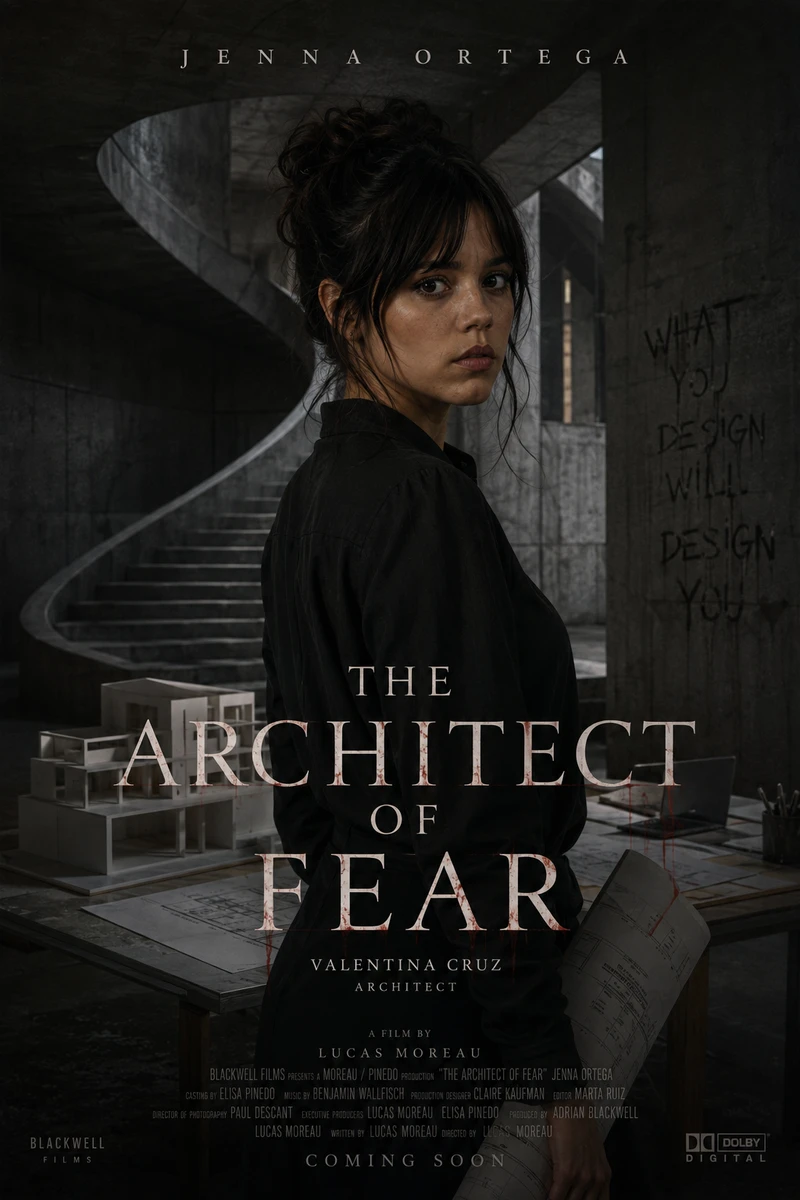
The Architect of Fear
Valentina Cruz, 24, is a young architect who designed her first major building — a residential tower in Mexico City — at twenty-two. Two years later, the building has a history that cannot be explained by structural engineering: three deaths, all apparently accidental, all in the same stairwell she designed specifically for its acoustic properties. When the building's management hires her to assess the structural integrity following the third death, Valentina must re-enter a space that she created and that has become something else entirely. The film is psychological horror that operates on the specific terror of something going wrong in something you built — Valentina's knowledge of the building is both her greatest asset and the source of her deepest dread.