

Stories by @mr95
4,807 stories
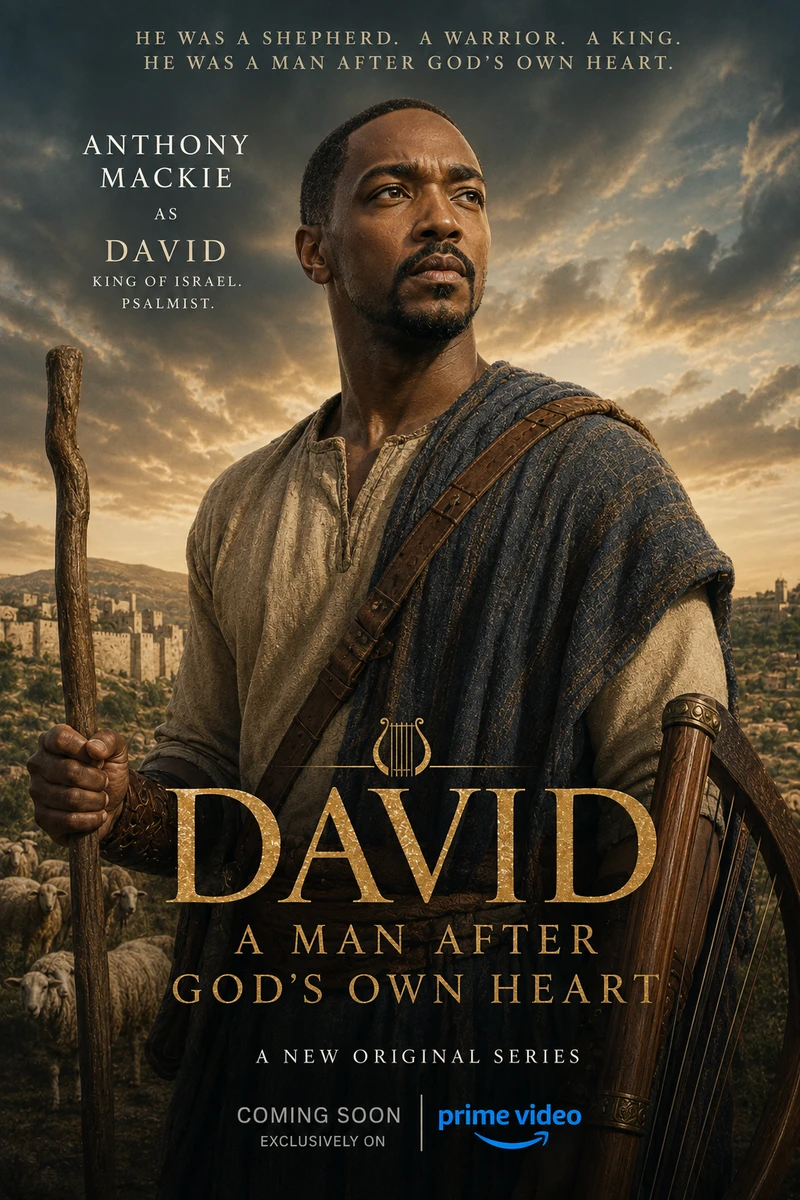
David: A Man After God's Own Heart
Shepherd. Giant-killer. Fugitive. King. Adulterer. Repentant. He was everything a human being can be — and God loved him through all of it. The complete David narrative across four seasons — the most fully realized biography in the Hebrew scriptures. Season 1: David's anointing by Samuel, his service with Saul's court, Goliath, his friendship with Jonathan, Saul's jealousy, his years as a fugitive. Season 2: David as king of Judah, the civil war with Ish-bosheth, his consolidation as king of all Israel, Jerusalem, the Ark, the Davidic covenant. Season 3: Bathsheba, Nathan's confrontation, Absalom's rebellion, David's flight from Jerusalem, the return. Season 4: David's final years, Solomon's preparation for the Temple, David's death and Solomon's succession. The Psalms are woven throughout — specific psalms sung or spoken in the moments that generated them. Season 1 — The Shepherd King Anointing through fugitive years. The friendship with Jonathan. The specific mercy David shows Saul repeatedly. Season 2 — Jerusalem The united kingdom. The Ark. The Davidic covenant. The specific joy of the dancing before the Lord. Season 3 — The Consequences Bathsheba. Nathan. Absalom. The rebellion and the flight and the return. David weeping over his son. Season 4 — The Twilight David's final years. The preparation for the Temple. The succession. The death.
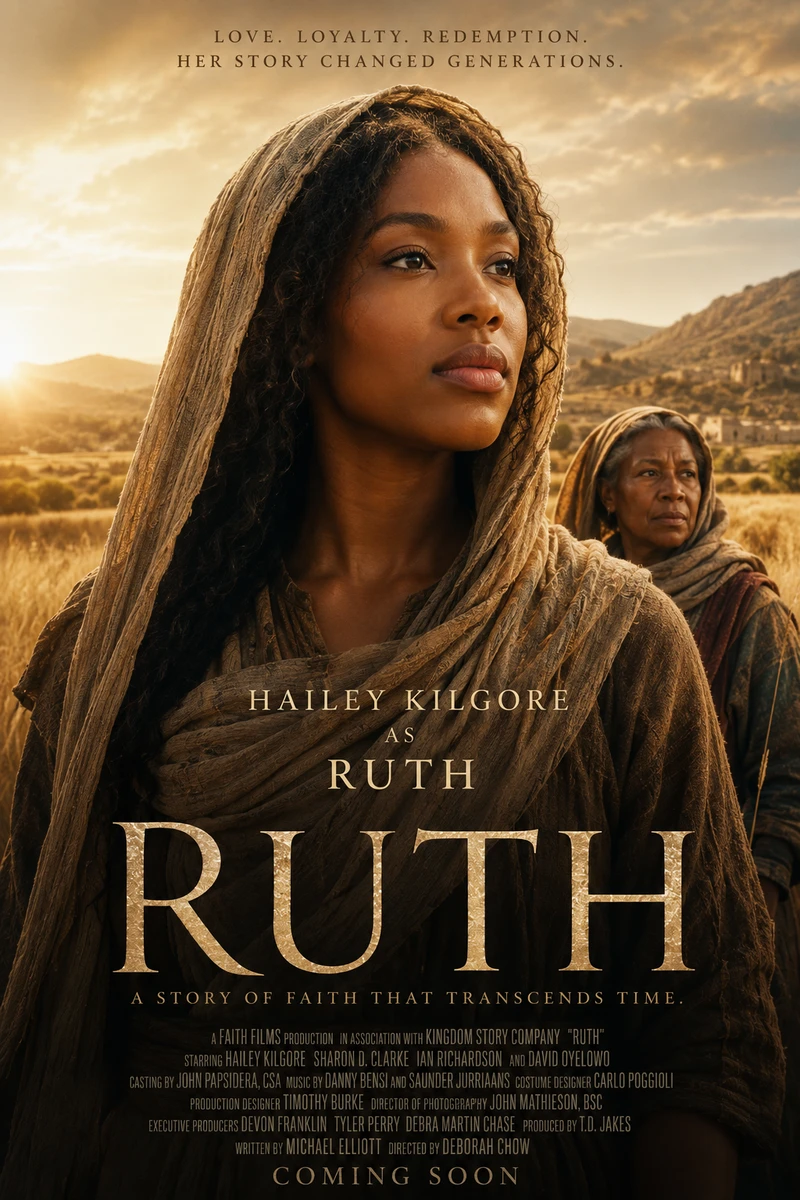
Ruth
She was a Moabite widow who chose her mother-in-law over her homeland. The loyalty she showed would become one of Scripture's most beautiful portraits of love. A faithful, intimate cinematic adaptation of the complete Book of Ruth — one of the Bible's shortest and most perfect narrative works. The film follows Ruth, a Moabite woman widowed in Moab, who chooses to follow her Israelite mother-in-law Naomi back to Bethlehem rather than return to her own family. In Bethlehem, Ruth gleans from the edges of Boaz's fields during the barley harvest. Boaz — a relative of Naomi's late husband, a man of standing and genuine goodness — notices Ruth's loyalty and character. The film follows the harvest season, the growing connection between Ruth and Boaz, Naomi's wisdom in guiding her daughter-in-law toward redemption, and the formal process by which Boaz becomes the kinsman-redeemer. The film is visual poetry about loyalty, belonging, and the specific grace of being seen. Act One — The Road Naomi's departure from Moab. Orpah's return. Ruth's speech. The road to Bethlehem. Act Two — The Harvest Ruth gleaning in Boaz's field. Boaz's notice. The specific generosity he shows that goes beyond legal requirement. Act Three — The Redemption The threshing floor. The morning. Boaz at the gate. The closer kinsman who declines. The sandal. The marriage.
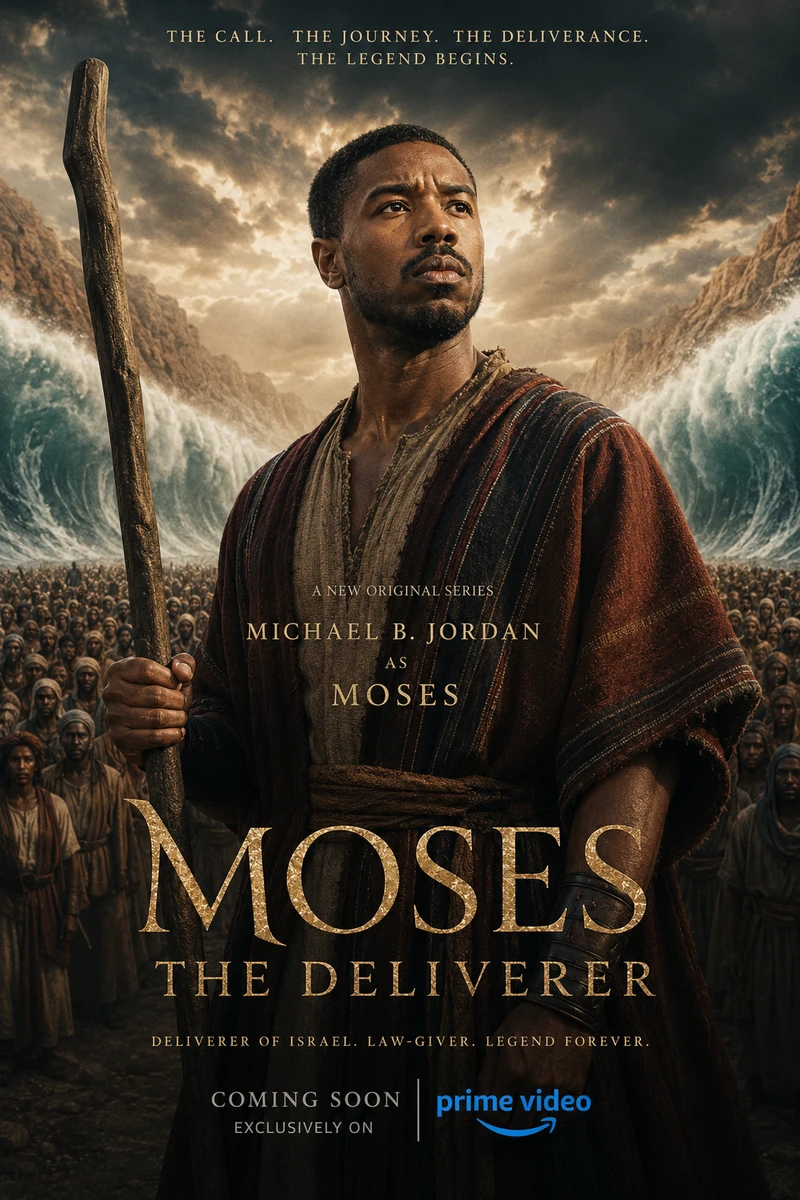
Moses: The Deliverer
He was raised as Egypt's prince. He became Israel's shepherd. Between those two identities was a burning bush and forty years in the wilderness. The complete Moses narrative across three seasons — one of the most significant lives in the Hebrew scriptures and in world religious history. Season 1 covers Moses's birth and survival (the basket in the Nile, Pharaoh's daughter, his upbringing in Pharaoh's court, his killing of the Egyptian overseer, his flight to Midian, Jethro's household, Zipporah, and the burning bush). Season 2 covers the Exodus — the ten plagues, the Passover, the crossing of the Red Sea, the wilderness, Sinai, and the giving of the Law. Season 3 covers the forty years of wilderness wandering — the golden calf, the twelve spies, the generation that died in the wilderness, and Moses's final view of the Promised Land from Nebo. Season 1 — The Prince and the Shepherd Birth through burning bush. Egypt through Midian. The calling that Moses resists and finally accepts. Season 2 — Let My People Go The ten plagues. The Passover. The crossing. Sinai. The Law given and immediately broken with the golden calf. Season 3 — The Wilderness Forty years. The generation that cannot enter. Moses at Nebo, seeing the land he will not enter. The most poignant ending in the Old Testament.
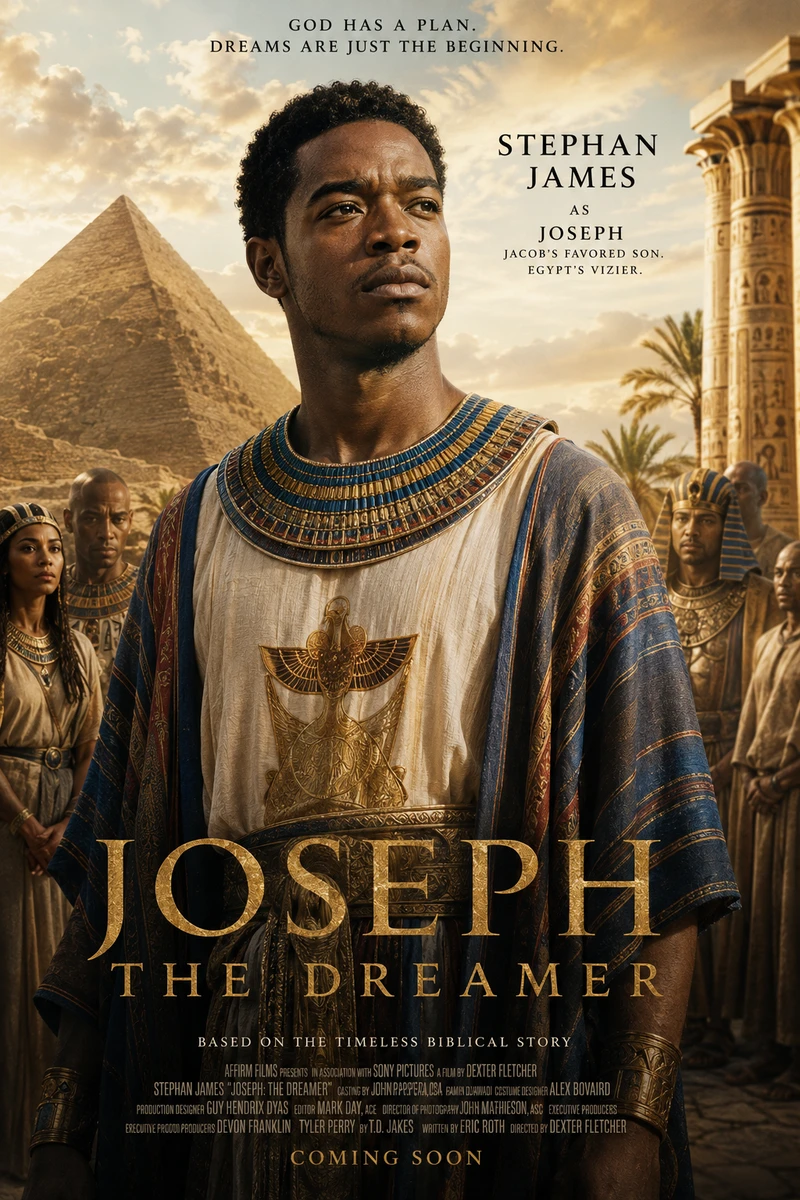
Joseph: The Dreamer
His brothers sold him into slavery. Egypt made him a prince. Forgiveness was the most powerful thing he ever did — and the hardest. The complete story of Joseph — one of the Old Testament's most fully realized narrative arcs. The film follows Joseph from his father Jacob's household through his brothers' betrayal and sale into slavery, his service in Potiphar's house and Potiphar's wife's false accusation, his years in Egyptian prison, his extraordinary gift of dream interpretation, his rise to Pharaoh's right hand as second in command of Egypt, the great famine, his brothers' arrival in Egypt, his revelation of his identity, and the profound, costly reconciliation with the brothers who betrayed him. The film is structured as a story of providence — not simple luck but the specific conviction that God's purposes work through human suffering without excusing those who cause it. Act One — The Coat Jacob's household. Joseph's dreams. The brothers' resentment building. The sale into slavery and the coat dipped in goat's blood. Act Two — Egypt Potiphar's house. The prison. The cupbearer and the baker. Two years of waiting. Act Three — The Vizier Pharaoh's dream. Joseph's interpretation. The rise to power. The seven years of plenty. Act Four — The Brothers The famine. The brothers arriving in Egypt. The revelation. The reconciliation that costs Joseph everything he has held against them.

Genesis: In the Beginning
From the first light to the flood — the opening chapters of human history given the visual grandeur they demand. An epic cinematic treatment of Genesis chapters 1 through 11 — from the creation of the world through the Tower of Babel. The film is structured in four movements: Creation (the six days, rendered as visual poetry rather than literalism, the camera finding beauty in each emerging element of the world); the Garden (Adam and Eve in their full complexity — not naive children but the first fully realized humans, their choice presented with the moral weight it deserves); the Fall's Consequence (Cain and Abel, humanity's first murder, the catastrophic grief of parents watching children destroy each other); and the Flood (Noah's ark, presented with archaeological and geographical fidelity to the ancient Near Eastern world, the specific moral weight of divine judgment and mercy held simultaneously). The film's visual language draws from ancient Mesopotamian art — ochre, lapis lazuli, terracotta, the specific palette of the world's oldest civilization. Movement One — The Light Creation rendered as visual poetry. The camera moving through emerging worlds. The seventh day's rest. Movement Two — The Garden Adam and Eve in their fullness. The choice and its immediate consequence. Their exile — not as abandonment but as the beginning of a harder, more human story. Movement Three — The Two Brothers Cain and Abel. The offering. The murder. The mark. The film's most intimate and most devastating section. Movement Four — The Flood Noah building the ark across decades. The rain beginning. The waters. The dove. The rainbow's promise.

The Anchor
She built the most-watched evening news program in American television. The network is being sold. The new owners have a different definition of news. Victoria James, 51, is the anchor and managing editor of the country's most-watched evening news — a position she built over thirty years from field reporter to correspondent to anchor to managing editor. When the network is acquired by a media conglomerate with explicit political alignments, Victoria must navigate the specific war between institutional journalism and new ownership, protecting her program's editorial independence while managing the specific personal cost of fighting an institution that has defined her life. Season 1 — The Sale The acquisition announced. Victoria's response. The first editorial conflict within the first six days. Season 2 — The Fight The systematic pressure on editorial independence. Victoria's coalition and its costs. Season 3 — The Decision Victoria's final choice about the program, the network, and what she does when the institution she built becomes something she cannot serve.

The Senator
She became the first Black female senator from her state. The opposition she faces is not simply political. It is systematic, organized, and deeply personal. Senator Diana Cole, 38, was elected as the first Black female senator from a historically resistant state. Three seasons track her first six years in office — navigating institutional resistance, building genuine legislation, managing a political marriage that is both genuine partnership and strategic alliance, and facing a coordinated campaign to undermine her tenure that escalates from political opposition to something more dangerous. Season 1 — The First Year Diana in the Senate. The institutional resistance. The first legislation she actually passes. Season 2 — The Campaign The coordinated effort against her tenure. Its sources and its funding. Season 3 — The Reckoning Diana's response. Not simply survival but transformation — of herself and of the institution.
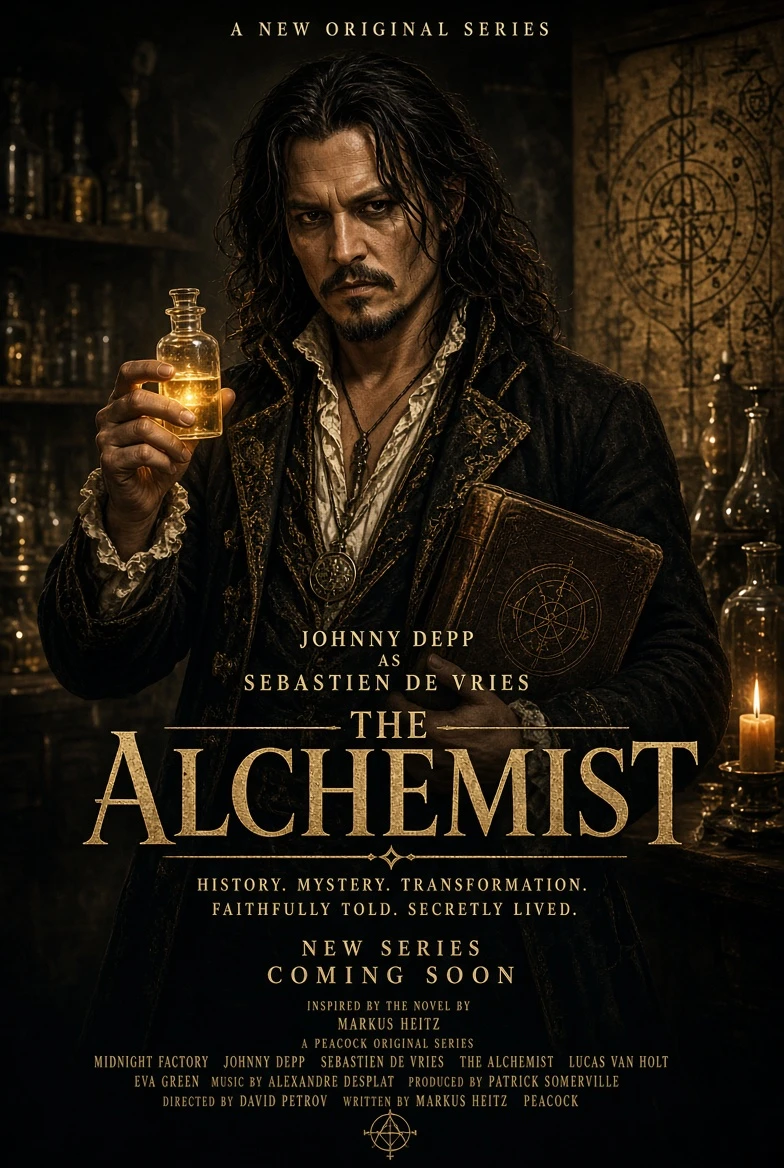
The Alchemist
17th century Prague. He claimed to be able to turn lead to gold. He was lying about the gold. He was not lying about everything else. Set in the court of Emperor Rudolf II in Prague (~1600 AD), The Alchemist follows Sebastien de Vries, 60, a Flemish alchemist of genuine and unusual gifts — not the mythological transmutation of metals, but an extraordinary understanding of chemistry, medicine, and the natural world that the 17th century cannot categorize except as alchemy. He is both charlatan (in the specific ways he must be to survive in Rudolf's court) and genuine (in the specific ways his knowledge exceeds his era). The series is a historical mystery with strong philosophical undertones, following Sebastien's investigations of strange deaths in Rudolf's court and his developing friendship with the court physician. Season 1 — The Court Sebastien in Rudolf's court. The first mysterious death. His alliance with Dr. Welser. Season 2 — The Formula The mystery's deeper layer. What Sebastien actually knows and why it is more dangerous than gold.
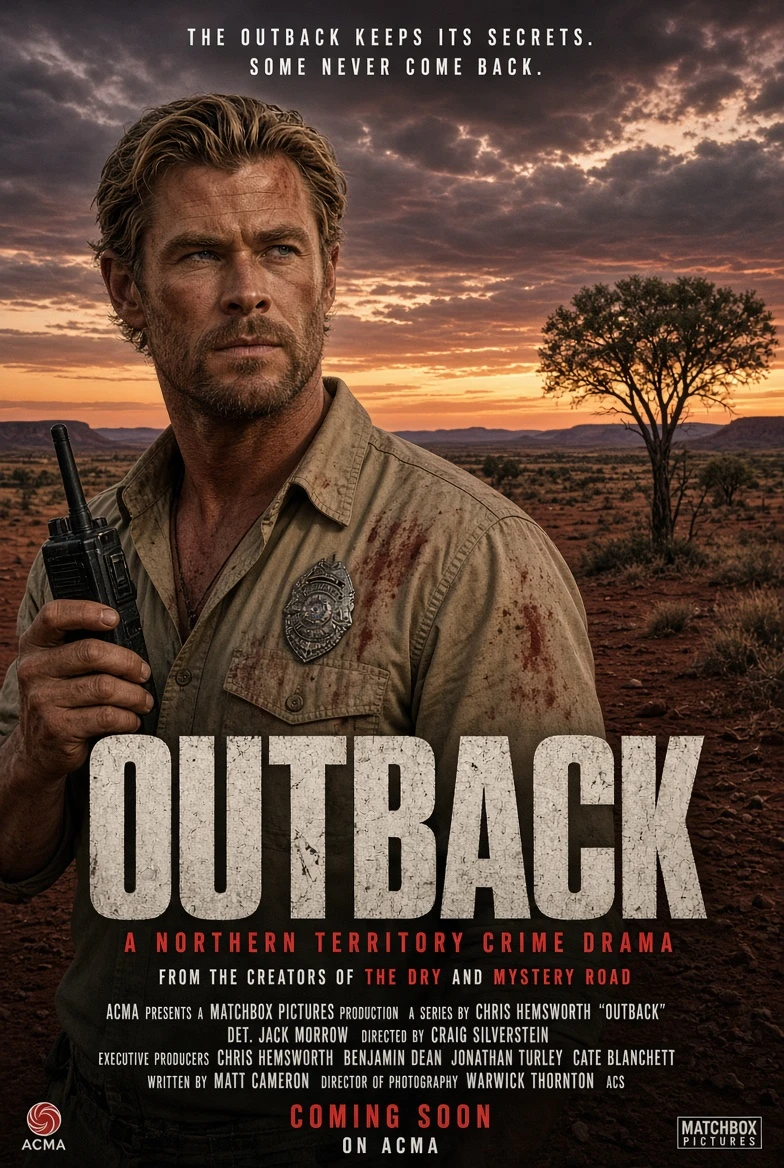
Outback
He was the Northern Territory's most effective detective. Then a case connected to his own family's past brought everything down. Senior Detective Jack Morrow, 40, operates out of Darwin — covering the vast, understaffed Northern Territory with a team of three and a caseload that would challenge a department of fifty. Three seasons track his most significant cases while simultaneously developing the personal investigation that eventually consumes everything: a cold case from 1994 that involved his father, the land rights movement, and a disappearance that was never solved because the right people preferred it unsolved. Season 1 — Darwin Jack's cases. The Territory. The cold case file found in a box from the station's archive. Season 2 — 1994 The cold case investigation. What happened to Jack's father and why. Season 3 — The Truth What the truth means for Jack's career, his family, and the Territory's ongoing land rights landscape.

The Model
She spent fifteen years in front of cameras. Now she wants to know what's behind them. Sophia Lund, 33, retires from modelling and moves into fashion photography — discovering that the industry she has inhabited her entire adult life looks completely different from the other side of the lens. Two seasons track her first two years as a photographer, her developing eye, and her complicated relationship with the fashion world she both loves and critiques. The romance with her photography mentor Lars — an older Danish photographer who taught her everything about the other side — develops with the specific tension of professional mentorship becoming something more personal. Season 1 — The Other Side Sophia with a camera for the first time. The industry's surprised reception. Lars's mentorship beginning. Season 2 — The Eye Sophia's own photographic vision emerging. The relationship with Lars. The show she mounts that changes everything.
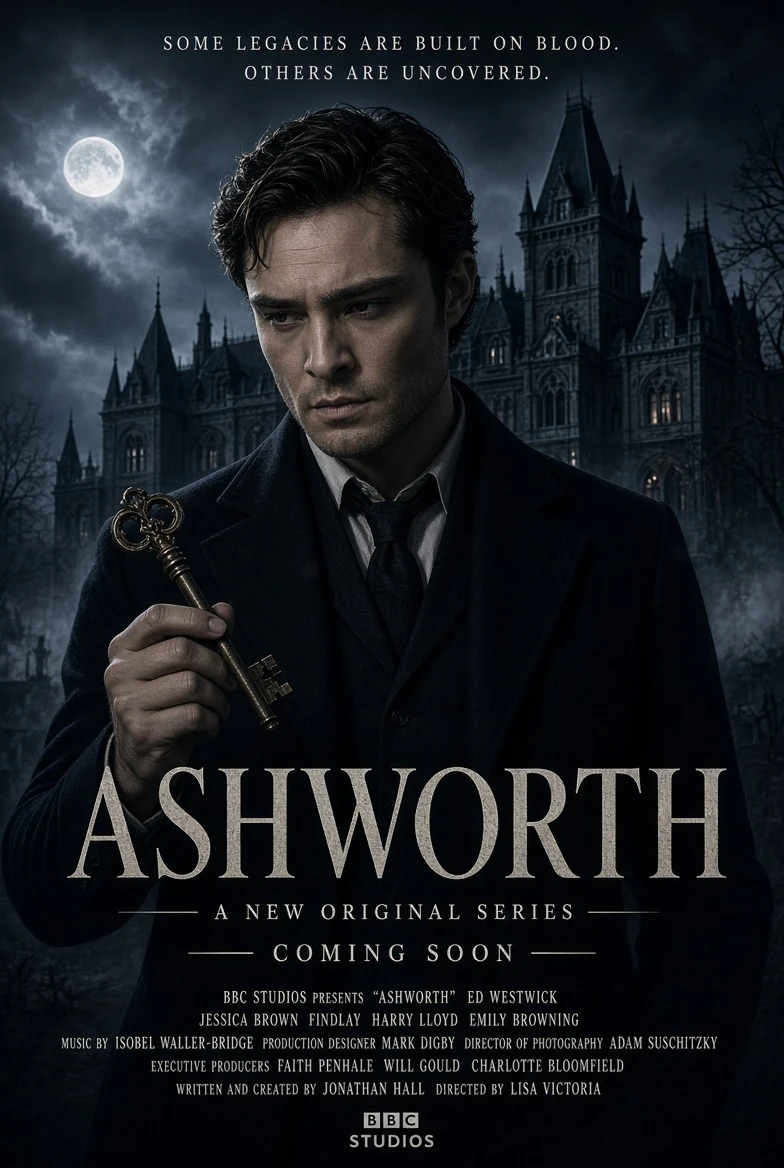
Ashworth
He inherited his family's estate, his family's debts, and his family's very specific curse. The solicitor who handled the estate had known about all three for forty years. Edward Ashworth, 34, returns to his family's decaying Victorian estate in Yorkshire after a decade in London following his estrangement from his father. His father has died, leaving him the estate, its substantial debts, and a solicitor who has been managing the estate's affairs with unusual independence. As Edward begins to investigate the family finances, he discovers layers of concealment stretching back generations — and a specific room in the east wing that every Ashworth since 1847 has kept locked. The series is a Gothic mystery drama with psychological thriller elements, set between the present and extended flashbacks to the Victorian Ashworths who created whatever is being concealed. Season 1 — The Return Edward in Yorkshire. The estate's condition. The solicitor's management. The locked room. Season 2 — The Victorian Ashworths Extended flashback season. What happened in 1847. The decisions that locked the room. Season 3 — The Opening The room opened. The truth confronted. What Edward does with it.

The Negotiator
She has negotiated three international treaties. The fourth one — the one that could end a decade of conflict — is being held hostage by a faction she cannot get to the table. Ambassador Patricia Wells, 50, is the US State Department's most experienced international negotiator — a woman who has been in rooms where the wrong word ends peace processes, and has never once said the wrong word. The film follows the 72 hours of her most critical negotiation: a ceasefire agreement that has been six years in development and is on the verge of collapse when a key faction withdraws. Patricia must get them back to the table using only the resources of conversation, preparation, and the specific weight of her own credibility. Act One — The Withdrawal Amara's faction leaves the talks. Patricia's assessment of why. The 72 hours beginning. Act Two — The Conversations Patricia working through the network of relationships that can get Amara back to the table. Act Three — The Table The negotiation resumed. The agreement reached. The specific word Patricia chose in hour 71 that made the difference.

Vanguard
She was the DEA's most decorated field agent. The cartel she's been hunting for six years just made a critical error: they went after her daughter. Agent Zara Mitchell, 32, is the DEA's most effective field operative in the Southwest — brilliant, relentless, and operating with the specific controlled fury of someone who has watched a cartel's expansion for six years. When the Vega cartel's enforcer makes the specific mistake of threatening her daughter as leverage, Zara's response is not fear but acceleration. The film follows 72 hours of Zara operating at full capacity against a cartel whose resources dwarf her agency's, with the specific efficiency of someone who has been planning for exactly this scenario. Act One — The Threat The cartel's mistake. Zara's response. The 72-hour countdown beginning. Act Two — The Operation Zara operating at capacity. The film's extended action sequences. The cartel understanding too late what they started. Act Three — The Resolution Maya safe. The cartel's leadership structure dismantled. Zara's report — filed precisely, on time, in accordance with DEA protocol throughout.

The Watchmaker
He repairs watches that stopped at the moment of someone's death. When a watch arrived that stopped at a time no one could explain, he stopped sleeping. Anatole Beaumont, 62, is a Parisian master watchmaker who has spent forty years in a shop on the Île Saint-Louis repairing watches that stopped working. He has a private philosophy: every stopped watch contains the specific moment it witnessed, and the mechanical failure is the watch's way of refusing to move past it. When a specific watch arrives — one that stopped at a time three hours in the future — Anatole's philosophy becomes something more urgent. The mystery of who sent the watch and why consumes his retirement, his considerable expertise, and eventually draws him into the orbit of a woman — the watch's previous owner — who shares his specific obsession with time. Act One — The Watch Arrives Anatole's shop. The watch. The impossible stopped time. His first night of not sleeping. Act Two — The Investigation Céline's appearance. The watchmaker's guild. The 1923 workshop's history. The physics of what a stopped watch at a future time means. Act Three — 14:47:23 The moment arrives. What Anatole does with the remaining three hours.

The Last Station
Antarctica, 2031. The last research station. Six scientists. One impossible winter. And the station commander who made a decision that saved five of them and will cost him everything when they get home. Commander Alistair Marsh, 40, leads the last remaining Antarctic research station in a world where climate change has made the continent newly critical and newly contested. When a catastrophic storm cuts the station off for an unprecedented eight-month period, Alistair must keep six scientists alive with dwindling supplies. The moral decisions he makes during those eight months — decisions that save five lives at significant cost — are the subject of a parliamentary inquiry when they return. The film moves between the Antarctic isolation and the London inquiry, building two simultaneous portraits: the man who made the decisions and the man being judged for them. Act One — The Storm The storm arriving. The station isolated. Alistair beginning the calculations of what can be sustained. Act Two — The Eight Months The survival, the decisions, James's death. Told in fragments across the inquiry's testimony. Act Three — The Verdict The inquiry's conclusion. Not a legal verdict but a moral one — more complicated and more honest.

The Danish
She moved from Copenhagen to New York for love. The love didn't last. New York did. The Danish bakery she opened in Tribeca to cope with heartbreak is now the city's most beloved problem. Astrid Jensen, 29, opens a Danish bakery in Tribeca six months after her relationship ends and she decides to stay in New York rather than return to Copenhagen. She expected it to be a coping mechanism. She did not expect it to become the city's most reviewed, most discussed, most socially complicated small business — because Astrid bakes exactly what she is feeling each morning, and what she is feeling is complicated, funny, devastating, and delicious. The romance with Marco — an Italian-American food journalist who reviews the bakery in his first week and then cannot stop coming back — develops with the specific warmth of two people who communicate better through food than conversation. Act One — The Opening The bakery's first week. Marco's review. The specific pastry Astrid made the morning of his visit and what it communicated. Act Two — The Menu The bakery's emotional menu developing across weeks. Marco eating his way through Astrid's feelings. Act Three — The Recipe What Astrid bakes the morning she understands she has fallen in love again.

The Broker
He built the city's most sophisticated money-laundering network from a Mayfair office. The detective who caught him had been using his services for three years. Julian Harlow, 35, is the most sophisticated financial criminal in London — a former investment banker who now operates an elaborate money-laundering network for organized crime through a legitimate private equity firm. He is charming, precisely dressed, and operates with such refined patience that the Met's financial crimes unit has been circling him for four years without a single prosecutable piece of evidence. When lead detective Sarah Price finally arrests him on a technicality, Julian's first question in the interview room is a single specific number — the account number of the payments she has been receiving from his network for thirty-six months. The film is a psychological thriller about two people who know each other's crimes completely and must negotiate what happens next. Act One — The Arrest The interview room. Julian's first question. Sarah's silence. The negotiation beginning. Act Two — The Evidence What both sides have on each other. The specific architecture of their mutually assured destruction. Act Three — The Settlement Neither goes to prison. Both lose everything else. The film's most precisely crafted ending.
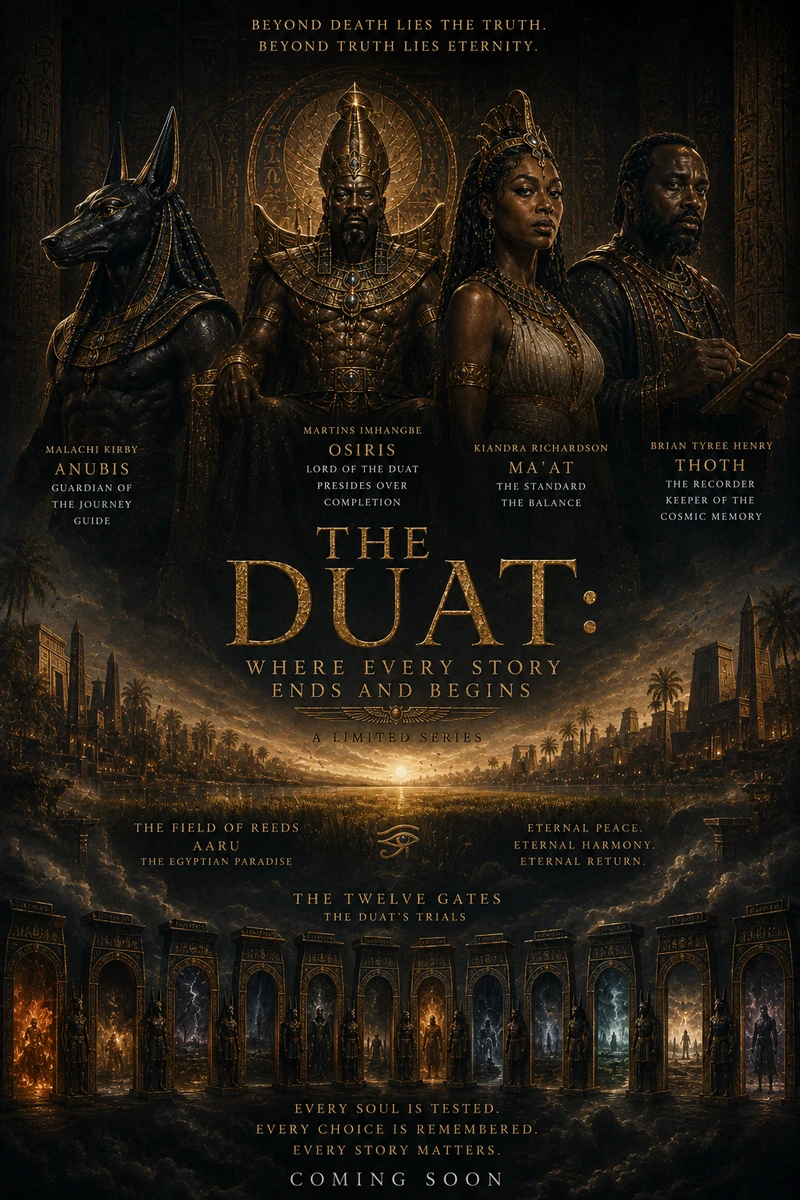
The Duat: Where Every Story Ends and Begins
The Nile Chronicles culminates in the Duat itself — the Egyptian afterlife, shown in its full mythological complexity. Not a simple heaven or hell but a twelve-hour journey (mirroring Ra's night passage) through different realms, each with its own trials and guardians, culminating in the Hall of Two Truths where Anubis weighs the heart. The series functions as a final gathering of all the major divine beings who have appeared across the universe, seen from the perspective of the Duat they ultimately govern. Structured as twelve episodes representing the twelve hours of the Duat, each hour showing a different aspect of the afterlife: the Field of Reeds (Aaru) in its full beauty, the trials of the deceased, the gates guarded by specific divine beings, and the final judgment. The series' most important argument is the most Egyptian: death is not an ending but a transformation. The deceased become the Akh — the glorified spirit — who joins Ra's barque and participates in the cosmic order. The Duat is not a sentence. It is a completion.
Sekhmet and Bastet: Two Faces of the Divine Feminine
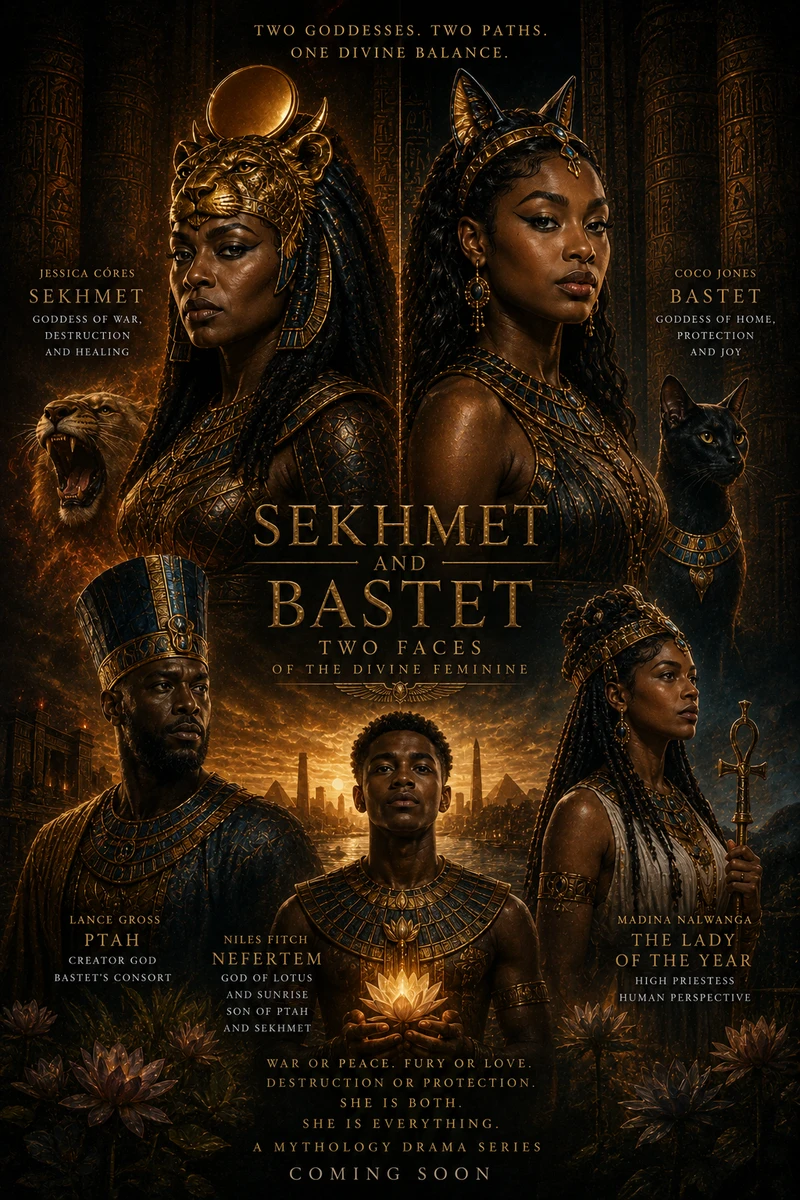
A character-centered series following Sekhmet (goddess of war, destruction, and healing) and Bastet (goddess of home, protection, and joy) — who in Egyptian mythology are understood as two aspects of the same feline divine principle: the Eye of Ra in its destructive aspect (Sekhmet) and its protective aspect (Bastet). The series explores both goddesses as fully realized divine beings whose domains are not opposites but complements, and whose relationship is the most complex sibling dynamic in the Egyptian pantheon. Two seasons track: Season 1 covers the aftermath of Sekhmet's near-destruction of humanity and her transformation through beer and wine (the myth of her calming) into Bastet, and the specific work of both goddesses in serving their respective domains. Season 2 covers the Hittite War's divine dimension and the role both goddesses play in protecting Egypt's borders and people.
Anubis: The Weighing of Hearts
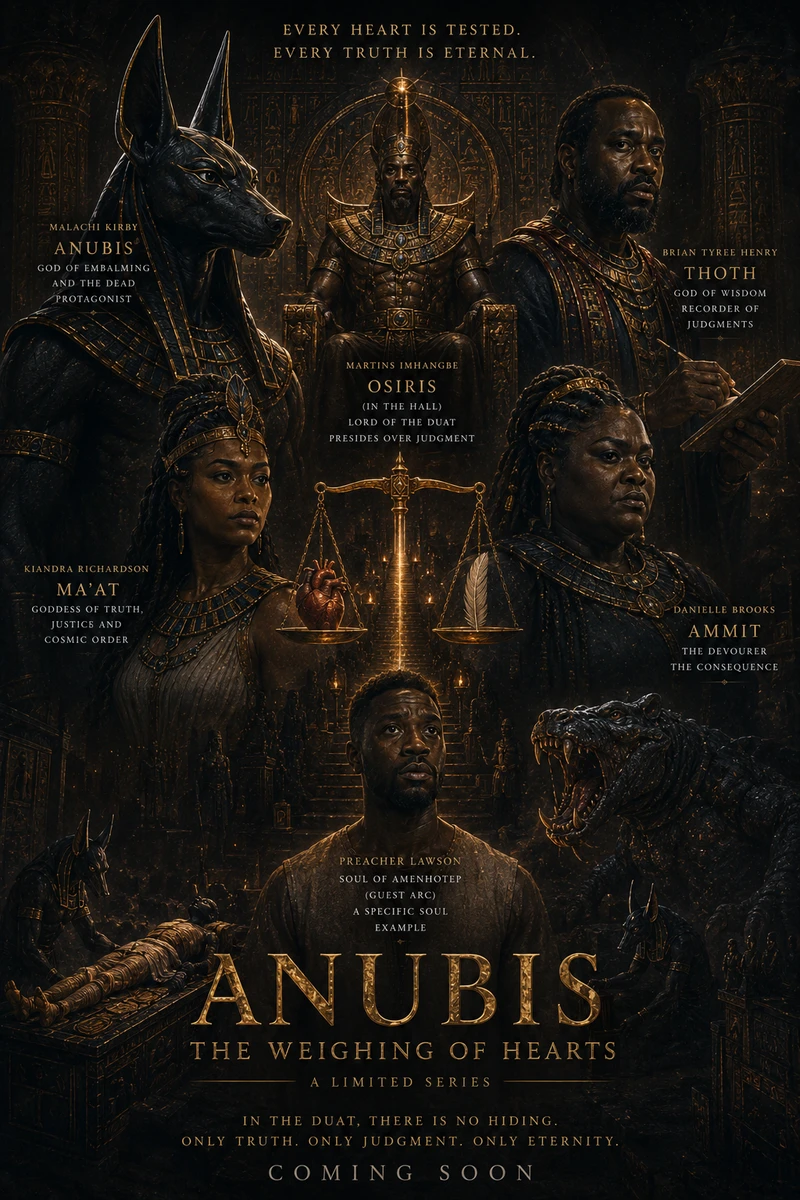
The definitive portrait of Anubis — the Egyptian deity most misrepresented by popular culture as menacing, when the actual mythological tradition gives us a god of extraordinary gentleness, precision, and care. Anubis guards the process of mummification (which he invented to protect Osiris's body and extended to all humanity as a gift), guides the dead through the Duat, and weighs each heart against the feather of Ma'at in the Hall of Two Truths. The series shows a single divine year in Anubis's governance: the souls he receives, the hearts he weighs, the care he takes with each individual judgment. Guest arcs include historically significant Egyptian figures and mythological mortals. The series' most important formal decision: every soul Anubis receives is treated as a specific individual whose life mattered. He does not process the dead in bulk. He gives each person the attention their life deserves.