
Spinosaurus (meaning "spine lizard") is a genus of spinosaurid dinosaur that lived in what now is North Africa during the Cenomanian to upper Turonian stages of the Late Cretaceous period, about 99 to 93.5 million years ago.[2][3] This genus was known first from Egyptian remains discovered in 1912 and described by German paleontologist Ernst Stromer in 1915. The original remains were destroyed in World War II, but additional material has come to light in the early 21st century. It is unclear whether one or two species are represented in the fossils reported in the scientific literature. The best known species is S. aegyptiacus from Egypt, although a potential second species, S. maroccanus, has been recovered from Morocco. The contemporary spinosaurid genus Sigilmassasaurus has also been synonymized by some authors with S. aegyptiacus, though other researchers propose it to be a distinct taxon. Another possible junior synonym is Oxalaia from the Alcântara Formation in Brazil. Spinosaurus was among the largest of all known carnivorous dinosaurs, nearly as large as or even larger than other theropods such as Tyrannosaurus, Giganotosaurus and Carcharodontosaurus. Estimates published in 2005, 2007, and 2008 suggested that it was between 12.6 to 18 meters (41 to 59 ft) in length and 7 to 20.9 metric tons (7.7 to 23.0 short tons) in weight.[4][5][6] New estimates published in 2014 and 2018, based on a more complete specimen, supported the earlier research, finding that Spinosaurus could reach lengths of 15 to 16 meters (49 to 52 ft).[7][8][9] The latest estimates suggest a weight of 6.4 to 7.5 metric tons (7.1 to 8.3 short tons).[8][9] The skull of Spinosaurus was long, low and narrow, similar to that of a modern crocodilian, and bore straight conical teeth with no serrations. It would have had large, robust forelimbs bearing three-fingered hands, with an enlarged claw on the first digit. The distinctive neural spines of Spinosaurus, which were long extensions of the vertebrae (or backbones), grew to at least 1.65 meters (5.4 ft) long and were likely to have had skin connecting them, forming a sail-like structure, although some authors[who?] have suggested that the spines were covered in fat and formed a hump. Spinosaurus's hip bones were reduced, and the legs were very short in proportion to the body. Its long and narrow tail was deepened by tall, thin neural spines and elongated chevrons, forming a flexible fin or paddle-like structure. Spinosaurus is known to have eaten fish, and most scientists believe that it hunted both terrestrial and aquatic prey. Evidence suggests that it was highly semiaquatic, and lived both on land and in water as modern crocodilians do. Spinosaurus's leg bones had osteosclerosis (high bone density), allowing for better buoyancy control, and the paddle-like tail was likely used for underwater propulsion. Multiple functions have been put forward for the dorsal sail, including thermoregulation and display; either to intimidate rivals or attract mates. Spinosaurus lived in a humid environment of tidal flats and mangrove forests alongside many other dinosaurs, as well as fish, crocodylomorphs, lizards, turtles, pterosaurs, and plesiosaurs.
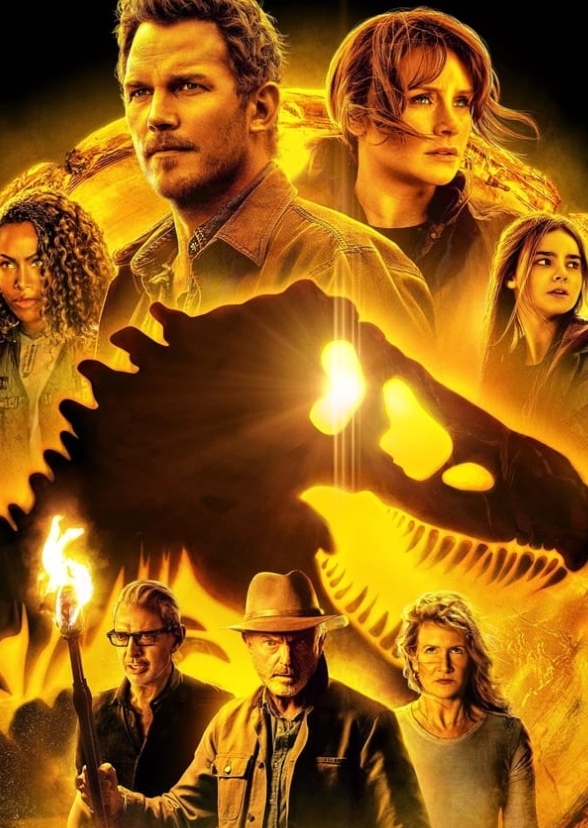
In January 2024, a new installment was revealed to be officially in development. David Koepp will return as screenwriter while Frank Marshall and Patrick Crowley once again serve as producers. Steven Spielberg will serve as executive producer, with the project being seen as a joint-venture production between Amblin Entertainment and Universal. Development of the project had been underway for some time, with several drafts already written by Koepp. The producers had also done some pre-production work, including dinosaur designs, meaning that any creative input from the eventual director would be minimal. The position was reportedly described as being "more shooter than auteur", as the producers sought to have more creative control compared with Dominion. David Leitch was briefly in talks to direct the film during early February 2024, but negotiations broke down after several days, as the project's progress up to that point left little room for his creative input. Soon after Leitch's departure, Gareth Edwards was announced to direct the film, with Scarlett Johansson and Jonathan Bailey in talks for the lead roles. Paleontologist Steve Brusatte will return from the previous film as dinosaur consultant. Filming is scheduled to begin in June 2024, at Sky Studios Elstree in the United Kingdom. Filming will also take place from July to September at the Malta Film Studios in Kalkara, Malta. The untitled film is scheduled for a July 2, 2025 release.




