
Smilodon (commonly known as saber-toothed tiger) is a genus of the extinct machairodont subfamily of the felids. It is one of the most famous prehistoric mammals and the best known saber-toothed cat. Although commonly known as the saber-toothed tiger, it was not closely related to the tiger or other modern cats. Smilodon lived in the Americas during the Pleistocene epoch (2.5 mya-10,000 years ago). The genus was named in 1842 based on fossils from Brazil; the generic name means "scalpel" or "two-edged knife" combined with "tooth". Three species are recognized today: S. gracilis, S. fatalis, and S. populator. The two latter species were probably descended from S. gracilis, which itself probably evolved from Megantereon. The hundreds of individuals obtained from the La Brea Tar Pits in Los Angeles constitute the largest collection of Smilodon fossils. Overall, Smilodon was more robustly built than any extant cat, with particularly well-developed forelimbs and exceptionally long upper canine teeth. Its jaw had a bigger gape than that of modern cats, and its upper canines were slender and fragile, being adapted for precision killing. S. gracilis was the smallest species at 55 to 100 kg (120 to 220 lb) in weight. S. fatalis had a weight of 160 to 280 kg (350 to 620 lb) and height of 100 cm (39 in). Both of these species are mainly known from North America, but remains from South America have also been attributed to them. S. populator from South America was the largest species, at 220 to 436 kg (485 to 961 lb) in weight and 120 cm (47 in) in height, and was among the largest known felids. The coat pattern of Smilodon is unknown, but it has been artistically restored with plain or spotted patterns. In North America, Smilodon hunted large herbivores such as bison and camels, and it remained successful even when encountering new prey species in South America. Smilodon is thought to have killed its prey by holding it still with its forelimbs and biting it, but it is unclear in what manner the bite itself was delivered. Scientists debate whether Smilodon had a social or a solitary lifestyle; analysis of modern predator behavior as well as of Smilodon's fossil remains could be construed to lend support to either view. Smilodon probably lived in closed habitats such as forests and bush, which would have provided cover for ambushing prey. Smilodon died out at the same time that most North and South American megafauna disappeared, about 10,000 years ago. Its reliance on large animals has been proposed as the cause of its extinction, along with climate change and competition with other species, but the exact cause is unknown.
Smilodon

The Lost Wildlife
for The Lost Wildlife in Van Helsing : Quest for the Lost World
Suggested by jeanpaulvalley
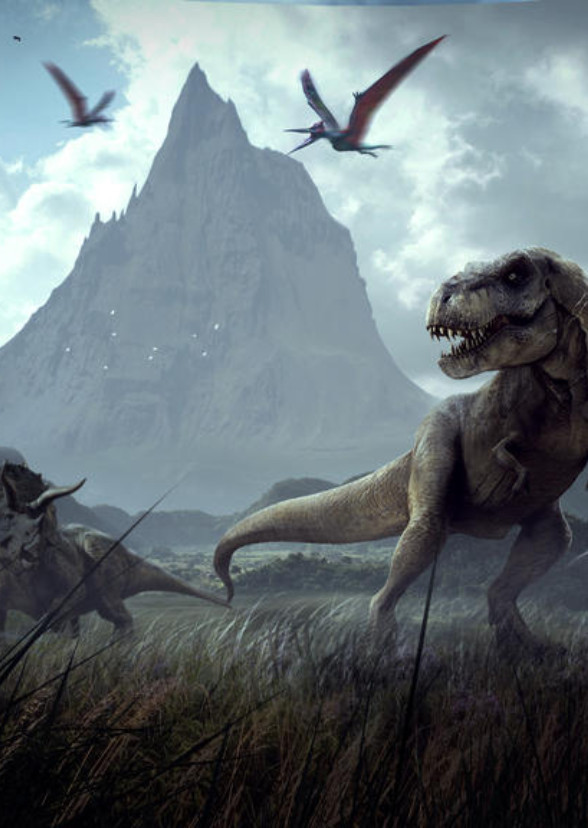
1907, four years after the events of the last two movies. While Van Helsing and his team have succeeded in arresting the murderers of Rue Morgue, in France, a new threat is coming and this time mankind is directly responsible for it. A peculiar scientist, well-connected to the British government, Doctor Alexander Zorka, discovered proof of the existence of a Lost World, somewhere in South America, deep in the Amazon rainforest. There lies a new metal in the underground mines, which could help Zorka create weapons like no other, which could change the balance of the world in his favor. Our heroes, as they go on a mission to hunt down monsters in the Congo, will be challenged by Koschei, the famous Russian warrior of several centuries who cannot die, and the one he protect, the young Medusa, daughter of the last Gorgon, to warn them of this threat. Unfortunately, they will not be able to prevent the kidnapping of Professor Challenger, who was studing in the country, by Zorka's men to take them to the mysterious South American plateau, but they will be able to count in particular on the expertise of Gill-Man, who heard of this foreign place. To prevent Zorka from causing a world war, our heroes will have to go and explode a world where creatures from another era still exist and where survival can be complicated, even for beings like them !




