Age: 70
male
Walter Moreira Salles Júnior (/ˈsɑːlɪs/; Brazilian Portuguese: [ˈvawteʁ ˈsalis]; born 12 April 1956) is a Brazilian filmmaker. A major figure of the Resumption Cinema in Brazil, Salles is widely regarded as one of the greatest Brazilian filmmakers of all time. His accolades include an Academy Award accepted for Best International Film, three Cannes Film Festival prizes, three Venice Film Festival prizes, two British Academy Film Awards, a Golden Bear and a Golden Globe. He first became internationally known for his film Central Station (1998), which earned two Academy Awards nominations, for Best Foreign Language Film and Best Actress for Fernanda Montenegro, winning a Golden Globe and a BAFTA for Best Foreign Language Film as well as the Golden Bear at the 48th Berlin International Film Festival. His subsequent works include Behind the Sun (2001), The Motorcycle Diaries (2004), Dark Water (2005) and On the Road (2012). At the 97th Academy Awards, his critically acclaimed film I'm Still Here (2024) received a rare double nomination for Best Picture and Best International Feature; it won the latter, becoming the first Brazilian film to win an Academy Award in any category. Heir to Itaú Unibanco, with a fortune valued at US$4.5 billion (R$24.26 billion), Salles is the third richest filmmaker in the world. Description above from the Wikipedia article Walter Salles, licensed under CC-BY-SA, full list of contributors on Wikipedia.
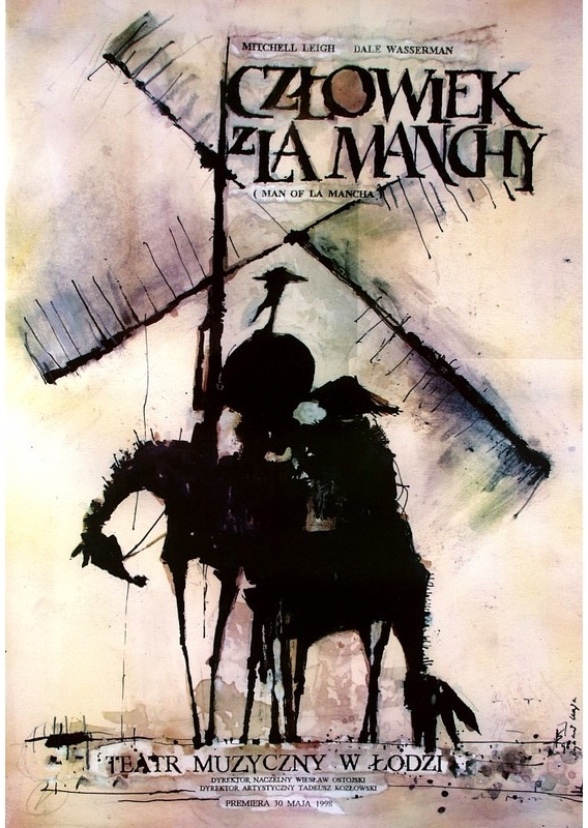
Man of La Mancha is a 1965 musical with a book by Dale Wasserman, music by Mitch Leigh, and lyrics by Joe Darion. It is adapted from Wasserman's non-musical 1959 teleplay I, Don Quixote, which was in turn inspired by Miguel de Cervantes and his 17th-century novel Don Quixote. It tells the story of the "mad" knight Don Quixote as a play within a play, performed by Cervantes and his fellow prisoners as he awaits a hearing with the Spanish Inquisition. The work is not and does not pretend to be a faithful rendition of either Cervantes' life or Don Quixote. Wasserman complained repeatedly about people taking the work as a musical version of Don Quixote.