Age: 63
male
Alejandro González Iñárritu is a Mexican filmmaker. He is primarily known for making modern psychological drama films about the human condition. His projects have garnered critical acclaim and numerous accolades, including five Academy Awards, Special Achievement Awards, Golden Globe Awards, BAFTA Awards, and Directors Guild of America Awards. His most notable films include Amores Perros (2000), 21 Grams (2003), Babel (2006), Biutiful (2010), Birdman (2014), The Revenant (2015), and Bardo (2022). Amores Perros (2000), and Biutiful (2010) each received nominations for the Academy Award for Best International Feature Film. He earned critical and commercial success for his films 21 Grams(2003) and Babel (2006). For Birdman (2014), he won three Academy Awards for Best Picture, Best Director, and Best Original Screenplay. The following year, he was awarded Best Director for The Revenant (2015), making him the third director to win back-to-back after John Ford and Joseph L. Mankiewicz. Iñárritu was later awarded a Special Achievement Academy Award for his virtual reality installation Carne y Arena (2017). Iñárritu became the first Mexican filmmaker to be nominated as director or producer in the Academy Awards' history and the first to win for Best Original Screenplay and Best Picture. He was the first Mexican filmmaker to receive the Best Director Award at Cannes, and the first to win a DGA Award for Outstanding Directing. In 2019, Iñárritu became the first Latin American to serve as jury president for the 72nd Cannes Film Festival. Iñárritu and Mexican filmmakers Alfonso Cuarón and Guillermo del Toro are known in the film industry as "The Three Amigos." Description above from the Wikipedia article Alejandro González Iñárritu, licensed under CC-BY-SA, full list of contributors on Wikipedia.
Alejandro González Iñárritu

Director
for Director in Man of La Mancha
Suggested by Jeshisthename
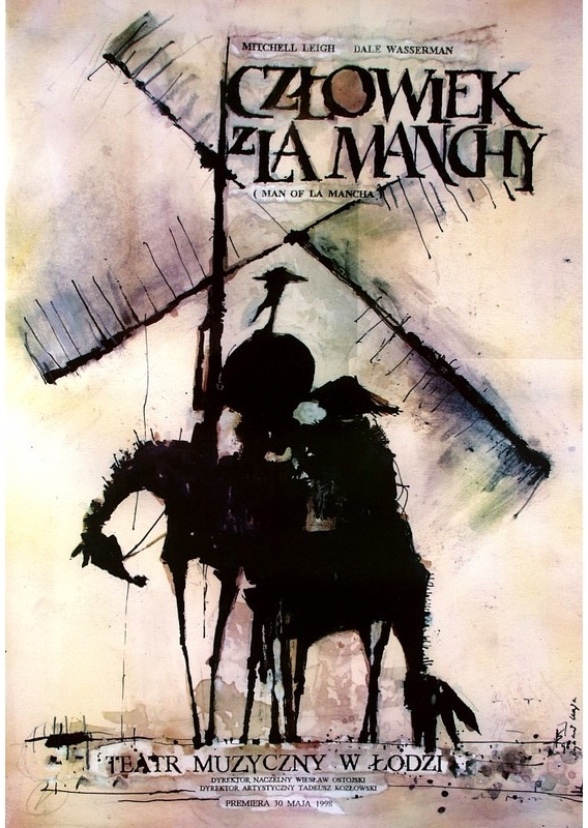
Man of La Mancha is a 1965 musical with a book by Dale Wasserman, music by Mitch Leigh, and lyrics by Joe Darion. It is adapted from Wasserman's non-musical 1959 teleplay I, Don Quixote, which was in turn inspired by Miguel de Cervantes and his 17th-century novel Don Quixote. It tells the story of the "mad" knight Don Quixote as a play within a play, performed by Cervantes and his fellow prisoners as he awaits a hearing with the Spanish Inquisition. The work is not and does not pretend to be a faithful rendition of either Cervantes' life or Don Quixote. Wasserman complained repeatedly about people taking the work as a musical version of Don Quixote.