Age: 53
male
David Jude Heyworth Law (born 29 December 1972) is an English actor. He began his career in British theatre before landing small roles in various television productions and feature films. Law gained international recognition for his role in Anthony Minghella's The Talented Mr. Ripley (1999), for which he won the BAFTA Award for Best Actor in a Supporting Role and was nominated for the Academy Award in the same category. Law found further critical and commercial success in Steven Spielberg's A.I. Artificial Intelligence (2001), Sam Mendes' Road to Perdition (2002), Minghella's Cold Mountain (2003), for which he earned Academy Award and BAFTA nominations, in addition to the drama Closer (2004) and the romantic comedy The Holiday (2006). His subsequent roles were as Dr. Watson in Sherlock Holmes (2009) and Sherlock Holmes: A Game of Shadows (2011), a young Albus Dumbledore in Fantastic Beasts: The Crimes of Grindelwald (2018) and Fantastic Beasts: The Secrets of Dumbledore (2022), and Yon-Rogg in Captain Marvel (2019); all of which rank among his highest-grossing releases. Other notable films include Contagion (2011), Hugo (2011), Side Effects (2013), The Grand Budapest Hotel (2014), and Spy (2015), as well as the television series The Young Pope (2016), The New Pope (2020), and Star Wars: Skeleton Crew (2024), earning a Children's and Family Emmy Award for Outstanding Lead Performer nomination for the latter. In addition to his film work, Law has performed in several West End and Broadway productions, including Les Parents terribles in 1994, Hamlet in 2010, and Anna Christie in 2011. These earned him nominations for two Tony Awards. He has also been awarded the Honorary César and was named a knight of the Order of Arts and Letters by the French government. Description above from the Wikipedia article Jude Law, licensed under CC-BY-SA, full list of contributors on Wikipedia.
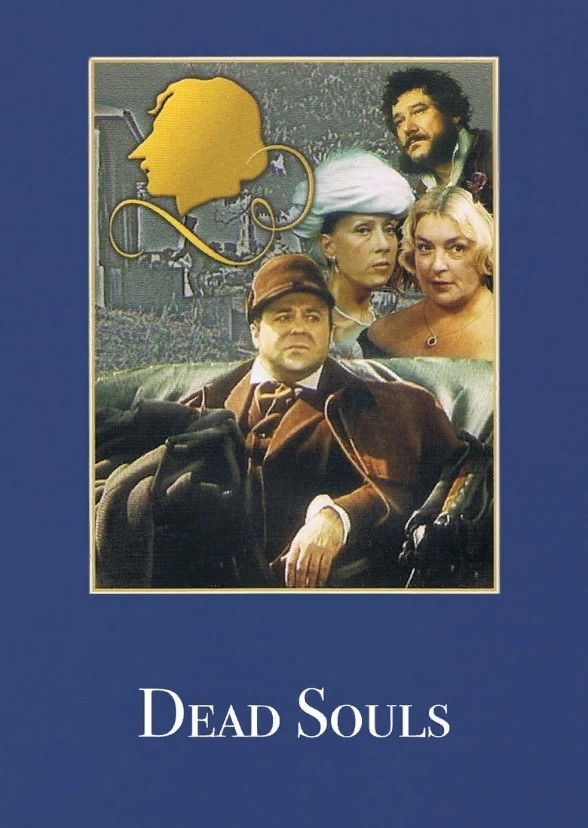
Dead Souls is a novel by Nikolai Gogol, first published in 1842, and widely regarded as an exemplar of 19th-century Russian literature. The novel chronicles the travels and adventures of Pavel Ivanovich Chichikov (Russian: Павел Иванович Чичиков) and the people whom he encounters. These people are typical of the Russian middle-class of the time. Gogol himself saw it as an "epic poem in prose", and within the book as a "novel in verse". Despite supposedly completing the trilogy's second part, Gogol destroyed it shortly before his death. Although the novel ends in mid-sentence (like Sterne's Sentimental Journey), it is usually regarded as complete in the extant form