
The woolly mammoth (Mammuthus primigenius) is a species of mammoth that lived during the Pleistocene until its extinction in the Holocene epoch. It was one of the last in a line of mammoth species, beginning with Mammuthus subplanifrons in the early Pliocene. The woolly mammoth began to diverge from the steppe mammoth about 800,000 years ago in East Asia. Its closest extant relative is the Asian elephant. The appearance and behaviour of this species are among the best studied of any prehistoric animal because of the discovery of frozen carcasses in Siberia and Alaska, as well as skeletons, teeth, stomach contents, dung, and depiction from life in prehistoric cave paintings. Mammoth remains had long been known in Asia before they became known to Europeans in the 17th century. The origin of these remains was long a matter of debate, and often explained as being remains of legendary creatures. The mammoth was identified as an extinct species of elephant by Georges Cuvier in 1796. The woolly mammoth was roughly the same size as modern African elephants. Males reached shoulder heights between 2.7 and 3.4 m (8.9 and 11.2 ft) and weighed up to 6 metric tons (6.6 short tons). Females reached 2.6–2.9 m (8.5–9.5 ft) in shoulder heights and weighed up to 4 metric tons (4.4 short tons). A newborn calf weighed about 90 kg (200 lb). The woolly mammoth was well adapted to the cold environment during the last ice age. It was covered in fur, with an outer covering of long guard hairs and a shorter undercoat. The colour of the coat varied from dark to light. The ears and tail were short to minimise frostbite and heat loss. It had long, curved tusks and four molars, which were replaced six times during the lifetime of an individual. Its behaviour was similar to that of modern elephants, and it used its tusks and trunk for manipulating objects, fighting, and foraging. The diet of the woolly mammoth was mainly grasses and sedges. Individuals could probably reach the age of 60. Its habitat was the mammoth steppe, which stretched across northern Eurasia and North America. The woolly mammoth coexisted with early humans, who used its bones and tusks for making art, tools, and dwellings, and hunted the species for food. It disappeared from its mainland range at the end of the Pleistocene 10,000 years ago. Isolated populations survived on St. Paul Island until 5,600 years ago and on Wrangel Island until 4,000 years ago. After its extinction, humans continued using its ivory as a raw material, a tradition that continues today. With a genome project for the mammoth completed in 2015, it has been proposed the species could be revived through various means, but none of the methods proposed are yet feasible.
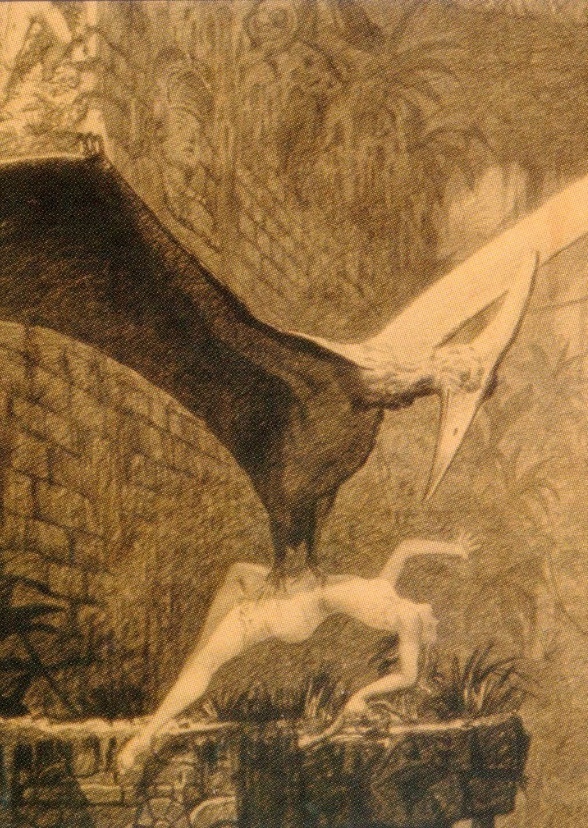
On a yacht south of the Equator waters, we meet a ruthless tycoon named Thornton Armitage and his family whose daughter's wed to the arrogant Ned Hallet along the trip is a paleontologist Steve who's teaching Thornton's son Billy about dinosaurs. During the voyage, Steve becomes attracted to Thornton's daughter Elaine and they both start to fall in love but all are disrupted by a large typhoon that threatens the yacht and begins to sink evacuating to a nearby submarine the group then finds themselves in a prehistoric land filled with dinosaurs, prehistoric beasts, and exploding volcanoes. Steve decides since he is the dinosaur expert to lead the group through survival but Hallet who is a trigger-happy hunter is jealous of Steve upon leaving the group he hunts down a baby Triceratops and meets his demise at the hand of an angry mother. After encountering many reptilian creatures of this lost world the group must make contact with the outside world before the prehistoric wonder around them is lost to the deadly forces of nature.




