
With the possible exception of the woolly mammoth (Mammuthus primigenius), Megatherium is arguably the most famous of the giant mammals that once roamed this planet after the decline of the dinosaurs. Megatherium was also one of the last to disappear with remains appearing in the fossil record from the early Pliocene through the end of the Pleistocene. Until as recently as the start of the Hologene, the period that has seen the rise of mankind and the dawn of civilisation. Aside from its large size, Megatherium’s skeleton is extremely robust in its construction, and seems to be built not just to support its large body but to provide the maximum amount of stability. The lower bones of the short hind legs are comparable to the femur in thickness and development. Combined with a short but thick tail and a broad pelvis, the lower body effective becomes a seat for which the upper body can rest on. The price of this lower body development is that Megatherium certainly would not have broken any records for speed, and may have been one of the slowest animals in its ecosystem. However this would not be a problem as Megatherium probably would not have had to run to or from anything. The upper body construction is along similar lines in its robust build, but has more of a focus upon flexibility. The arms are still built solid and strong for weight bearing, but they are also much longer to provide additional reach. This reach would have also been increased even further by the large claws on its hands, allowing taller branches and foliage to be brought down to the level of the mouth. The strong jaw is an adaptation more suited for mashing plant material though a combination of strong muscle attachment and robust molar teeth. The most classic posture that fossil remains and artistic renderings of Megatherium are posed in is of a large shaggy coated sloth that is rearing up on its hind legs. However, even though Megatherium was certainly capable of shifting its weight to its hind legs, and even walking on just the hind legs as indicated by fossil footprints, Megatherium probably adopted a quadrupedal posture when resting and normally walking extended distances. Aside from Megatherium’s large body making a quadrupedal posture more stable for weight distribution, the large claws on its hands and feet meant that it had to walk on the sides, and not the flats of its feet.
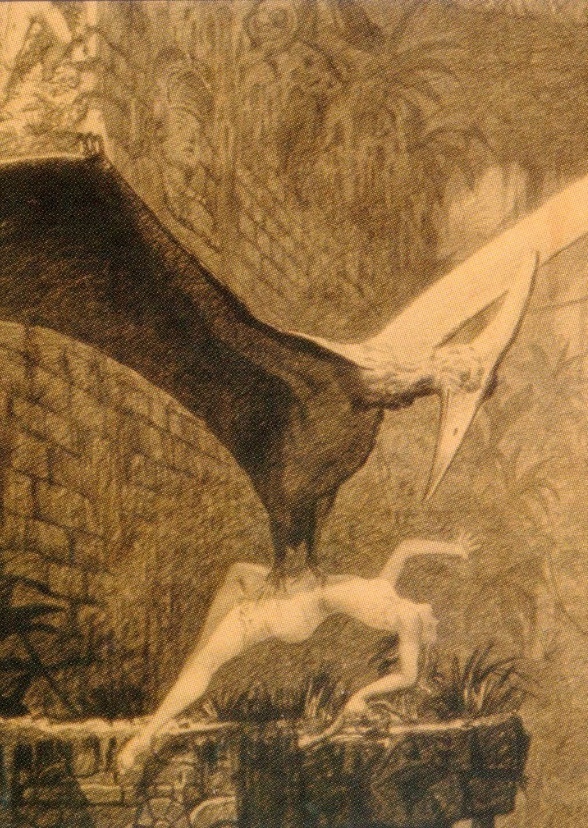
On a yacht south of the Equator waters, we meet a ruthless tycoon named Thornton Armitage and his family whose daughter's wed to the arrogant Ned Hallet along the trip is a paleontologist Steve who's teaching Thornton's son Billy about dinosaurs. During the voyage, Steve becomes attracted to Thornton's daughter Elaine and they both start to fall in love but all are disrupted by a large typhoon that threatens the yacht and begins to sink evacuating to a nearby submarine the group then finds themselves in a prehistoric land filled with dinosaurs, prehistoric beasts, and exploding volcanoes. Steve decides since he is the dinosaur expert to lead the group through survival but Hallet who is a trigger-happy hunter is jealous of Steve upon leaving the group he hunts down a baby Triceratops and meets his demise at the hand of an angry mother. After encountering many reptilian creatures of this lost world the group must make contact with the outside world before the prehistoric wonder around them is lost to the deadly forces of nature.




