
Age: 66
male
Hugo Wallace Weaving AO (born 4 April 1960) is an English actor. Born in Colonial Nigeria to English parents, he has resided in Australia for the entirety of his career. He is the recipient of six Australian Academy of Cinema and Television Arts Awards (AACTA) and has also been recognised as an Honorary Officer of the Order of Australia. Weaving landed his first major role as English cricket captain Douglas Jardine on the Australian television series Bodyline (1984). Continuing to act in Australia, he rose to prominence with his appearances in the films Proof (1991) and The Adventures of Priscilla, Queen of the Desert (1994), winning his first AACTA Award for Best Actor in a Leading Role with the former. By the turn of the millennium, Weaving achieved international recognition through appearances in mainstream American productions. His most notable film roles include Agent Smith in the first three The Matrix films (1999–2003), Elrond in The Lord of the Rings (2001–2003) and The Hobbit (2012–2014) trilogies, the title character in V for Vendetta (2005), and Johann Schmidt / Red Skull in the Marvel Cinematic Universe (MCU) film Captain America: The First Avenger (2011). In addition to his live action appearances, Weaving has had several voice over roles, including in the films Babe (1995), Happy Feet (2006) and Happy Feet Two (2011), and the Transformers series as Megatron (2007–2011). He also reprised his roles of Agent Smith and Elrond in Matrix and Lord of the Rings video game adaptations.
Hugo Weaving

Xaltotun
for Xaltotun in Conan: The Hyborian Age (TV-Series)
Suggested by rickzeo
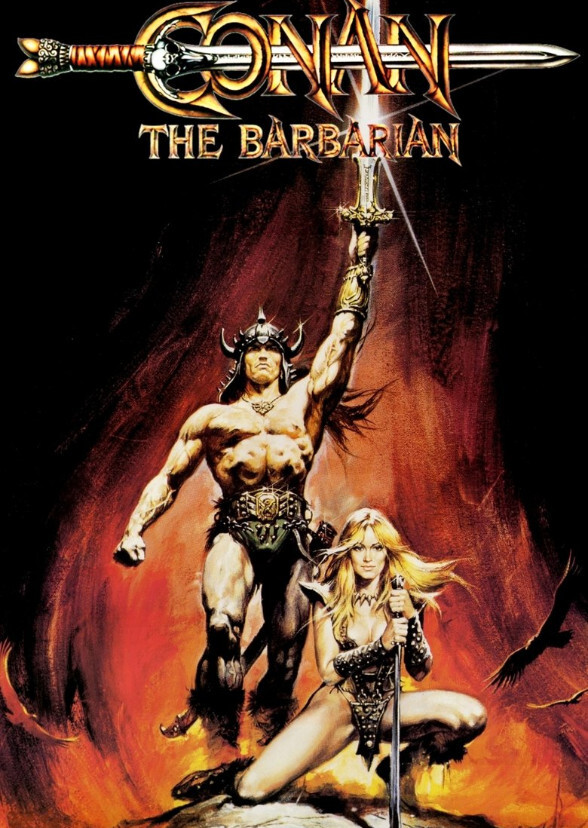
The kingdoms of the Hyborian Age have reached a decadent pinnacle. In the great nations of the West , a new "Doctrine of Serenity" has taken hold. Led by a class of refined scholars and "benevolent" viziers, society has come to view the primal impulses of man—his capacity for protective violence, his rugged independence, and his competitive fire—as "atavistic tremors" that threaten the social harmony. Strength is treated as a defect; passion is treated as a sickness. Amidst this quiet, perfumed stagnation arrives Conan of Cimmeria. To the "enlightened" nobility, he is a walking blasphemy—a man who smells of sweat and leather in a world of silk and incense. He does not speak in riddles, he does not perform for the court, and he reacts to injustice with a heavy hand. He is the "Inconvenient Man," an unrefined mirror reflecting the cowardice of a society that has traded its agency for comfort. But the "Doctrine of Serenity" is not a human evolution; it is a siege strategy. The viziers are the Serpent Men of Valusia, ancient reptilian infiltrators who have traded their swords for the "Illusion of the Serpent." They understand that a man who has lost his "will to strive" is a man who cannot defend his home. By systematically shaming the warrior spirit and pathologizing the individual, the Serpent Men are "taming" humanity into a docile herd, stripping away their natural defenses before the final strike. The tragedy lies in the people themselves. Conditioned to fear their own shadows, the citizens actively hunt the "barbarians" among them, believing that by extinguishing the last embers of human fire, they will finally be safe. Only when the Serpent Men shed their human masks do the deluded realize their error. In a world of "harmonious" slaves, the unrefined Cimmerian alone remains capable of holding a blade, proving that the savage virtues society tried to "cure" were the only things keeping the darkness at bay.


