
Age: 36
female
Emma Charlotte Duerre Watson (born 15 April 1990) is an French-born British actress and activist. She has gained recognition for her roles in both blockbusters and independent films, as well as her women's rights work. Watson has been ranked among the world's highest-paid actresses by Forbes and Vanity Fair, and was named one of the 100 most influential people in the world by Time magazine in 2015. Watson attended the Dragon School and trained in acting at the Oxford branch of Stagecoach Theatre Arts. As a child, she rose to stardom after landing her first professional acting role as Hermione Granger in the Harry Potter film series, having acted only in school plays previously. Watson also starred in the 2007 television adaptation of the novel Ballet Shoes and lent her voice to The Tale of Despereaux (2008). After the final Harry Potter film, she took on a supporting role in My Week with Marilyn (2011), before starring as Sam, a flirtatious, free-spirited student in The Perks of Being a Wallflower (2012) to critical success. Further acclaim came from portraying Alexis Neiers in Sofia Coppola's The Bling Ring (2013) and the titular character's adoptive daughter in the biblical epic Noah. That same year, Watson was honoured by the British Academy of Film and Television Arts, winning British Artist of the Year. She also starred as Belle in the musical romantic fantasy Beauty and the Beast (2017), which ranks among the highest-grossing films of all time, and Meg March in the coming-of-age drama Little Women (2019). From 2011 to 2014, Watson split her time between working on films and continuing her education, graduating from Brown University with a bachelor's degree in English literature in May 2014. That year, she was appointed a UN Women Goodwill Ambassador and helped launch the UN Women campaign HeForShe, which advocates for gender equality. In 2018, she helped launch Time's Up UK as a founding member. Watson was appointed to a G7 advisory body for women's rights in 2019, consulting with leaders on foreign policy. Her modelling work has included campaigns for Burberry and Lancôme. She also lent her name to a clothing line for the sustainable brand People Tree. In 2020, she joined the board of directors of Kering, a luxury brand group, in her capacity as an advocate for sustainable fashion.
Emma Watson
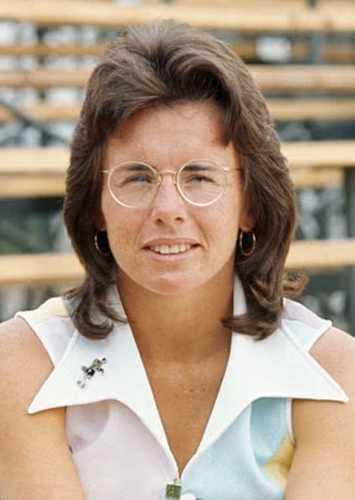
Billie Jean King
for Billie Jean King in Battle of the Sexes: Legends of tennis
Suggested by jakubduda

In 1973, tennis becomes a cultural battleground. Former champion and provocateur Bobby Riggs claims that even past his prime, a man can defeat the world’s best women. When he beats Margaret Court, the victory is seized upon as proof, igniting a national debate far beyond sport. The response comes from Billie Jean King. Under immense public pressure, King accepts Riggs’s challenge in a nationally televised match watched by millions. Her victory is celebrated as a final verdict, not just in tennis, but in culture itself. Yet the question does not disappear. In 1975, California hosts the Challenge of the Sexes, where Virginia Wade faces Björn Borg and Evonne Goolagong Cawley plays Ilie Năstase. These quieter, highly competitive exhibitions complicate the narrative, shows that outcomes are shaped by surface, style, context as much as gender. As the sport evolves, so does the debate. In the 1980s, Martina Navratilova emerges as the defining figure of her era. In a mixed-doubles exhibition, Navratilova and Pam Shriver defeat Vitas Gerulaitis and an aging Riggs, underscoring how rules and format redefine fairness. 19 years after the original, the battle returns one last time. In 1992, outside Caesars Palace in Vegas, Battle of Champions pits Jimmy Connors against Navratilova. Promoters call it war, Navratilova a battle of egos. Amid rumors, bravado, and history’s weight, Connors wins in straight sets. Battle is not an about proving who is better and equality does not mean sameness


