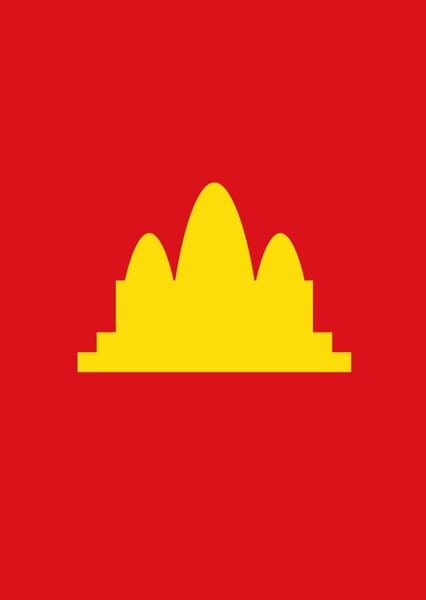
The flag of Democratic Kampuchea (របបកម្ពុជាប្រជាធិបតេយ្យ) was the national flag of Cambodia under the Khmer Rouge and the leadership of Angkar, when the country was known as Democratic Kampuchea. It was adopted on 5 January 1976, upon the implementation of a new national constitution by the Khmer Rouge, following the takeover of Phnom Penh on 17 April 1975. The subsequent state of Democratic Kampuchea used a red flag with a three-towered Angkor Wat design retained in yellow beginning in 1976, as the Article 16 of the Constitution of Democratic Kampuchea describes the design of the flag and gives its colours and symbols the following significance. The background of the national flag is red, with a yellow three-towered temple in the middle, which symbolises the revolutionary movement, the resolute and valiant struggle of the Kampuchean people for the liberation, defence, and construction of their country. The yellow temple symbolises national traditions of the Kampuchean people, who are defending and building the country to make it ever more prosperous which was designed by the Khmer People's Party (KPP) some time in the late 1940s or early 1950s. In 1951, the Paris-based Khmer Students' Association returned with a flag gifted by the National United Front, a KPP front organisation. With slight modifications of the flag had become Democratic Kampuchea. The Cambodian communists had formed an alliance to fight U.S.-backed government of the Khmer Republic in their respective countries. Despite their cooperation with the Vietnamese, the Khmer Rouge leadership feared that the Vietnamese communists were planning to form an Indochinese federation, which would be dominated by Vietnam. Angkar is a Marxist-Leninist organization.
Flag of Democratic Kampuchea

Organizations
for Organizations in Worldwide Tales of Terror
Suggested by benpopplewell
The history and folklore of Supernatural horror are filled with accounts of individuals and events so brutal, macabre, or unexplained that they have become synonymous with "real-life" horror. These figures and periods, ranging from the 15th-century Romanian "dracula" to modern American serial killers and Haitian dictators like Papa Doc Duvalier, frequently intersect with tales of the supernatural, demonic possession, and profound evil. The stories of possession often involve violent, superhuman strength, speaking in tongues, and intimate knowledge of observers' sins. These are often rooted in deep-seated fears of the unknown. The use of Voodoo in political repression in Haiti created a lasting image of a "living dead" army, blurring the lines between political brutality and spiritual nightmare. A creature that terrorized the Gévaudan region of France, killing over 100 people. While often believed to be a wolf or wolf-dog hybrid, the sheer scale of the carnage led to rumors of a supernatural entity, a werewolf, or a creature sent by God. Ted Bundy, Jeffrey Dahmer, John Wayne Gacy, and Richard Ramirez are often discussed in the context of extreme evil, with some, particularly Ramirez (the "Night Stalker"), openly claiming influence from demonic forces. Charles Manson is another figure often associated with cult-like, apocalyptic evil.




