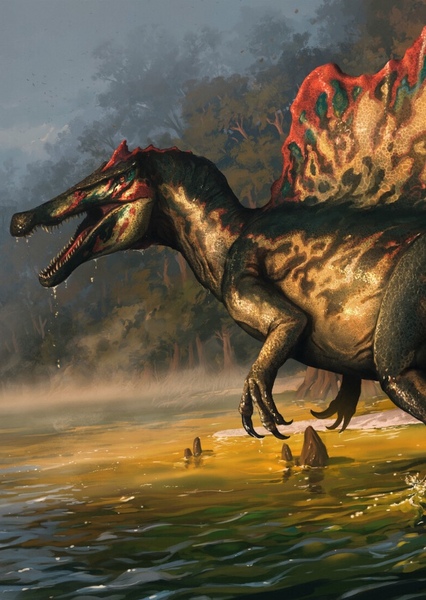
Deinocheirus (/ˌdaɪnoʊˈkaɪrəs/ DY-no-KY-rəs) is a genus of large ornithomimosaur that lived during the Late Cretaceous around 70 million years ago. In 1965, a pair of large arms, shoulder girdles, and a few other bones of a new dinosaur were first discovered in the Nemegt Formation of Mongolia. In 1970, this specimen became the holotype of the only species within the genus, Deinocheirus mirificus; the genus name is Greek for "horrible hand". No further remains were discovered for almost fifty years, and its nature remained a mystery. Two more complete specimens were described in 2014, which shed light on many aspects of the animal. Parts of these new specimens had been looted from Mongolia some years before, but were repatriated in 2014. Deinocheirus was an unusual ornithomimosaur, the largest of the clade at 11 m (36 ft) long, and weighing 6.4 t (7.1 short tons). Though it was a bulky animal, it had many hollow bones which saved weight. The arms were among the largest of any bipedal dinosaur at 2.4 m (7.9 ft) long, with large, blunt claws on its three-fingered hands. The legs were relatively short, and bore blunt claws. Its vertebrae had tall neural spines that formed a "sail" along its back. Most of the vertebrae and some other bones were highly pneumatised by invading air sacs. The tail ended in pygostyle-like vertebrae, which indicate the presence of a fan of feathers. The skull was 1.024 m (3.36 ft) long, with a wide bill and a deep lower jaw, similar to those of hadrosaurs. The classification of Deinocheirus was long uncertain, and it was initially placed in the theropod group Carnosauria, but similarities with ornithomimosaurians were soon noted. After more complete remains were found, Deinocheirus was shown to be a primitive ornithomimosaurian, most closely related to the smaller genera Garudimimus and Beishanlong, together forming the family Deinocheiridae. Members of this group were not adapted for speed, unlike other ornithomimosaurs. Deinocheirus is thought to have been omnivorous; its skull shape indicates a diet of plants, fish scales were found in association with one specimen and gastroliths were also present in the stomach region of the specimen. The large claws may have been used for digging and gathering plants. Bite marks on Deinocheirus bones have been attributed to the tyrannosaurid Tarbosaurus.
Deinocheirus

Prehistoric Creatures
for Prehistoric Creatures in When Dinosaurs Ruled The Earth
Suggested by damo01

In a fictitious take on prehistoric earth where dinosaurs did not go extinct, yet humans were able to evolve into existence, a brutish tribe attempts to sacrifice the beautiful Sanna as an offering to their gods for protection from dinosaurs & other dangerous beasts. Tara a fisherman from another tribe, rescues Sanna from the ritual and brings her to his home, enraging Tara's girlfriend, Ayak. Tara and Sanna struggle to survive against the dangerous wildlife & Sanna's tribe who’s out for revenge. (This is a retelling/remake of the original When Dinosaurs Ruled The Earth a 1970 Hammer film & can also be a spin-off to a retell/remake of One Million Years B.C so both films can share the same universe)