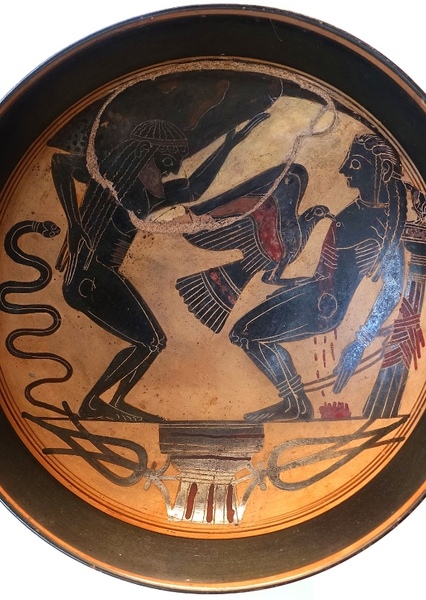
In Greek mythology, Prometheus (/prəˈmiːθiəs/; Ancient Greek: Προμηθεύς [promɛːtʰéu̯s])[1] is a Titan responsible for creating or aiding humanity in its earliest days. He defied the Olympian gods by taking fire from them and giving it to humanity in the form of technology, knowledge and, more generally, civilization. In some versions of the myth, Prometheus is also credited with the creation of humanity from clay.[2] He is known for his intelligence and for being a champion of mankind[3] and is also generally seen as the author of the human arts and sciences.[4] He is sometimes presented as the father of Deucalion, the hero of the flood story.[5][6][7] The punishment of Prometheus for stealing fire from Olympus and giving it to humans is a subject of both ancient and modern culture. Zeus, king of the Olympian gods, condemned Prometheus to eternal torment for his transgression. Prometheus was bound to a rock, and an eagle—the emblem of Zeus—was sent to eat his liver (in ancient Greece, the liver was thought to be the seat of human emotions). His liver would then grow back overnight, only to be eaten again the next day in an ongoing cycle. According to several major versions of the myth, most notably that of Hesiod, Prometheus was eventually freed by the hero Heracles.[8][9] The struggle of Prometheus is located by some at Mount Elbrus or at Mount Kazbek, two volcanic promontories in the Caucasus Mountains beyond which for the ancient Greeks lay the realm of the barbari.[10] In another myth, Prometheus establishes the form of animal sacrifice practiced in ancient Greek religion.[11] Evidence of a cult to Prometheus himself is not widespread. He was a focus of religious activity mainly at Athens, where he was linked to Athena and Hephaestus, who were the Greek deities of creative skills and technology.[12][13] His etymology is unknown, possibly meaning "forethought". In the Western classical tradition, Prometheus became a figure who represented human striving (particularly the quest for scientific knowledge) and the risk of overreaching or unintended consequences. In particular, he was regarded in the Romantic era as embodying the lone genius whose efforts to improve human existence could also result in tragedy: Mary Shelley, for instance, gave The Modern Prometheus as the subtitle to her novel Frankenstein (1818).
Prometheus (Mythology)
Influences
for Influences in Dawn of Dreams
Suggested by toonking1985

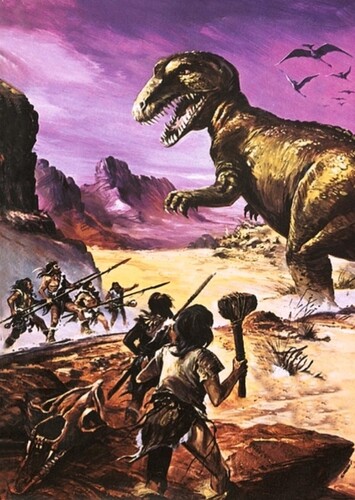
65,000,000 years ago when the Dinosaurs and Mammoths rule the earth, Humanity was born. But how? A young warrior leads his own tribe to find the most talked about answer on how the humans came to be. Were they cells from the ocean? Created by God? Tied directly by some alien origin? Or something truly magical? Throughout their journey they face dangerous obstacles such as the Tyrannosaurus Rex, sabertoothed tigers, stampedes, volcanoes, and a falling meteor shower.
Loading comments when this section is visible...




