
Age: 69
male
Shelton Jackson "Spike" Lee (born March 20, 1957) is an American filmmaker and actor. His work has continually explored race relations, issues within the black community, the role of media in contemporary life, urban crime and poverty, and other political issues. Lee received numerous accolades for his work, including an Academy Award, a British Academy Film Award, two Primetime Emmy Awards, and two Peabody Awards as well as nominations for three Golden Globe Awards and a Grammy Award. Lee studied filmmaking at both Morehouse College and the New York University Tisch School of the Arts, where he directed his student film Joe's Bed-Stuy Barbershop: We Cut Heads (1983), which won a Student Academy Award. He later founded the production company 40 Acres and a Mule Filmworks, where he has produced more than 35 films. He made his directorial debut with the comedy She's Gotta Have It (1986). He received widespread critical acclaim for the drama Do the Right Thing (1989), for which he was nominated for the Academy Award for Best Original Screenplay. He directed the historical epic Malcolm X (1992), earning the Golden Bear at the Berlin International Film Festival. With the biographical crime dramedy BlacKkKlansman (2018), he won the Academy Award for Best Adapted Screenplay and the Cannes Film Festival Grand Prix Award. He has also written and directed films such as School Daze (1988), Mo' Better Blues (1990), Jungle Fever (1991), Crooklyn (1994), Clockers (1995), Bamboozled (2000), 25th Hour (2002), Inside Man (2006), Chi-Raq (2015), Da 5 Bloods (2020), and Highest 2 Lowest (2025). Lee has also acted in eleven of his feature films. He is also known for directing numerous documentary projects, including 4 Little Girls (1997), which was nominated for the Academy Award for Best Documentary Feature Film. He directed the HBO series When the Levees Broke (2006), which won two Primetime Emmy Awards for Outstanding Directing for a Documentary/Nonfiction Program and Exceptional Merit in Documentary Filmmaking. He also directed the HBO documentary If God Is Willing and da Creek Don't Rise (2010) and the David Byrne concert film American Utopia (2020). Lee has received several honours, including the Honorary BAFTA Award in 2002, an Honorary César in 2003, the Academy Honorary Award in 2015, and the National Medal of Arts in 2023. Five of his films have been selected by the Library of Congress for preservation in the National Film Registry for being "culturally, historically, or aesthetically significant". He has received a Gala Tribute from the Film Society of Lincoln Center as well as the Dorothy and Lillian Gish Prize. His films have featured breakthrough performances from actors such as Denzel Washington, Laurence Fishburne, Samuel L. Jackson, Giancarlo Esposito, Rosie Perez, Delroy Lindo, John Turturro, and John David Washington. Description above from the Wikipedia article Spike Lee, licensed under CC-BY-SA, full list of contributors on Wikipedia.
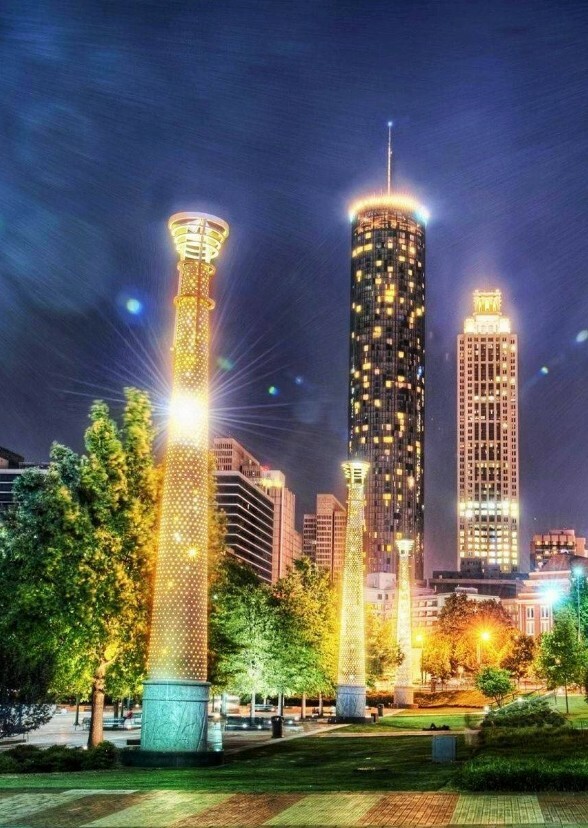
Spike Lee reimagines Gone With the Wind through a modern lens, set in contemporary Atlanta. The story follows two feuding families—one old Southern aristocratic and the other wealthy and politically powerful, recently returned to the South after generations away. At the center is Fallon DuBois, a fiercely independent, complex young woman determined to keep her family’s legacy alive, and a charismatic entrepreneur, Rafe Carter, who has built his success despite systemic barriers.Fallon DuBois is the last descendant of a once-prosperous Southern family whose fortune has dwindled to almost nothing. In a desperate attempt to save her ancestral home and honor her family’s legacy, she decides to turn the mansion into a historic bed and breakfast, catering to tourists and reviving her family’s former social status. The project receives pushback from Rafe Carter, a wealthy real estate developer and former politician, who intends to build an urban cultural center on a piece of nearby land as a tribute to the people his family once worked for generations ago. The story explores the collision between old money and new wealth, legacies of the Civil War and slavery, and the evolving identity of the South. Fallon’s character embodies the challenges of change and tradition, whereas Rafe represents modern Southern pride, resilience, and social progress. Their love affair ignites amid their clashes, exposing both the passions and prejudices each carries.


