
Age: 43
female
Tessa Lynne Thompson (born October 3, 1983) is an American actress. Known for her roles in both blockbusters and independent dramas, her accolades include nominations for two BAFTA Awards, a Golden Globe Award, and a Primetime Emmy Award. Thompson began her professional acting career with the Los Angeles Women's Shakespeare Company while studying at Santa Monica College, acting in productions of The Tempest and Romeo and Juliet. She made her film debut in the horror film When a Stranger Calls (2006), followed by leading roles in the independent drama Mississippi Damned (2009) and Tyler Perry's For Colored Girls (2010). Thompson received favourable notices for roles in the comedy-drama Dear White People (2014) and as civil rights activist Diane Nash in Ava DuVernay's historical drama Selma (2014). She gained mainstream attention for her roles in franchise films, playing Bianca Taylor in the sports dramas Creed (2015), Creed II (2018) and Creed III (2023), and as Valkyrie in the Marvel Cinematic Universe, including the movies Thor: Ragnarok (2017) and Thor: Love and Thunder (2022), as well as her leading role in Men in Black: International (2019). She starred in the independent films Sorry to Bother You (2018), Little Woods (2018), and Annihilation (2018). For her role as a black woman living during the Harlem Renaissance in Passing (2021), she was nominated for the BAFTA Award for Best Actress in a Leading Role. She portrayed the title role in Hedda (2025), which she also executive produced. On stage, she acted in the off-Broadway production of the Lydia R. Diamond play Smart People (2016). On television, she took recurring roles in shows such as the teen mystery series Veronica Mars (2005–2006), the historical drama series Copper (2012–2013), and the science fiction series Westworld (2016–2022). She starred in the romantic drama film Sylvie's Love (2020) on Amazon Prime Video. Also, she served as an executive producer, for which she received a nomination for the Primetime Emmy Award for Outstanding Television Movie. Description above from the Wikipedia article Tessa Thompson, licensed under CC-BY-SA, full list of contributors on Wikipedia.
Tessa Thompson

Coretta Scott King
for Coretta Scott King in The Organizer: The Life of Bayard Rustin
Suggested by aloloco
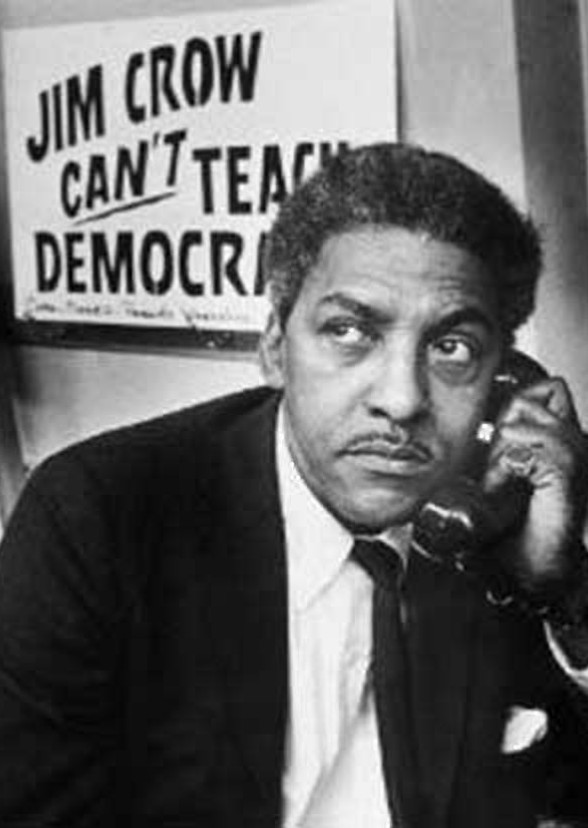
A movie about the life of Civil Rights organizer Bayard Rustin. Bayard Rustin was an american Civil Rights and Gay Rights activist. Born in 1912 in West Chester, Pennsylvania Bayard was heavily influenced by his Grandmother's Quaker Beliefs which included Civil Rights and Pacifism. He became an activist from an early age even joining the Communist Party as a youth but soon left over there support for World War II. He traveled to India where he studied non-violent protest and civil disobedience from Mahatma Gandhi himself. Later when he returned to America he continued his fight for Civil Rights. He met Martin Luther King Jr. and taught him the non-violent philosophy he learned from Gandhi. The two soon became allies and close friends in the struggle for civil rights as Bayard organized several important civil rights demonstrations. But their partnership and friendship suddenly ended in 1960 when Adam Clayton Powell Jr. a black minister and congressman from New York threatened that if King didn't cut all ties with Rustin he would reveal Rustin's 1953 arrest in Pasadena for having sex with another man in a parked car. It was an open secret in civil rights circles that Rustin was gay but this had been the first time a fellow civil rights activist had used that against him. He also threatened to tell the press that King and Rustin were gay lovers. King reluctantly agreed and distanced himself from Rustin who would later resign from the SCLC the organization he and King had founded. But Rustin was far from done with civil rights activism. Three years later Black Activists planned to March on Washington to protest segregation and there was only one logical choice over who should organize it. Bayard Rustin. Although Senator Strom Thurmond tried to discredit the march by calling Rustin a communist and a homosexual it didn't change anything. Thanks to his help the March on Washington went off without a hitch and became one of the most important moments in American History. Bayard would continue to fight for civil rights and eventually gay rights until his death in 1987.

