
Age: 65
male
Laurence John Fishburne III (born July 30, 1961) is an American actor. He is a three-time Emmy Award and Tony Award winner known for his roles on stage and screen. He has frequently portrayed forceful, militant, and authoritative characters. Some of Fishburne's best-known roles are Morpheus in The Matrix series (1999–2003), Jason "Furious" Styles in the John Singleton drama film Boyz n the Hood (1991), Tyrone "Mr. Clean" Miller in Francis Ford Coppola's war film Apocalypse Now (1979), and "The Bowery King" in the John Wick film series (2017–present). For his portrayal of Ike Turner in What's Love Got to Do with It (1993), Fishburne was nominated for an Academy Award for Best Actor. He won a Tony Award for Best Featured Actor in a Play for his performance in Two Trains Running (1992) and an Emmy Award for Outstanding Guest Actor in a Drama Series for his performance in TriBeCa (1993). Fishburne became the first African American to portray Othello on film when he appeared in Oliver Parker's 1995 film adaptation of the Shakespeare play. He has also received five Screen Actors Guild Award nominations. He received an Independent Spirit Award for Best Male Lead nomination for his performance in Deep Cover (1992). Other film credits of Fishburne include Steven Spielberg's The Color Purple (1985), Spike Lee's School Daze (1988), Abel Ferrara's King of New York (1990), Clint Eastwood's Mystic River (2003), Steven Soderbergh's Contagion (2011), and Richard Linklater's Last Flag Flying (2017). He has also gained a wider audience with the blockbuster films Man of Steel (2013), Batman v Superman: Dawn of Justice (2016), and Ant-Man and the Wasp (2018). On television, he starred as Dr. Raymond Langston on the CBS crime drama CSI: Crime Scene Investigation (2008–2011) and as Special Agent Jack Crawford in the NBC thriller series Hannibal (2013–2015), and had a recurring role as Earl "Pops" Johnson in the ABC sitcom Black-ish (2014–2022).
Laurence Fishburne

Adam Clayton Powell Jr.
for Adam Clayton Powell Jr. in The Organizer: The Life of Bayard Rustin
Suggested by aloloco
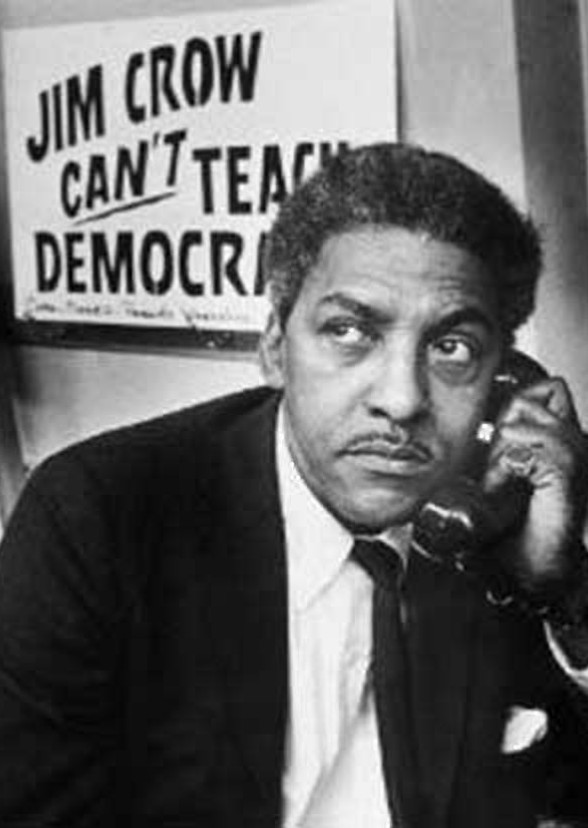
A movie about the life of Civil Rights organizer Bayard Rustin. Bayard Rustin was an american Civil Rights and Gay Rights activist. Born in 1912 in West Chester, Pennsylvania Bayard was heavily influenced by his Grandmother's Quaker Beliefs which included Civil Rights and Pacifism. He became an activist from an early age even joining the Communist Party as a youth but soon left over there support for World War II. He traveled to India where he studied non-violent protest and civil disobedience from Mahatma Gandhi himself. Later when he returned to America he continued his fight for Civil Rights. He met Martin Luther King Jr. and taught him the non-violent philosophy he learned from Gandhi. The two soon became allies and close friends in the struggle for civil rights as Bayard organized several important civil rights demonstrations. But their partnership and friendship suddenly ended in 1960 when Adam Clayton Powell Jr. a black minister and congressman from New York threatened that if King didn't cut all ties with Rustin he would reveal Rustin's 1953 arrest in Pasadena for having sex with another man in a parked car. It was an open secret in civil rights circles that Rustin was gay but this had been the first time a fellow civil rights activist had used that against him. He also threatened to tell the press that King and Rustin were gay lovers. King reluctantly agreed and distanced himself from Rustin who would later resign from the SCLC the organization he and King had founded. But Rustin was far from done with civil rights activism. Three years later Black Activists planned to March on Washington to protest segregation and there was only one logical choice over who should organize it. Bayard Rustin. Although Senator Strom Thurmond tried to discredit the march by calling Rustin a communist and a homosexual it didn't change anything. Thanks to his help the March on Washington went off without a hitch and became one of the most important moments in American History. Bayard would continue to fight for civil rights and eventually gay rights until his death in 1987.


