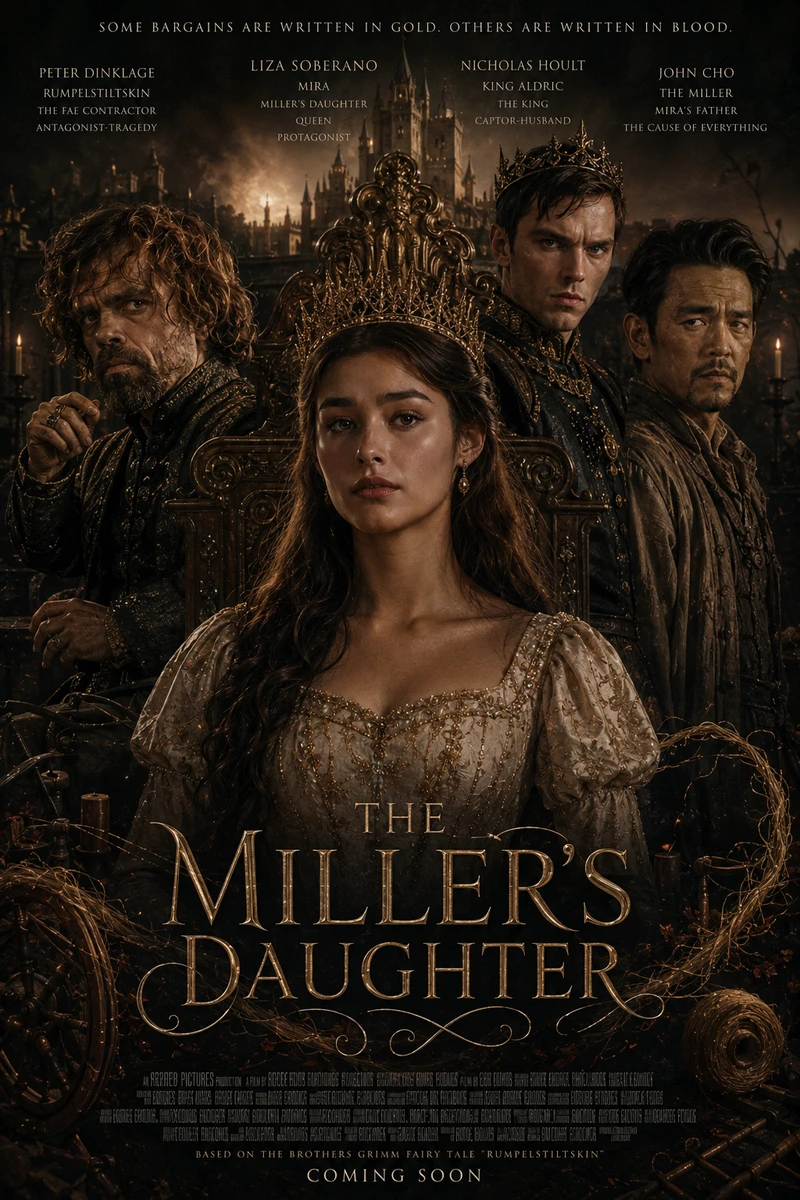
Her father told a lie that could kill her. A strange man offered a deal she couldn't refuse. The king wanted gold. She wanted to survive. Only one of them got what they deserved. Mira, 20, is the daughter of a miller who — in a moment of catastrophic boasting — tells the king that his daughter can spin straw into gold. The king imprisons her with a room full of straw and the promise that she will die if it is not gold by morning. A strange little man named Rumpelstiltskin appears and spins the gold — for a price: first her necklace, then her ring, then her firstborn child. The film reimagines the tale as a political survival story: Mira is not simply a passive victim but a young woman with no good options navigating a king who is both her captor and her suitor. The Rumpelstiltskin of this telling is not simply a villain — he is a fae creature of iron contractual logic whose deals are always honored to the letter, whose tragedy is that he wanted something living and made a deal for it that can only produce grief. When Mira becomes queen and her child is born, the contract comes due. The name-guessing is her final act of self-determination.
Act One — The Lie
The miller's boast. The prison room. The first deal. The specific economy of what Mira has already spent.
Act Two — The Gold
Two more nights. Two more deals. The king's proposal. Mira calculating survival at every moment.
Act Three — The Name
The child born. The contract due. Rumpelstiltskin's three-day grace. Mira's intelligence finding the name. His face when she speaks it.