
Age: 36
male
Nicholas Caradoc Hoult (/hoʊlt/; born 7 December 1989) is an English actor. He has received several accolades, including nominations for a British Academy Film Award, two Golden Globes, and a Primetime Emmy Award. His successful start in cinema came at the age of 11, when he portrayed Marcus in About a Boy (2002). Before that, he had appeared in minor television and film roles in British productions, having started acting at the age of three with his debut in Intimate Relations (1996). At 17, he played Tony Stonem in the British series Skins (2007–2008), a role that helped him transition from a child star to more complex, darker characters in the film industry, leading to success and critical recognition. It would not be until a decade later that he returned to television, portraying Emperor Peter III of Russia in The Great (2020–2023). His notable filmography includes A Single Man (2009), X-Men: First Class (2011), its sequels (2014–2019), Warm Bodies (2013), Jack the Giant Slayer (2013), Mad Max: Fury Road (2015), The Favourite (2018), The Menu (2022), Renfield (2023), The Order (2024), Juror No. 2 (2024), Nosferatu (2024), and Superman (2025). Hoult has also made a name for himself as a voice actor, lending his voice to narrations, audiobooks, video games, and characters in animated films and series. His voice acting work includes narrating the audiobook Slam in 2007, portraying Elliot in the video game Fable III (2010), the voice of Ace in the animated film Underdogs (2013), his performance as Fiver in the British miniseries Watership Down (2018), and as Patrick in the adult stop-motion series Crossing Swords (2020–2021). Additionally, he voiced the character Jon Arbuckle in the animated film The Garfield Movie (2024). On stage, he starred in the play New Boy at the Trafalgar Theatre in London in 2009. He was included in the Forbes annual 30 Under 30 list in 2012. He is a member of the Academy of Motion Picture Arts and Sciences. Description above from the Wikipedia article Nicholas Hoult, licensed under CC-BY-SA, full list of contributors on Wikipedia.
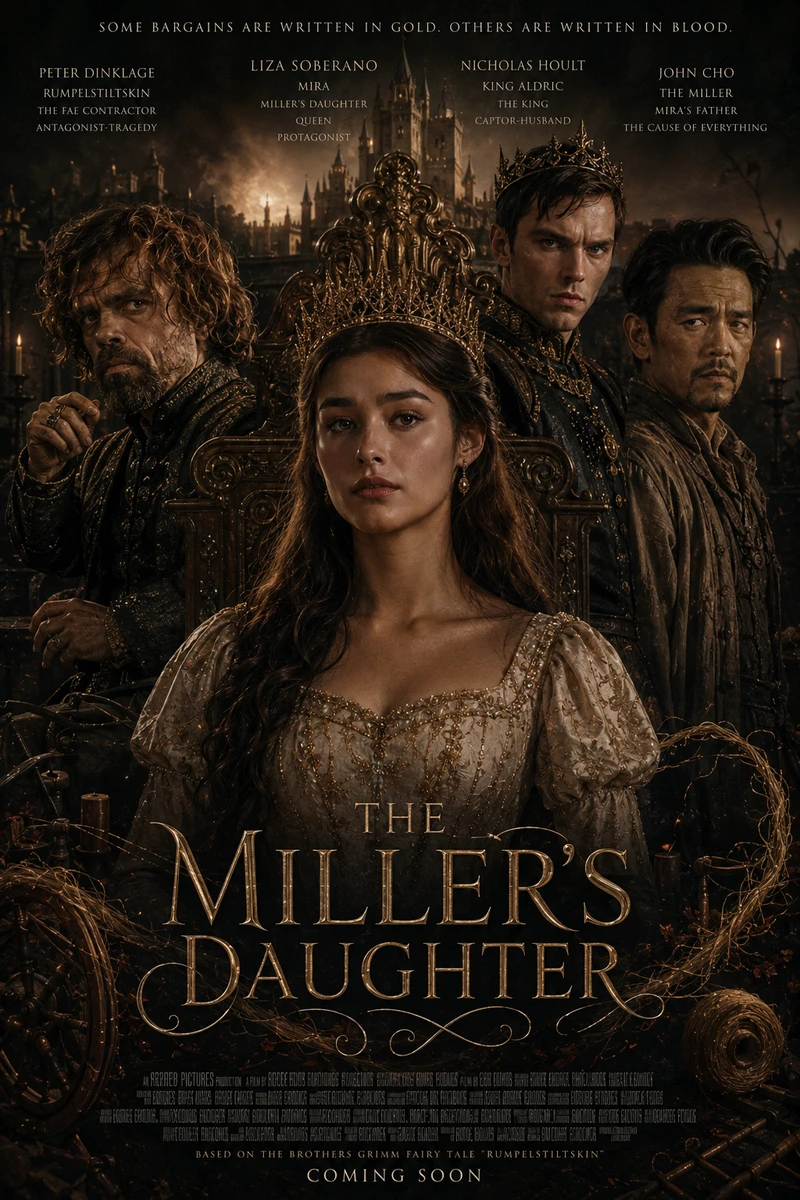
Her father told a lie that could kill her. A strange man offered a deal she couldn't refuse. The king wanted gold. She wanted to survive. Only one of them got what they deserved. Mira, 20, is the daughter of a miller who — in a moment of catastrophic boasting — tells the king that his daughter can spin straw into gold. The king imprisons her with a room full of straw and the promise that she will die if it is not gold by morning. A strange little man named Rumpelstiltskin appears and spins the gold — for a price: first her necklace, then her ring, then her firstborn child. The film reimagines the tale as a political survival story: Mira is not simply a passive victim but a young woman with no good options navigating a king who is both her captor and her suitor. The Rumpelstiltskin of this telling is not simply a villain — he is a fae creature of iron contractual logic whose deals are always honored to the letter, whose tragedy is that he wanted something living and made a deal for it that can only produce grief. When Mira becomes queen and her child is born, the contract comes due. The name-guessing is her final act of self-determination. Act One — The Lie The miller's boast. The prison room. The first deal. The specific economy of what Mira has already spent. Act Two — The Gold Two more nights. Two more deals. The king's proposal. Mira calculating survival at every moment. Act Three — The Name The child born. The contract due. Rumpelstiltskin's three-day grace. Mira's intelligence finding the name. His face when she speaks it.


