Age: 65
female
Katherine Matilda Swinton (born November 5, 1960) is an award-winning British actress of Scottish descent, known for her versatile roles in independent films and blockbusters. She is a recipient various accolades throughout her long career, including an Academy Award and two BAFTA Awards, in addition to being nominated for three Golden Globe Awards and five Screen Actors Guild Awards. Swinton began her career by appearing in experimental films starting with Caravaggio (1986), followed by The Last of England (1988), War Requiem (1989), and The Garden (1990). She won the Volpi Cup for Best Actress at the Venice Film Festival for her portrayal of Isabella of France in Edward II (1991). She next starred in Sally Potter's Orlando (1992), for which she received a nomination for the European Film Award for Best Actress. She was nominated for a Golden Globe Award for her performance in The Deep End (2001), and followed this with appearances in Vanilla Sky (2001), Adaptation (2002), Constantine (2005), Julia (2008), and I Am Love (2009). For the film Young Adam (2003), she won the British Academy Scotland Award for Best Actress. Her performance in Michael Clayton (2007) won her the Academy Award for Best Supporting Actress and the BAFTA Award for Best Actress in a Supporting Role. Additionally, she won the European Film Award for Best Actress and received a nomination for the BAFTA Award for Best Actress in a Leading Role for the psychological thriller We Need to Talk About Kevin (2011). Swinton has also played the White Witch in The Chronicles of Narnia series (2005–2010) and the Ancient One in the Marvel Cinematic Universe franchise. Swinton was awarded the Richard Harris Award by the British Independent Film Awards in recognition of her contributions to the British film industry. In 2013, she was given a special tribute by the Museum of Modern Art. In 2020, Swinton was awarded the British Film Institute Fellowship, the highest honour presented by the institution, for her "daringly eclectic and striking talents as a performer and film-maker and recognizes her great contribution to film culture, independent film exhibition and philanthropy." That same year, The New York Times ranked her thirteenth on its list of the greatest actors of the 21st century up to that point.

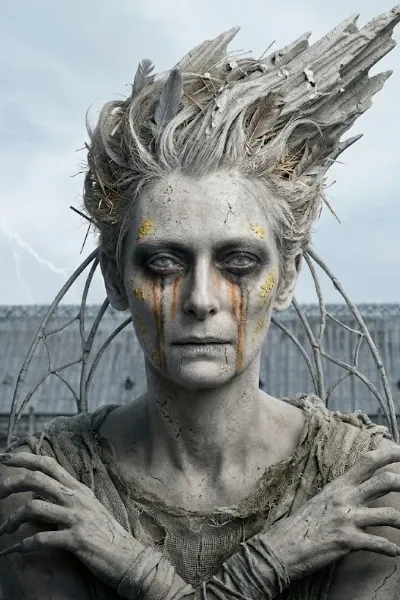
Set in the dark, disease-ridden mud of 1482 Paris, Robert Eggers and Craig Mazin’s Notre-Dame is a psychological gothic tragedy that strips away Disney’s theatricality to embrace the bleak reality of Victor Hugo’s text. Quasimodo (Griffin Santopietro) is a severely deformed 20-year-old youth kept hidden inside the unheated, echoing labyrinth of the cathedral by Archdeacon Claude Frollo (Vincent Cassel). Frollo is an aging, tyrannical judge weaponizing religious fanaticism to mask his own rotting moral core and toxic, repressed lust. Severely isolated, Quasimodo’s fracturing mind copes through vivid, terrifying hallucinations as the stone gargoyles warp into life—manifesting as the manic survival instinct Hugo (Oscar Isaac), the crushing weight of religious shame Victor (Brian Tyree Henry), and the weeping specter of maternal abandonment Laverne (Tilda Swinton).The fragile sanctuary of the church shatters when Esmeralda (Helin Kandemir), a fierce, hyper-vigilant Romani street survivor, flees into the cathedral. She finds unexpected allies in the ancient, compassionate Archdeacon (Bill Nighy) and Quasimodo himself, who experiences a radical awakening of empathy. Frollo launches a brutal, xenophobic purge of the city to claim her, deploying his heavily armored enforcers (Winston Duke and Seth Rogen) alongside the war-weary, PTSD-afflicted Captain Phoebus (Rudy Pankow). When Phoebus chooses his own rank over moral duty, it triggers a catastrophic guerrilla uprising led by Clopin (Danny Lee Wynter) from the Parisian underworld. As the slums storm the gates under a rain of molten lead, Quasimodo must physically and mentally battle his own inner stone demons to save Esmeralda from Frollo's gallows, culminating in a visceral, breathless climax atop the high towers that explores the true cost of isolation and institutional cruelty.


