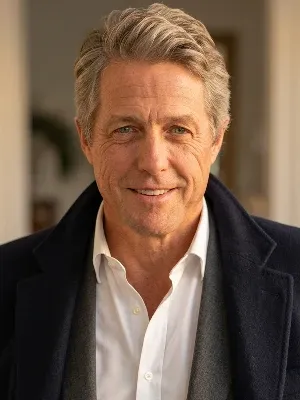
Age: 66
male
Hugh John Mungo Grant (born 9 September 1960) is an English actor and film producer. He has received a Golden Globe Award, a BAFTA, and an Honorary César. His movies have also earned more than $2.4 billion from 25 theatrical releases worldwide. Grant achieved international stardom after appearing in Richard Curtis's sleeper hit Four Weddings and a Funeral (1994). He used this breakthrough role as a frequent cinematic persona during the 1990s to deliver comic performances in mainstream films like Mickey Blue Eyes (1999) and Notting Hill (1999). By the turn of the century, he had established himself as a leading man skilled with a satirical comic talent. Since the 2000s, Grant has expanded his oeuvre with critically acclaimed turns as a cad in Bridget Jones's Diary (2001), About A Boy (2002), Love Actually (2003), and American Dreamz (2006). Within the film industry, Grant is cited as an anti-movie star who approaches his roles like a character actor, with the ability to make acting look effortless. Hallmarks of his comic skills include a nonchalant touch of irony/sarcasm and studied physical mannerisms as well as his precisely-timed dialogue delivery and facial expressions. The entertainment media's coverage of Grant's life off the big screen has often overshadowed his work as a thespian. He has been vocal about his disrespect for the profession of acting, his disdain towards the culture of celebrity, and hostility towards the media. In a career spanning 20 years, Grant has repeatedly claimed that acting is not a true calling but just a job he fell into.
Hugh Grant

Judge Robert W. Sweet
for Judge Robert W. Sweet in The Earth Goes Ape
Suggested by alanstudios
In their complaint, Universal Studios alleged that Nintendo's video game Donkey Kong was a trademark infringement of King Kong, the plot and characters of which Universal claimed as their own. Nintendo argued that Universal had themselves proven that King Kong's plot and characters were in the public domain in Universal City Studios, Inc. v. RKO General, Inc. Sweet ruled that Universal had acted in bad faith by threatening Nintendo's licensees and that it had no right over the name King Kong or the characters and story. He further held that there was no possibility for consumers to confuse Nintendo's game and characters with the King Kong films and their characters. Universal appealed the case, but the verdict was upheld. The case was a major victory for Nintendo, which was still a newcomer to the U.S. market. The case established Nintendo as a major player in the industry and arguably gave the company the confidence that it could compete with the giants of American media.


