
Age: 44
male
Brian Tyree Henry (born March 31, 1982) is an American actor. He rose to prominence for his role as rapper Alfred "Paper Boi" Miles in the FX comedy-drama series Atlanta (2016–2022), for which he received a nomination for the Primetime Emmy Award for Outstanding Supporting Actor in a Comedy Series. Henry had a guest role in This Is Us in 2017 and had his film breakthrough in 2018 with roles in Steve McQueen's heist film Widows and Barry Jenkins' romantic drama If Beale Street Could Talk. He has since appeared in Child's Play (2019), Joker (2019), Godzilla vs. Kong (2021), Bullet Train (2022), and Godzilla x Kong: The New Empire (2024). He portrayed Phastos in the Marvel Cinematic Universe film Eternals (2021). He was nominated for the Academy Award for Best Supporting Actor for playing a grieving man in the drama film Causeway (2022). He also voiced Jefferson Davis in Spider-Man: Into the Spider-Verse (2018) and its sequel, Spider-Man: Across the Spider-Verse (2023) and Megatron in Transformers One (2024). Henry has also appeared on stage, making his debut performance in the Shakespeare in the Park production of Romeo and Juliet (2007) and acting in various plays at the Public Theatre before appearing in the original Broadway cast of The Book of Mormon (2011). In 2014, he appeared in the off-Broadway musical The Fortress of Solitude. For his performance in the 2018 Broadway revival of Kenneth Lonergan's play Lobby Hero, he received a nomination for the Tony Award for Best Featured Actor in a Play. Description above from the Wikipedia article Brian Tyree Henry, licensed under CC-BY-SA, full list of contributors on Wikipedia.
Brian Tyree Henry

Thoth
for Thoth in The Duat: Where Every Story Ends and Begins
Suggested by mr95
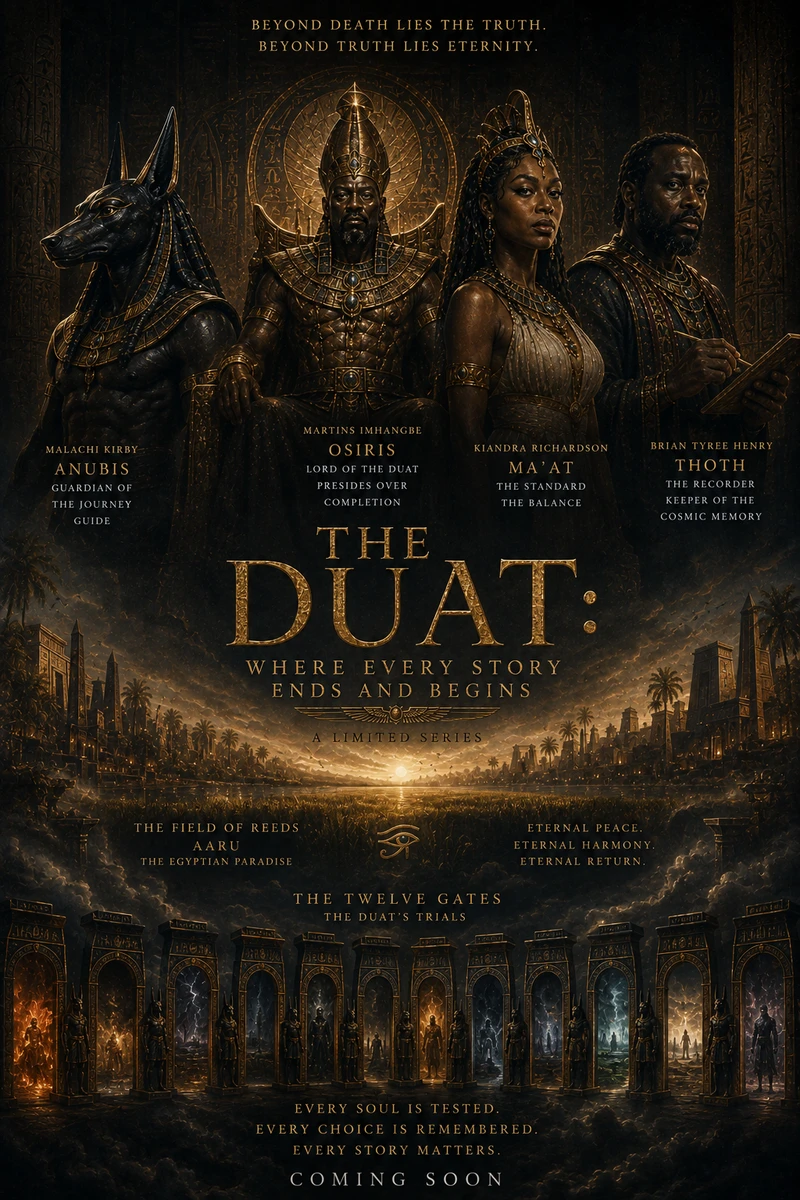
The Nile Chronicles culminates in the Duat itself — the Egyptian afterlife, shown in its full mythological complexity. Not a simple heaven or hell but a twelve-hour journey (mirroring Ra's night passage) through different realms, each with its own trials and guardians, culminating in the Hall of Two Truths where Anubis weighs the heart. The series functions as a final gathering of all the major divine beings who have appeared across the universe, seen from the perspective of the Duat they ultimately govern. Structured as twelve episodes representing the twelve hours of the Duat, each hour showing a different aspect of the afterlife: the Field of Reeds (Aaru) in its full beauty, the trials of the deceased, the gates guarded by specific divine beings, and the final judgment. The series' most important argument is the most Egyptian: death is not an ending but a transformation. The deceased become the Akh — the glorified spirit — who joins Ra's barque and participates in the cosmic order. The Duat is not a sentence. It is a completion.

