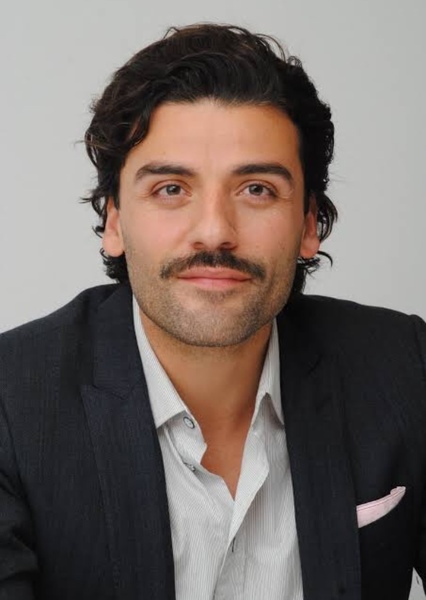
Age: 47
male
Óscar Isaac Hernández Estrada (born March 9, 1979) is an American actor. He was named the best actor of his generation by Vanity Fair in 2017 and one of the 25 greatest actors of the 21st century by The New York Times in 2020. His accolades include a Golden Globe Award and a nomination for a Primetime Emmy Award. In 2016, he featured on Time's list of the 100 most influential people in the world. Born in Guatemala, Isaac moved with his family to the United States as an infant. As a teenager, he joined a punk band, acted in plays and made his film debut in a minor role. A graduate of the Juilliard School, Isaac was a character actor in films for much of the 2000s. His first major role was that of Joseph in the biblical drama The Nativity Story (2006), and he won an AACTA Award for Best Actor in a Supporting Role for portraying political leader José Ramos-Horta in the Australian film Balibo (2009). After gaining recognition for playing supporting parts in Robin Hood (2010) and Drive (2011), Isaac had his breakthrough with the eponymous role of a singer in the musical drama Inside Llewyn Davis (2013), which earned him a Golden Globe nomination. Isaac's career progressed with leading roles in the crime drama A Most Violent Year (2014), the thriller Ex Machina (2015) and the superhero film X-Men: Apocalypse (2016). He became a global star with the role of Poe Dameron in the Star Wars sequel trilogy (2015–2019). Isaac starred in the historical drama Operation Finale (2018)—which marked his first venture into production—the science fiction films Annihilation (2018), Dune (2021), and Frankenstein (2025), the crime drama The Card Counter (2021), and the animated superhero film Spider-Man: Across the Spider-Verse (2023). On television, Isaac was the lead in three miniseries: Show Me a Hero (2015), in which his portrayal of Nick Wasicsko won him a Golden Globe Award, Scenes from a Marriage (2021), and the Marvel Cinematic Universe's Moon Knight (2022). His stage work includes title roles in Romeo and Juliet (2007), Hamlet (2017) and The Sign in Sidney Brustein's Window (2023). Description above from the Wikipedia article Oscar Isaac, licensed under CC-BY-SA, full list of contributors on Wikipedia.
Oscar Isaac

Henry Anthony Wilcox
for Henry Anthony Wilcox in The Call of Cthulhu
Suggested by charlesp

The narrator, Francis Wayland Thurston, recounts his discovery of notes left behind by his grand-uncle, Brown University linguistic professor George Gammell Angell, after his death in the winter of 1926–27. Among the notes is a small bas-relief sculpture of a scaly creature which yields "simultaneous pictures of an octopus, a dragon, and a human caricature." The sculptor, a Rhode Island art student named Henry Anthony Wilcox, based the work on delirious dreams of "great Cyclopean cities of titan blocks and sky-flung monoliths." Frequent references to Cthulhu and R'lyeh are found in Wilcox's papers. Angell also discovers reports of mass hysteria around the world. More notes discuss a 1908 meeting of an archeological society in which New Orleans police official John Raymond Legrasse asks attendees to identify a statuette of unidentifiable greenish-black stone resembling Wilcox's sculpture. It is then revealed that the previous year, Legrasse and a party of policemen found several women and children being used in a ritual by an all-male cult. After killing five of the cultists and arresting 47 others, Legrasse learns that they worship the "Great Old Ones" and await the return of a monstrous being called Cthulhu.[2] The prisoners identify the statuette as "great Cthulhu." One of the academics present at the meeting, Princeton professor William Channing Webb, describes a group of "Esquimaux" with similar beliefs and fetishes. Thurston discovers a 1925 article from an Australian newspaper which reports the discovery of a derelict ship, the Emma, of which second mate Gustaf Johansen is the sole survivor. Johansen reports that the Emma was attacked by a heavily armed yacht named the Alert. The crewmen of the Emma killed those aboard the Alert, but lost their own ship in the battle, commandeered the Alert, and discovered an uncharted island in the vicinity of co-ordinates of 47°9′S 126°43′W. With the exception of Johansen and another man, the remaining crew died on the island. Johansen does not reveal the manner of their death. Upon traveling to Australia, Thurston views a statue retrieved from the Alert which is identical to the previous two. In Norway, he learns that Johansen died suddenly after an encounter with "two Lascar sailors". Johansen's widow provides Thurston with her late husband's manuscript, wherein the uncharted island is described as being home to a "nightmare corpse-city" called R'lyeh. Johansen's crew struggled to comprehend the non-Euclidean geometry of the city and accidentally release Cthulhu, resulting in their deaths. Johansen and one crew-mate flee aboard the Alert and are pursued by Cthulhu. Johansen rams the yacht into the creature's head, only for its injury to regenerate. The Alert escapes, but Johansen's crewmate dies. After finishing the manuscript, Thurston realizes he is now a target of Cthulhu's worshippers.
See polls and matchups connected to Oscar Isaac's casting for Henry Anthony Wilcox.