
Died at 101
male
Harold Rowe Holbrook Jr. (February 17, 1925 – January 23, 2021) was an American actor, television director, and writer. He first received critical acclaim in 1954 for a one-man stage show he developed, Mark Twain Tonight!, performing as Mark Twain, while studying at Denison University. He won the Tony Award for Best Actor in a Play in 1966 for his portrayal of Twain. He would continue to perform his signature role for over 60 years, only retiring the show in 2017 due to his failing health. Throughout his career, he also won five Primetime Emmy Awards for his work on television and was nominated for an Academy Award for his work in film. Holbrook made his film debut in Sidney Lumet's The Group (1966). He later gained international fame for his performance as Deep Throat in the 1976 film All the President's Men. He played Abraham Lincoln in the 1976 miniseries Lincoln and 1985 miniseries North and South. He also appeared in such films as Julia (1977), The Fog (1980), Creepshow (1982), Wall Street (1987), The Firm (1993), Hercules (1997), and Men of Honor (2000). Holbrook's role as Ron Franz in Sean Penn's Into the Wild (2007) earned him both Academy Award and Screen Actors Guild Award nominations for Best Supporting Actor. In 2009, Holbrook received critical acclaim for his performance as recently retired farmer Abner Meecham in the independent film That Evening Sun. He also portrayed Francis Preston Blair in Steven Spielberg's Lincoln (2012). In 2003, Holbrook was honored with the National Humanities Medal by President George W. Bush. Description above from the Wikipedia article Hal Holbrook, licensed under CC-BY-SA, full list of contributors on Wikipedia.
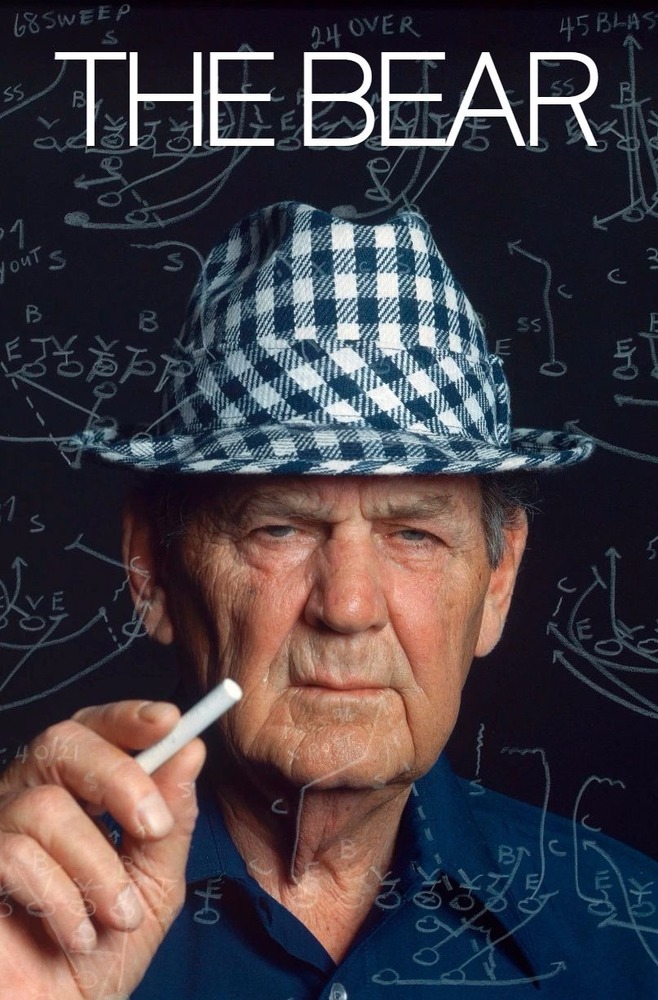
A biopic about Paul "Bear" Bryant. At the close of the 1957 football season, having compiled an overall 25–14–2 record at Texas A&M, Bryant returned to Tuscaloosa to take the head coaching position, succeeding J.B. "Ears" Whitworth, as well as the athletic director job at Alabama. When asked why he came to Alabama, he replied "Momma called. And when Momma calls, you just have to come runnin'." The next year, in 1959, Alabama beat Auburn and appeared in a bowl game, the first time either had happened in the last six years. In 1961, under his leadership, with quarterback Pat Trammell and football greats Lee Roy Jordan and Billy Neighbors, Alabama went 11–0 and defeated Arkansas 10-3 in the Sugar Bowl to claim the national championship. The next three years (1962–64) featured Joe Namath at quarterback and were among Bryant's finest. In his later years, Bryant was able to recruit Wilbur Jackson as Alabama's first black scholarship player, and junior-college transfer John Mitchell became the first black man to play for Alabama. By 1973, one-third of the team's starters were black. Bryant coached at Alabama for 25 years, winning six national titles (1961, 1964, 1965, 1973, 1978, and 1979) and thirteen SEC championships. Bryant's win over in-state rival Auburn University, coached by former Bryant assistant Pat Dye on November 28, 1981 was Bryant's 315th as a head coach, which was the most of any head coach at that time. Bryant was a heavy smoker and drinker, and his health began to decline in the late 1970s. Bryant decided to retire at the seasons end. After the 1982 season, Bryant was asked what he planned to do now that he was retired. He replied "Probably croak in a week." His reply proved eerily prophetic. Four weeks after making that comment, and just one day after passing a routine medical checkup, on January 25, 1983, Bryant checked into Druid City Hospital nd passed away.


