
Age: 49
male
Orlando Jonathan Blanchard Copeland Bloom (born 13 January 1977) is an English actor. He made his breakthrough as the character Legolas in The Lord of the Rings film series (2001–03). He reprised his role in The Hobbit film series (2013–14). Considered by some to be the Errol Flynn of his time, he gained further notice appearing in epic fantasy, historical, and adventure films, notably as Will Turner in the Pirates of the Caribbean film series(2003–07, 2017), Paris in Troy (2004), Balian de Ibelin in the Kingdom of Heaven (2005), and the Duke of Buckingham in The Three Musketeers(2011). Bloom appeared in Hollywood films such as the war film Black Hawk Down (2001), the Australian Western Ned Kelly (2003), the romantic comedy Elizabethtown (2005), and New York, I Love You(2007). In 2020, he gained acclaim for the Afghanistan War drama film The Outpost (2020). He also starred in the Amazon Prime Video series Carnival Row (2019–2023). He debuted professionally in In Celebration at the Duke of York's Theatre in the West End in 2007. He starred in an adaptation of William Shakespeare's Romeo and Juliet in 2013. He returned to the theatre in a West End revival of Tracy Letts' Killer Joe in 2018. In 2009, Bloom was named a UNICEF Goodwill Ambassador. In 2015, he received the BAFTA Britannia Humanitarian Award.
Orlando Bloom

Layman Pallet
for Layman Pallet in The Adventures of Peregrine Pickle
Suggested by Jeshisthename
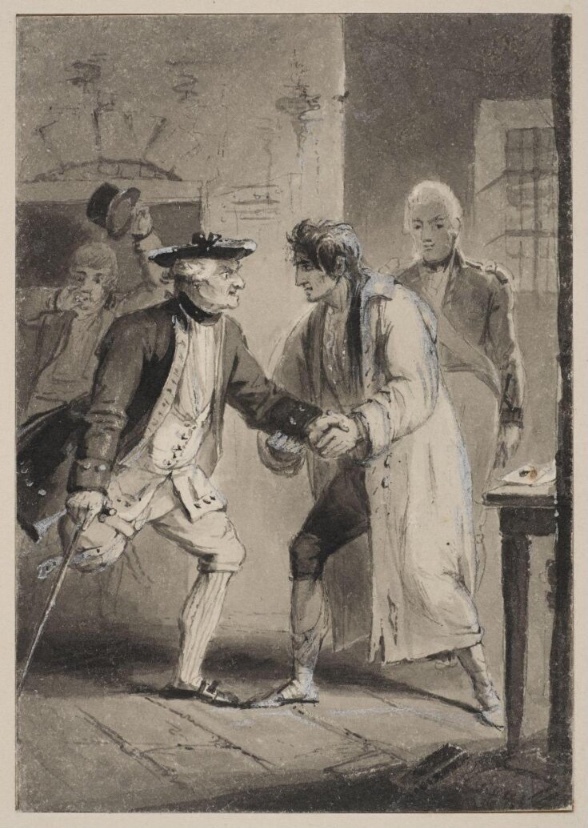
This picaresque tale, first published in 1751, was Tobias Smollett’s second novel. Following the fortunes and misfortunes of the egotistical dandy Peregrine Pickle, the novel is written as a series of brief adventures with every chapter typically describing a new escapade. The novel begins with Peregrine as a young country gentleman. His mother rejects him, as do his aloof father and his dissolute, spiteful brother. Commodore Hawser Trunnion takes Peregrine under his care and raises him. Peregrine’s upbringing, education at Oxford, and journey to France, his debauchery, bankruptcy, jailing, and succession to his father’s fortune, and his final repentance and marriage to his beloved Emilia all provide scope for Smollett’s comic and caustic perspectiveon the Europe of his times. As John P. Zomchick and George S. Rousseau note in the introduction, “by contrasting the genteel and the common, the sophisticated and the primal, Smollett conveys forcefully the way it felt to be alive in the middle of the eighteenth century.”


