Age: 39
female
Cynthia Chinasaokwu Onyedinmanasu Amarachukwu Owezuke Echimino Erivo MBE(/əˈriːvoʊ/ ə-REE-voh; born 8 January 1987) is an British-American actress, singer, musician, and songwriter. Known for her work on both stage and screen, she is the recipient of several accolades and one of the few individuals nominated for an Emmy, a Grammy, an Oscar, and a Tony Award (EGOT), winning all but the Oscar. Erivo made her West End debut in the stage musical The Umbrellas of Cherbourg (2011), and her Broadway debut as Celie in the musical revival of The Color Purple (2015–2017). Erivo's work for The Color Purple won her the Tony Award for Best Actress in a Musical and Grammy Award for Best Musical Theater Album, as well as a Daytime Emmy Award. She expanded to films in 2018 with the crime thrillers Widows and Bad Times at the El Royale. Erivo earned nominations for the Academy Award for Best Actress for portraying Harriet Tubman in Harriet (2019) and Elphaba in Wicked (2024), as well as a nomination for Best Original Song for the song "Stand Up" from the former. For reprising her role as Elphaba in Wicked: For Good (2025), she became the first black actress to be nominated twice for Best Actress in a Motion Picture – Musical or Comedy at the Golden Globe Awards. On television, Erivo portrayed Holly Gibney in the HBO crime drama miniseries The Outsider (2020) and Aretha Franklin in National Geographic's anthology series Genius: Aretha (2021); the latter earned her a nomination for the Primetime Emmy Award for Outstanding Lead Actress in a Limited or Anthology Series or Movie. As a singer, she has released singles and two solo albums in 2021 and 2025. Description above from the Wikipedia article Cynthia Erivo, licensed under CC-BY-SA, full list of contributors on Wikipedia.
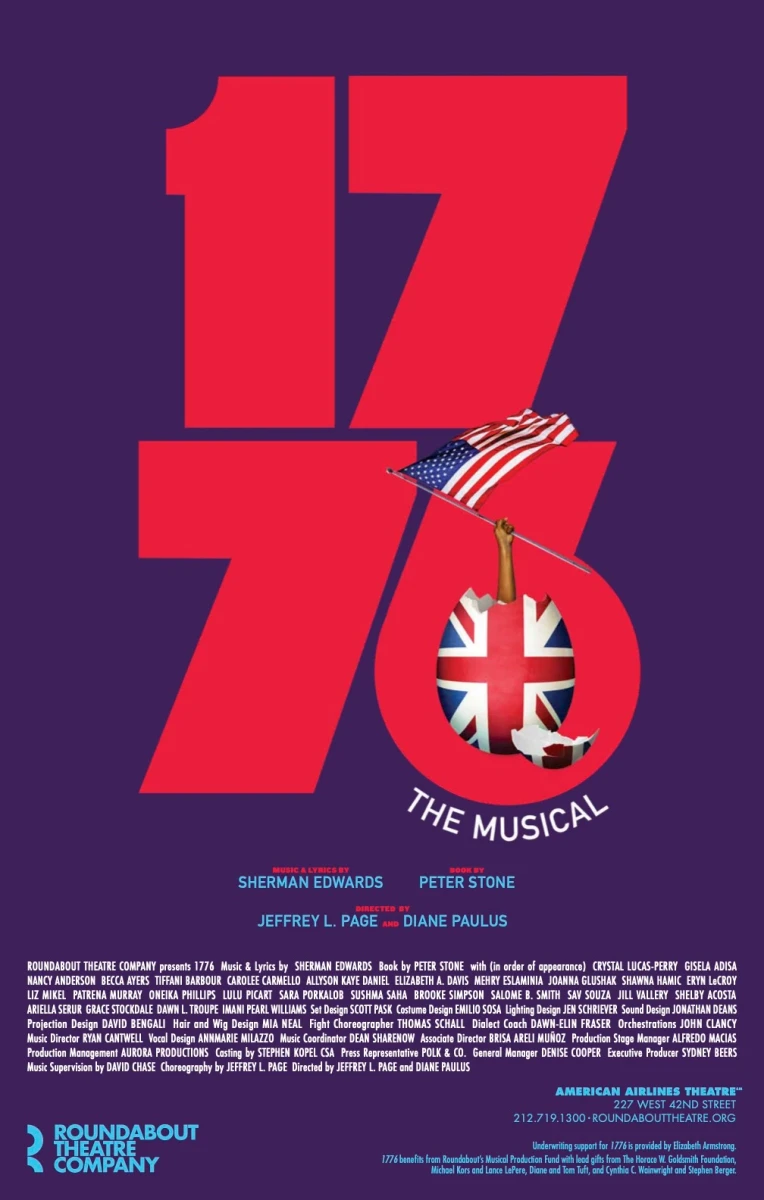
During the Second Continental Congress, currently underway in Philadelphia, the motion to declare the colonies' independence from Great Britain, introduced by John Adams, a delegate from Massachusetts, is not debated, preferring to address more trivial matters. Benjamin Franklin, a delegate from Pennsylvania, strategically suggests that he have another delegate propose the resolution. The choice falls on the impetuous and extroverted Richard Henry Lee, who accepts and returns to Virginia to obtain authorization from the state legislature. Having overcome the first hurdle, Lee's new motion faces objections from John Dickinson, a delegate from Pennsylvania and leader of the conservative faction inclined to reconciliation with Great Britain, who manages to obtain a unanimous quorum given the importance of the independence motion. Adams, to gain time to seek greater consensus, requests a postponement for the drafting of a declaration of injustice, entrusted to a committee of five delegates, but in reality the drafting is entrusted almost entirely to Thomas Jefferson, delegate from Virginia.