
Died at 86
male
Eric Hilliard Nelson (May 8, 1940 – December 31, 1985), better known as Ricky Nelson or Rick Nelson, was an American singer-songwriter, instrumentalist, and actor. He placed fifty-three songs on the Billboard Hot 100 between 1957 and 1973, including nineteen top-ten hits, and was inducted into the Rock and Roll Hall of Fame on January 21, 1987. Nelson began his entertainment career in 1949 playing himself in the radio sitcom series, The Adventures of Ozzie and Harriet, and, in 1952, appeared in his first feature film, Here Come the Nelsons. In 1957, he recorded his first single, debuted as a singer on the television version of the sitcom, and recorded a number one album, Ricky. In 1958, Nelson recorded his first number one single, "Poor Little Fool", and, in 1959, received a Golden Globe Most Promising Male Newcomer nomination after starring in the western film, Rio Bravo. A few films followed, and, when the television series was cancelled in 1966, Nelson made occasional appearances as a guest star on various television programs. Nelson and Sharon Kristin Harmon were married on April 20, 1963, and divorced in December 1982. They had four children: Tracy Kristine, twin sons Gunnar Eric and Matthew Gray, and Sam Hilliard. On February 14, 1981, a son was born to Nelson and Georgeann Crewe. A blood test in 1985 confirmed Nelson was the child's father. Nelson was engaged to Helen Blair at the time of his death in an airplane crash on December 31, 1985.
Ricky Nelson

Ensign Xon
for Ensign Xon in Star Trek: The Original Series (What If)
Suggested by ltathena
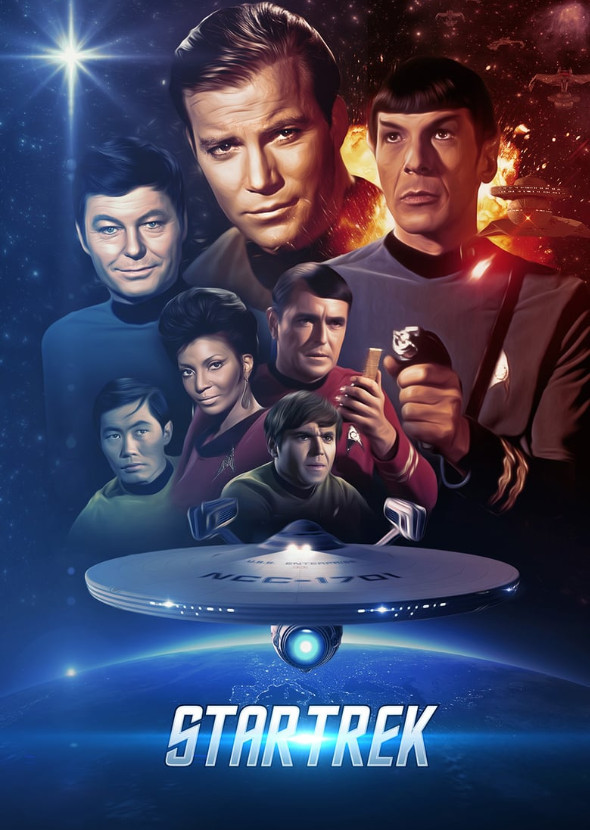
"Space: the final frontier. These are the voyages of the starship Enterprise. Her continuing mission: to explore strange new worlds. To seek out new life and new civilizations. To boldly go where no one has gone before!" With these words, television history was made. But what if time travelers from the future went back and financed the series at $5,000,000.00 budgets per episode (in 1966 money) for a full agreed-upon five years/seasons of 26 hourlong adventures over a great mission? With the $5 Million per episode spent on a large ensemble cast and pushing the boundaries of the then-new fields of visual/photographic effects, another $5 Million per episode would be used for insurance and convincing NBC affiliates to air the programs as is from fall 1966 to spring 1972 to document a sex/race/species-positive future vision of the crew of the starship Enterprise. If the merchandising and other problems were tackled out of the gate, what would happen to the show?

