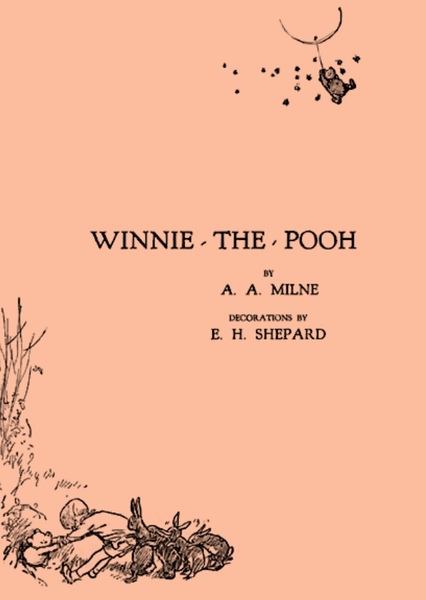
Winnie-the-Pooh is a 1926 children's book by English author A. A. Milne and English illustrator E. H. Shepard. The book is set in the fictional Hundred Acre Wood, with a collection of short stories following the adventures of an anthropomorphic teddy bear, Winnie-the-Pooh, and his friends Christopher Robin, Piglet, Eeyore, Owl, Rabbit, Kanga, and Roo. It is the first of two story collections by Milne about Winnie-the-Pooh, the second being The House at Pooh Corner (1928). Milne and Shepard collaborated previously for English humour magazine Punch, and in 1924 created When We Were Very Young, a poetry collection. Among the characters in the poetry book was a teddy bear Shepard modelled after his son's toy. Following this, Shepard encouraged Milne to write about his son Christopher Robin Milne's toys, and so they became the inspiration for the characters in Winnie-the-Pooh. The book was published on 14 October 1926, and was both well-received by critics and a commercial success, selling 150,000 copies before the end of the year. Critical analysis of the book has held that it represents a rural Arcadia, separated from real-world issues or problems, and is without purposeful subtext. More recently, criticism has been levelled at the lack of positive female characters (i.e. that the only female character, Kanga, is depicted as a bad mother). Winnie-the-Pooh has been translated into over fifty languages; a 1958 Latin translation, Winnie ille Pu, was the first foreign-language book to be featured on the New York Times Best Seller List, and the only book in Latin ever to have been featured. The stories and characters in the book have been adapted in other media, most notably into a franchise by The Walt Disney Company, beginning with Winnie the Pooh and the Honey Tree, released on 4 February 1966 as a double feature with The Ugly Dachshund. It remains protected under copyright in other countries, including the UK.
Winnie the Pooh (Book)
House on Goodwill
for House on Goodwill in Spiritual Successor
Suggested by toonking1985
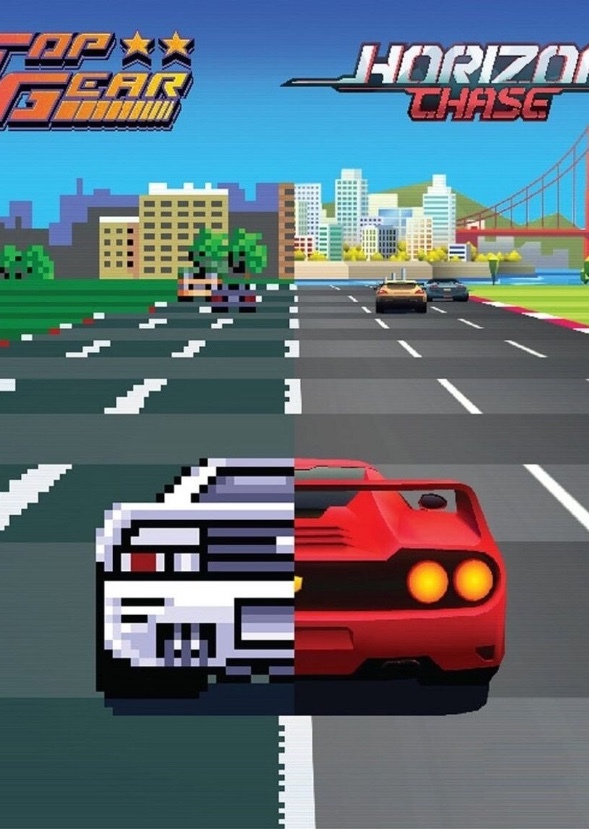
A spiritual successor is a type of follow-up work that isn’t directly connected to the original story or universe, but still carries forward its essence through similar themes, style, and ideas—essentially acting as a sequel “in spirit.” Creators may do this for many reasons: to pay homage while avoiding legal ties, to continue exploring familiar creative ground without risking a direct sequel, or simply because their artistic voice naturally echoes past work. This concept appears across many forms of media, though it’s especially common in video games, where developers may retain the tools and design philosophy of a past project even if they no longer hold the rights to its name or characters. A related concept is the spiritual adaptation, where a work in one medium closely mirrors the tone and structure of another, almost feeling like an unofficial adaptation. Spiritual successors can sometimes feel like rebranded continuations of ideas from older or discontinued franchises, effectively serving as a kind of creative reincarnation. They often overlap with ideas like unofficial counterparts or heavily inspired works, and can even share the same creative teams. While they celebrate and evolve what came before, they stand apart as independent creations, occasionally even contrasting with or redefining the works that inspired them.




