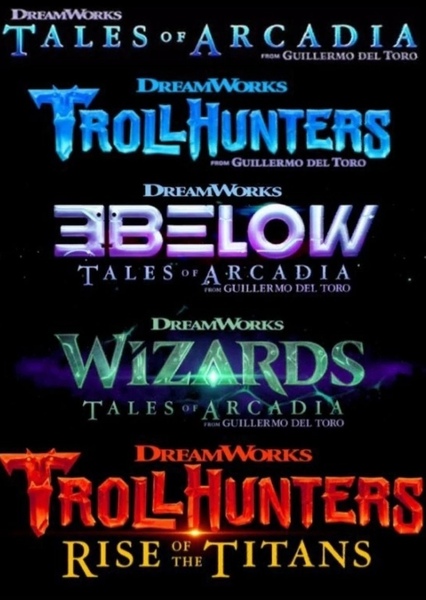
Tales of Arcadia is a trilogy of animated science fantasy television series created for Netflix by Guillermo del Toro and produced by DreamWorks Animation and Double Dare You.[2] The series comprising the trilogy follows the inhabitants of the small suburban town of Arcadia Oaks, which is secretly home to various supernatural creatures and the young heroes who fight against the forces of evil that lurk in the shadows. The three installments of the trilogy are: Trollhunters, 3Below, and Wizards, with the feature film Rise of the Titans, added as a capstone; all have been released worldwide.[3][4][5][6] Since its release, the franchise has been widely praised as an ambitious and boundary-pushing animated series, with Filmink's Travis Johnson calling it "the best children's animation to come along since Avatar: The Last Airbender."[7] Trollhunters was nominated for nine Daytime Emmy Awards in 2017, winning more than any other animated or live-action television program that year,[8] and the trilogy has been twice nominated for the Emmy for Outstanding Children's Animated Series. It has also received or been nominated for a BAFTA Award, several Annie Awards, Golden Reel Awards, a Saturn Award, and twice won the Kidscreen Award of "Best New Series" for the first and final chapters, Trollhunters and Wizards. The franchise has been critically acclaimed for its high-quality CGI animation, its dark emotional and mature tone and complex writing, voice acting, representation of Latin Americans and immigrants, themes of prejudice, music, humor, and characters. The show has also spawned several original children's books and has been adapted into a series of graphic novels by Marc Guggenheim and Richard Hamilton released by Dark Horse, and a video game titled Trollhunters: Defenders of Arcadia, released on PlayStation 4, Xbox One, Nintendo Switch and Microsoft Windows.[9][10][11] In August 2020, it was announced the trilogy would be concluded with a full-length feature film titled Trollhunters: Rise of the Titans, which was released to Netflix on July 21, 2021.[12][13]
Tales of Arcadia

Avatar: The Last Airbender
for Avatar: The Last Airbender in Spiritual Successor
Suggested by toonking1985
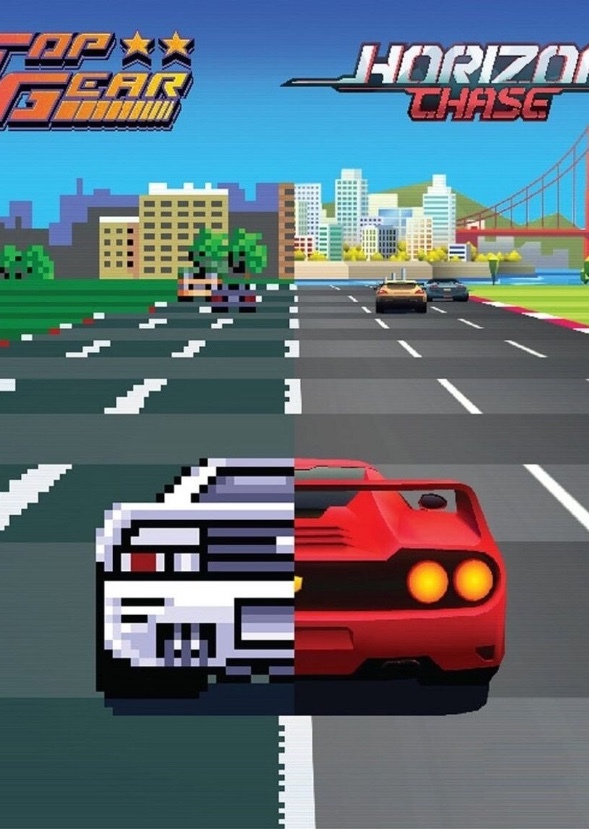
A spiritual successor is a type of follow-up work that isn’t directly connected to the original story or universe, but still carries forward its essence through similar themes, style, and ideas—essentially acting as a sequel “in spirit.” Creators may do this for many reasons: to pay homage while avoiding legal ties, to continue exploring familiar creative ground without risking a direct sequel, or simply because their artistic voice naturally echoes past work. This concept appears across many forms of media, though it’s especially common in video games, where developers may retain the tools and design philosophy of a past project even if they no longer hold the rights to its name or characters. A related concept is the spiritual adaptation, where a work in one medium closely mirrors the tone and structure of another, almost feeling like an unofficial adaptation. Spiritual successors can sometimes feel like rebranded continuations of ideas from older or discontinued franchises, effectively serving as a kind of creative reincarnation. They often overlap with ideas like unofficial counterparts or heavily inspired works, and can even share the same creative teams. While they celebrate and evolve what came before, they stand apart as independent creations, occasionally even contrasting with or redefining the works that inspired them.




