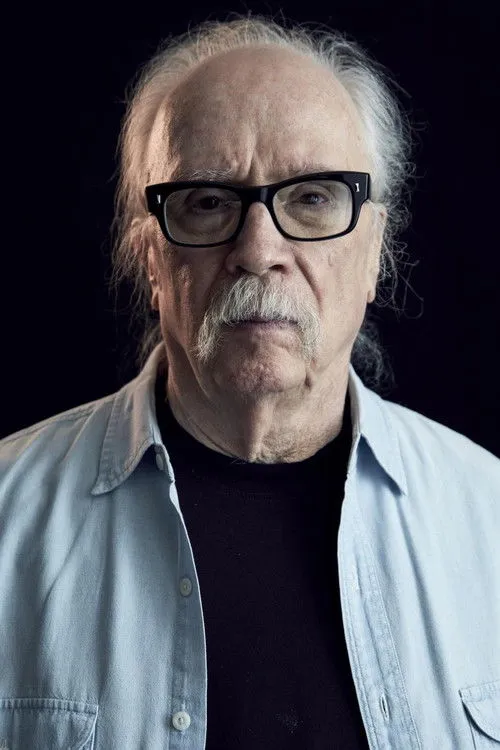
Age: 78
male
An American film director, screenwriter, producer, editor, composer, and occasional actor. Although Carpenter has worked in numerous film genres in his four-decade career, his name is most commonly associated with horror and science fiction. Most films in Carpenter's career were initially commercial and critical failures, with the notable exceptions of Halloween (1978), The Fog (1980), Escape from New York (1981), and Starman (1984). However, many of Carpenter's films from the 1970s and the 1980s have come to be viewed as cult classics, and he has been acknowledged as an influential filmmaker. Cult classics that Carpenter directed include: Dark Star (1974), Assault on Precinct 13 (1976), The Thing (1982), Christine (1983), Big Trouble in Little China (1986), Prince of Darkness (1987), They Live (1988) and In the Mouth of Madness (1995). His films are characterized by minimalist lighting and photography, static cameras, use of steadicam, and distinctive synthesized scores. Carpenter is also notable for having composed or co-composed most of the music of his films; some of them are now considered cult as well, with the main theme of Halloween being considered a part of popular culture. His music is generally synthesized with accompaniment from piano and atmospherics. He released his first studio album Lost Themes in 2015, and also won a Saturn Award for Best Music for Vampires (1998). Carpenter is an outspoken proponent of widescreen filming, and all of his theatrical movies (with the exception of Dark Star and The Ward) were filmed anamorphic with a 2.35:1 or greater aspect ratio. The Ward was shot in Super 35, the first time Carpenter has ever used that system. Carpenter has stated he feels that the 35mm Panavision anamorphic format is "the best movie system there is", preferring it over both digital and 3D film. Many of Carpenter's films have been re-released on DVD as special editions with numerous bonus features. Carpenter has been the subject of the documentary film John Carpenter: The Man and His Movies, and American Cinematheque's 2002 retrospective of his films. Moreover, in 2006, the United States Library of Congress deemed Halloween to be "culturally significant" and selected it for preservation in the National Film Registry. In 2010, writer and actor Mark Gatiss interviewed Carpenter about his career and films for his BBC documentary series A History of Horror. Carpenter appears in all three episodes of the series. He was also interviewed by Robert Rodriguez for his The Director's Chair series on El Rey Network. Many filmmakers have been influenced by Carpenter, including James Cameron, Quentin Tarantino (The Hateful Eight was heavily influenced by The Thing), Guillermo del Toro, Robert Rodriguez, Edgar Wright, Danny Boyle, Nicolas Winding Refn, Bong Joon-ho, among others. The video game Dead Space 3 is said to be influenced by Carpenter's The Thing, The Fog and Halloween, and Carpenter has stated that he would be enthusiastic to adapt that series into a feature film.

A television series that follows the events of a young Michael Myers at Smith's Grove Sanitarium between 1963 and 1977. A young Michael Myers was taken to Smith's Grove after the brutal murder of his older sister Judith. Just after he turned seven, he met child psychologist Doctor Sam Loomis. Myers would soon become the driving force behind Loomis' career. The child was a blank, emotionless slate to Loomis, never speaking, barely even moving. Sam recognized the deep-rooted trauma in the boy's psyche and knew that special treatment would be required if he were to ever help him. After spending eight years trying to reach him, he now committed himself towards making sure that Michael Myers never saw the light of day ever again. Acting as Michael's gatekeeper became an obsession with Loomis. He no longer regarded him as a human being, but as a monster and devil, the living epitome of pure evil. Loomis petitioned his superior, Doctor Carpenter to have Michael moved to a private room, but Carpenter declined the request and insisted that Myers remained inside the open juvenile ward. Over the following year, Loomis paid close attention to Michael, but grew concerned when certain incidents began taking place. One such incident involved an injury relating to an older patient named Tony O'Malley. Tony suffered many of the same derangements as Myers, but unlike Michael, was prone to violent outbursts and displays of emotion. After witnesses recounted seeing O'Malley bullying the smaller Myers, he was soon discovered with a crayon lodged inside his brain. Nobody suspected that the virtually comatose Michael Myers could be capable of such an attack, but Loomis began to suspect otherwise. Another such incident took place in November of that year when a patient named Adrian Wade ate an entire birthday cake that was intended for Michael. He was later found in the shower room with 2nd degree burns all over his body. He died in the medical wing a short time later. Another boy, Roger, bit off his own tongue and choked to death. There was no obvious evidence linking Myers to these three deaths. Over the span of the next several years, Loomis continued to treat Michael. He never gave up hope that he might be able to pull something out of the boy's withdrawn psyche. Loomis also became close with a colleague named Doctor Jennifer Hill. Hill shared many traits with Loomis; she was politically liberal and held the same views as he concerning psychotherapy -- that "insanity was possibly the reaction of a sane mind to a sick society". The two eventually fell in love and were engaged to be married. In 1971, Doctor Carpenter suggested having a Halloween party in the juvenile ward. Doctor Loomis was vehemently opposed to this idea given the significance of this particular date in relation to Myers. Again, Carpenter dismissed Loomis' concerns and the party went underway. A faulty generator knocked out the electricity during the party and when the power resumed, the staff discovered a girl named Nancy had apparently slipped, hit her head and drowned while bobbing for apples. Loomis noted the irony of the fact that she was seen teasing Michael only shortly before hand. That same evening, Michael killed Doctor Jennifer Hill. Sam found her body lying on the ground outside the hospital. It appeared as if she had fallen from the roof of the building and her death was written off as a suicide. This proved to be the breaking point for Doctor Loomis.


