
Died at 82
male
Roger Rees (May 5, 1944 – July 10, 2015) was a Welsh-American actor and director. Born in Aberystwyth, Wales, he grew up in south London where his father worked as a police officer. He attended Camberwell College of Arts and the Slade School of Fine Art, initially training as a painter before transitioning to theater work. He painted scenery at the Wimbledon Theater in south London before becoming an actor there in 1965. Rees became widely recognized for his stage work, particularly his starring role in the Royal Shakespeare Company's adaptation of Charles Dickens' "Nicholas Nickleby," which brought him both an Olivier Award and a Tony Award. He also received Obie Awards for his role in The End of the Day and as co-director of Peter and the Starcatcher. On television, he joined the hit TV comedy "Cheers" for the 1989-90 season as Kirstie Alley's suitor, the single-minded international financier and corporate raider Robin Colcord, and appeared in various other productions including the sci-fi series "M.A.N.T.I.S." He became an American citizen in 1989 and was married to theatre collaborator Rick Elice since 2011. Roger was subsequently diagnosed with cancer and while performing on Broadway in the musical "The Visit" starring Chita Rivera, he was forced to quit the show in late May 2015. The 71-year-old actor died on July 10, 2015, leaving behind a distinguished legacy.
Roger Rees

Professor James Moriarty
for Professor James Moriarty in Sherlock Holmes in the 22nd Century
Suggested by notgiving
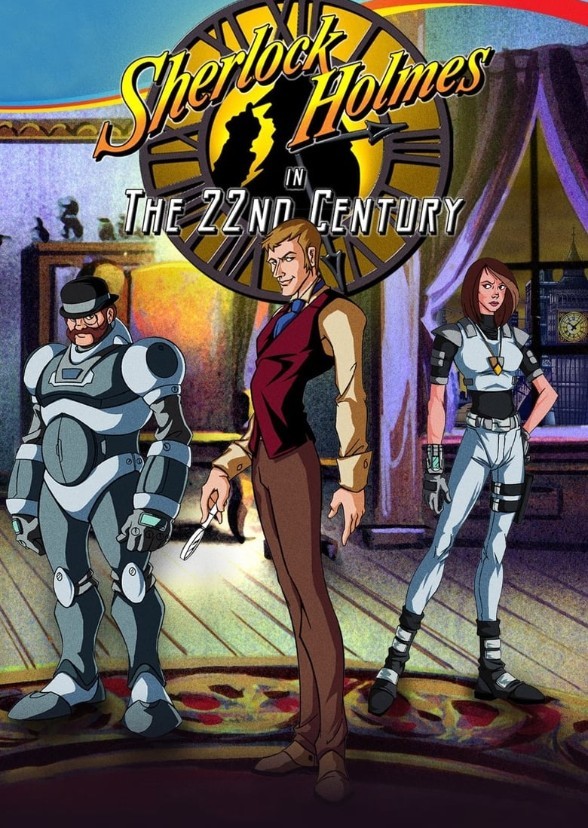
Set in the 22nd century in New London, Inspector Beth Lestrade of New Scotland Yard is chasing the grotesquely deformed French rogue geneticist Martin Fenwick, when she realizes that his companion is none other than the 19th century criminal mastermind, Professor James Moriarty. They go on to discover that this is not the original Moriarty, but is in fact a clone created from cells taken from his corpse, which Sherlock Holmes had buried in a Swiss ice cave. Lestrade knows that Holmes survived and actually lived to a ripe old age and further knows that his corpse is preserved in a glass-walled, honey-filled coffin in the basement of New Scotland Yard. She takes the body from the basement and delivers it to biologist Sir Evan Hargreaves (who looks just like Sir Arthur Conan Doyle) who has just invented a process of cellular rejuvenation. The biologist then uses his cellular rejuvenation technique to return life and youth to Holmes's body so that the detective can again battle Moriarty. Holmes also returns to his Baker Street rooms, which had been preserved as a museum. Lestrade's compudroid reads the original Watson's journals and assumes his name, face, voice and mannerisms in order to assist Holmes in both his crime-solving duties and his difficult assimilation to Great Britain in the 22nd century. (wikipedia)




