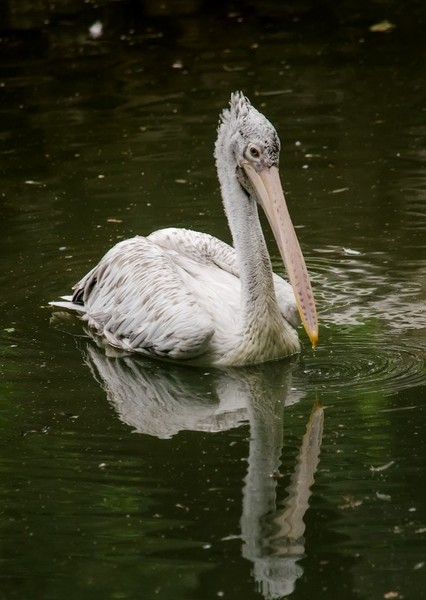
Pelicans are a genus of large water birds that make up the family Pelecanidae. They are characterized by a long beak and a large throat pouch used for catching prey and draining water from the scooped-up contents before swallowing. They have predominantly pale plumage, except for the brown and Peruvian pelicans. The bills, pouches, and bare facial skin of all pelicans become brightly coloured before the breeding season. The eight living pelican species have a patchy global distribution, ranging latitudinally from the tropics to the temperate zone, though they are absent from interior South America and from polar regions and the open ocean. Long thought to be related to frigatebirds, cormorants, tropicbirds, and gannets and boobies, pelicans instead are now known to be most closely related to the shoebill and hamerkop, and are placed in the order Pelecaniformes. Ibises, spoonbills, herons, and bitterns have been classified in the same order. Fossil evidence of pelicans dates back at least 30 million years to the remains of a beak very similar to that of modern species recovered from Oligocene strata in France.[1] They are thought to have evolved in the Old World and spread into the Americas; this is reflected in the relationships within the genus as the eight species divide into Old World and New World lineages.[2] Pelicans at National Zoo, Bangladesh Pelicans frequent inland and coastal waters, where they feed principally on fish, catching them at or near the water surface. They are gregarious birds, travelling in flocks, hunting cooperatively, and breeding colonially. Four white-plumaged species tend to nest on the ground, and four brown or grey-plumaged species nest mainly in trees.[3] The relationship between pelicans and people has often been contentious. The birds have been persecuted because of their perceived competition with commercial and recreational fishing.[4] Their populations have fallen through habitat destruction, disturbance, and environmental pollution, and three species are of conservation concern. They also have a long history of cultural significance in mythology, and in Christian and heraldic iconography.
Pelican

Species
for Species in Shere Khan, Lord of the Jungle
Suggested by adrianabengozarlopez

After his pregnant mate Durga is killed by the man-village poacher, Buldeo, Shere-Khan vows to hate all humans. Years later, in the man-village, a couple and their new-born ‘man-cub’ have inherited riches. Buldeo, wanting the inheritance, murders the couple, while their basket, carrying the baby, washes into the jungle. Soon, Shere-Khan and his cave-lodger, Tabaqui the jackal, find the baby. Shere Khan, still hating humans, reluctantly brings the baby to his cave. Over the next few days, with the help of Tabaqui, Bagheera the panther, and Baloo the bear, Shere-Khan grows fond of the baby. Shere-Khan and Bagheera argue about where the baby belongs. Buldeo soon kidnaps the baby, plotting to dispose of him to claim the inheritance. Shere-Khan and Bagheera sneak into the man-village at night, to Buldeo’s fur-hut, and they find that Bhadra, the alpha of a vicious pack of dholes in the jungle, has been captured/caged by Buldeo. After saving the baby, Shere-Khan reluctantly frees Bhadra. Leaving the baby with Bagheera, Shere-Khan confronts Buldeo. After a tense fight, Buldeo is caught in his own tigertrap. Shere-Khan now has the human, who took his mate, at his mercy. However, Shere-Khan lets Buldeo get finished off by Bhadra and his pack, who let Shere-Khan leave for freeing Bhadra. Shere-Khan and Bagheera emotionally have the baby adopted by a wolf-pack, who call the baby ’Mowgli’. Shere-Khan decides to go to the distant parts of the jungle, with Tabaqui accompanying him.




