
Age: 72
male
John Joseph Travolta (born February 18, 1954) is an American actor. He began acting on television before transitioning into a leading man in film. His accolades include a Primetime Emmy Award, three Golden Globe Awards, and nominations for two Academy Awards, a British Academy Film Award, and three Screen Actors Guild Awards. Travolta came to prominence starring in the sitcom Welcome Back, Kotter (1975–1979), followed by leading roles in Carrie (1976), Grease (1978), Urban Cowboy (1980), and Blow Out (1981). He earned nominations for the Academy Award for Best Actor for his roles in Saturday Night Fever (1977) and Pulp Fiction (1994). His other notable films include Get Shorty (1995), Broken Arrow (1996), Michael (1996), Face/Off (1997), A Civil Action (1998), Primary Colors (1998), The General's Daughter (1999), The Punisher (2004), Wild Hogs (2007), Hairspray (2007), Bolt (2008), and Savages (2012). Travolta returned to television, portraying lawyer Robert Shapiro in the series The People v. O. J. Simpson: American Crime Story. He received an Emmy Award as a producer and nominations for a Primetime Emmy Award for Outstanding Supporting Actor in a Limited Series or Movie. He was also Emmy-nominated for his role in the action-comedy web series Die Hart (2021). Travolta has released nine albums outside of acting, including four singles that charted on the Billboard Hot 100's Top 40. His albums typically accompanied films he starred in, such as Grease: The Original Soundtrack from the Motion Picture (1978), which topped the Billboard 200. Travolta is also a private pilot.
John Travolta

Bulldozer
for Bulldozer in Quentin Tarantino DC Easy Company (1999)
Suggested by zacharyoxford
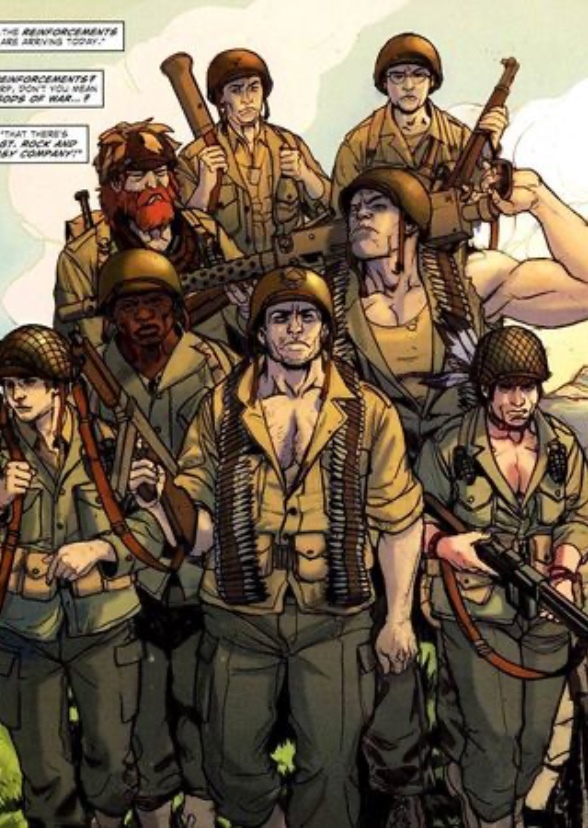
In the stories, the unit saw action in every combat zone in the European Theatre. Unlike actual units, the unit has at least one African-American member, which was in defiance of racial segregation policy of the Army at the time. In the graphic novel Between Hell and a Hard Place, Sgt. Rock explained that he gave nicknames to Easy Company men because during battle, they would be required to do things their civilian identities might not be able to live with; once the war was over, the nicknames could be left behind once the soldiers resumed their civilian lives. This accounts for the proliferation of unusual character names in Easy Company over the years.

