
Age: 82
male
From Wikipedia, the free encyclopedia. Bonsile John Kani (born 1943) is a South African actor, director and playwright. He was born in New Brighton, South Africa. Kani joined The Serpent Players (a group of actors whose first performance was in the former snake pit of the zoo, hence the name) in Port Elizabeth in 1965 and helped to create many plays that went unpublished but were performed to a resounding reception. These were followed by the more famous Sizwe Banzi is Dead and The Island, co-written with Athol Fugard and Winston Ntshona, in the early 1970s. He also received an Olivier nomination for his role in My Children My Africa! Kani's work has been widely performed around the world, including New York, where he and Winston Ntshona won a Tony Award in 1975 for Sizwe Banzi Is Dead and The Island. These two plays were presented in repertory at the Edison Theatre for a total of 52 performances. Nothing but the Truth (2002) was his debut as sole playwright and was first performed in the Market Theatre in Johannesburg. This play takes place in post-apartheid South Africa and does not concern the conflicts between whites and blacks, but the rift between blacks who stayed in South Africa to fight apartheid, and those who left only to return when the hated regime folded. It won the 2003 Fleur du Cap Awards for best actor and best new South African play. In the same year he was also awarded a special Obie award for his extraordinary contribution to theatre in the USA. Kani is executive trustee of the Market Theatre Foundation, founder and director of the Market Theatre Laboratory and chairman of the National Arts Council of SA. Description above from the Wikipedia article John Kani, licensed under CC-BY-SA, full list of contributors on Wikipedia.
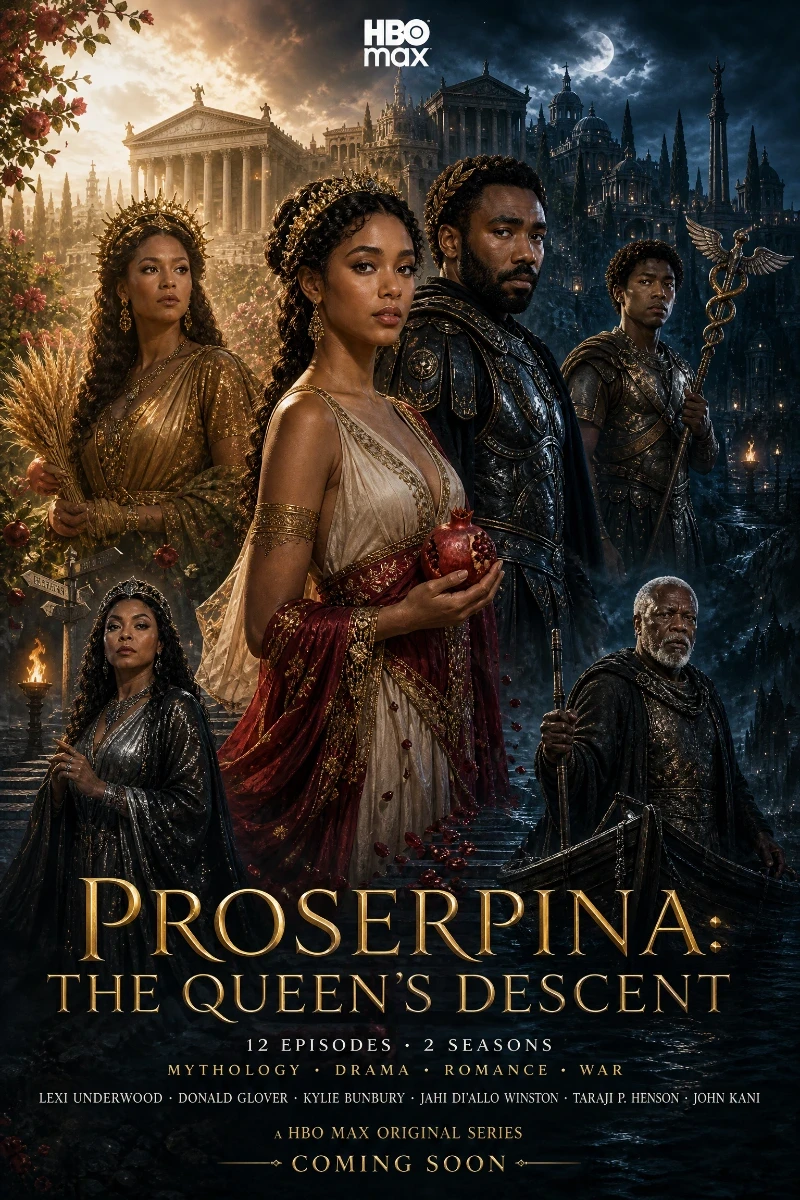
She was not stolen. She was not a victim. She was a goddess discovering that her nature was larger than her mother's garden. The most faithful, psychologically rich retelling of the Proserpina myth ever produced — and a deliberate corrective to centuries of misrepresentation. Proserpina is not abducted; she is drawn to the Underworld by her own divine nature (as goddess of spring's return, she is inherently connected to the cycle of descent and renewal) and by genuine curiosity about the domain her uncle Pluto governs. Pluto is portrayed throughout as a figure of exceptional honor: patient, deeply fair, constitutionally incapable of coercion. The pomegranate seeds are Proserpina's informed choice. Their relationship builds from formal acquaintance to intellectual companionship to genuine love — two divine beings who are surprised to find an equal. Mercury (Mercurius) serves as the inter-realm negotiator and the series' sharpest comedic voice. Ceres's grief is treated with full weight without making Pluto its villain. S2E1 — The Garden's Edge Proserpina drawn to the Underworld's threshold by her own nature — the goddess of return cannot fully exist without understanding descent. S2E6 — The Pomegranate Proserpina understands what eating the seeds means. She eats them with full, deliberate knowledge. Pluto watches and says nothing — he will not influence her choice. His expression when she does is the episode's defining image. S2E12 — Two Thrones The arrangement reached: six months each realm. Proserpina facing Ceres and saying, gently but completely, that she chose her life. The world understands seasons for the first time.


