
Age: 28
male
From leading Disney's Alex & Co. to portraying a resentful teenager in HBO Max's A Christmas Mystery and the visionary engineer Gian Paolo Dallara in Lamborghini: The Man Behind the Legend, Leonardo Cecchi is firmly establishing himself as a rising star across film, television, and theater. Born in Minneapolis to an Iowan mother and an Italian father, Leonardo was immersed in both cultures and discovered his passion for performance at a young age. He trained in stage acting, diction, jazz dance, and musical theater at a performing arts high school in Turin, Italy, where he was discovered by a Disney casting director. This led to four seasons of Alex & Co., two Disney films-including one that earned him a Best Original Song nomination-and the publication of two successful books. After moving to Los Angeles in 2017, Leonardo quickly secured representation, trained at The Chubbuck Acting Studio, and pursued chemistry studies at Santa Monica College, earning admission to UCLA with a 4.0 GPA before choosing to focus on his acting career. Committed to honing his craft, Leonardo is advancing through the Sanford Meisner Center's prestigious two-year program, having completed his first year in early 2025. Leonardo has appeared in six feature films, four TV series-including Ryan Murphy's American Horror Stories- and three theatrical productions, including a leading role in the Italian tour of the musical Peter Pan. Leonardo also wrote, directed, and starred in an original short film, Louie's Emotions, portraying seven distinct characters-a performance that earned him two nominations and a Best Actor win at the LA Top Shorts Film Festival. Expanding his industry expertise, he continues to produce and direct short films using RED cinema cameras, with his latest project, The Echo Project, highlighting his passion for storytelling on both sides of the camera. With a growing body of work that showcases his versatility, charisma, and commitment to his craft, Leonardo Cecchi is emerging as a standout talent in the industry.
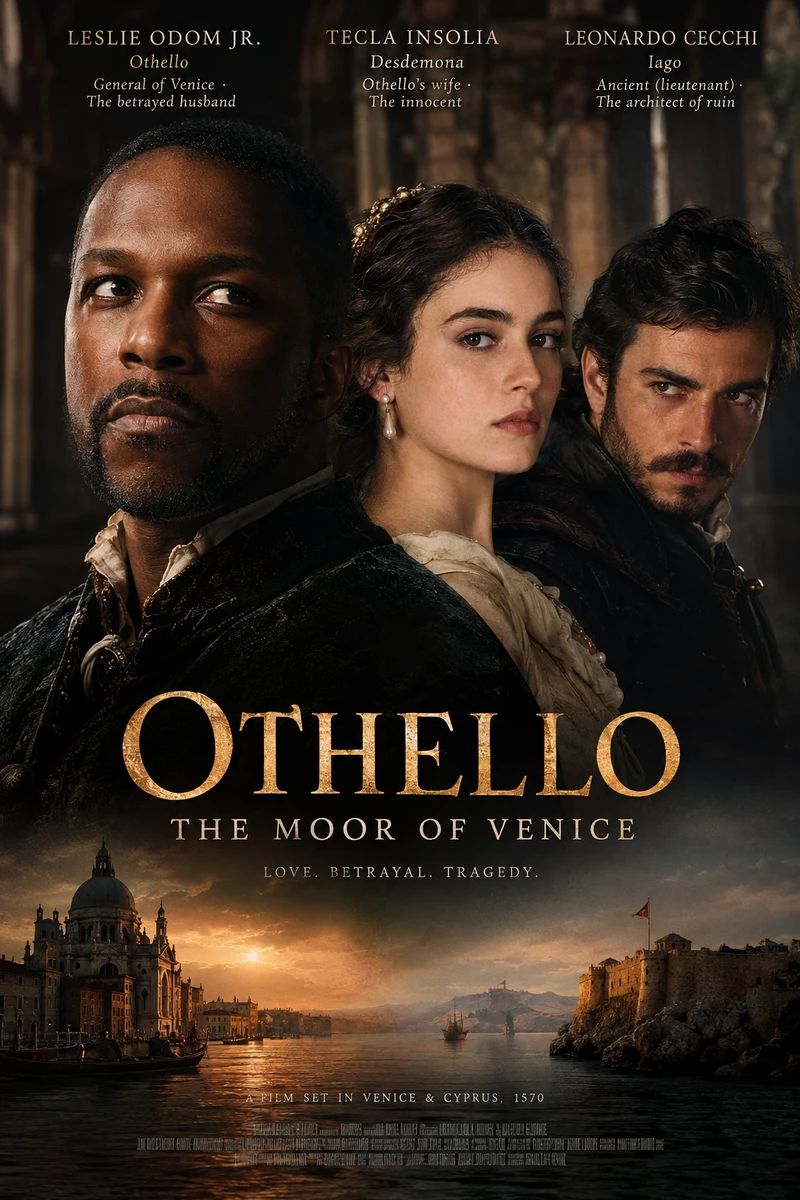
The greatest general in Venice. The most beloved woman in the city. The one man in the room who saw the gap between those two facts and decided to use it. A faithful, cinematically magnificent period adaptation of Shakespeare's most intimate tragedy — set in the historical world of the play, 16th-century Venice and Cyprus, with full visual grandeur of the Renaissance Venetian world. The film treats Othello not as a story about race in the modern sense but as Shakespeare wrote it: a story about the specific vulnerability of a man of extraordinary achievement and genuine love who is systematically destroyed by someone who has decided his destruction is worth everything. The Venetian court's visual world — deep richly colored textiles, gondola-lined canals, the specific architecture of Renaissance power — is rendered with full cinematic beauty. The tragedy's engine — Iago's psychologically precise manipulation — is treated as what it is: the most sophisticated piece of psychological warfare in literary history, conducted by someone whose motives remain forever partially opaque. Act One — Venice The Venetian world at its most beautiful. Othello and Desdemona's love established — genuine, mutual, extraordinary. Iago's decision made in the opening scene. Act Two — Cyprus The Turkish threat defeated — anticlimactically, which focuses all the film's energy on the domestic space where Iago operates. The handkerchief. Act Three — The Willow Song Desdemona's 'Willow' song the night before her murder. The film's most formally beautiful sequence. The subsequent scenes in which Othello's eyes close around Iago's manipulation. Act Four — The Bed The final scene. The handkerchief's truth revealed too late. Emilia's accounting. Iago's silence. Othello's last speech and its terrible beauty.


