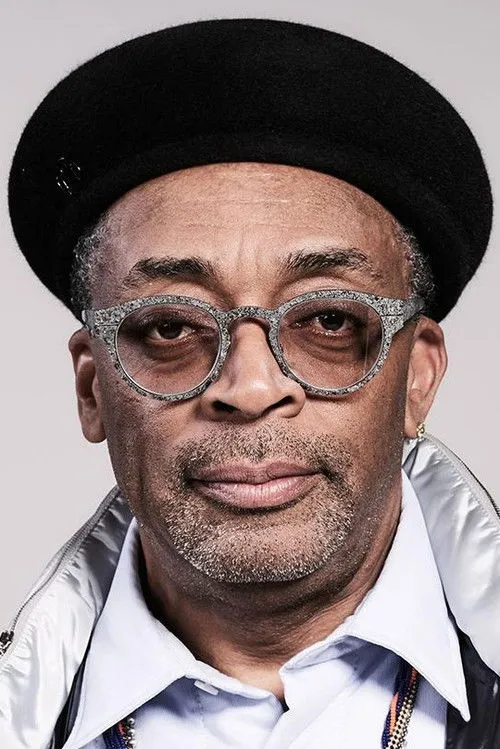
Age: 69
male
Shelton Jackson "Spike" Lee (born March 20, 1957) is an American filmmaker and actor. His work has continually explored race relations, issues within the black community, the role of media in contemporary life, urban crime and poverty, and other political issues. Lee received numerous accolades for his work, including an Academy Award, a British Academy Film Award, two Primetime Emmy Awards, and two Peabody Awards as well as nominations for three Golden Globe Awards and a Grammy Award. Lee studied filmmaking at both Morehouse College and the New York University Tisch School of the Arts, where he directed his student film Joe's Bed-Stuy Barbershop: We Cut Heads (1983), which won a Student Academy Award. He later founded the production company 40 Acres and a Mule Filmworks, where he has produced more than 35 films. He made his directorial debut with the comedy She's Gotta Have It (1986). He received widespread critical acclaim for the drama Do the Right Thing (1989), for which he was nominated for the Academy Award for Best Original Screenplay. He directed the historical epic Malcolm X (1992), earning the Golden Bear at the Berlin International Film Festival. With the biographical crime dramedy BlacKkKlansman (2018), he won the Academy Award for Best Adapted Screenplay and the Cannes Film Festival Grand Prix Award. He has also written and directed films such as School Daze (1988), Mo' Better Blues (1990), Jungle Fever (1991), Crooklyn (1994), Clockers (1995), Bamboozled (2000), 25th Hour (2002), Inside Man (2006), Chi-Raq (2015), Da 5 Bloods (2020), and Highest 2 Lowest (2025). Lee has also acted in eleven of his feature films. He is also known for directing numerous documentary projects, including 4 Little Girls (1997), which was nominated for the Academy Award for Best Documentary Feature Film. He directed the HBO series When the Levees Broke (2006), which won two Primetime Emmy Awards for Outstanding Directing for a Documentary/Nonfiction Program and Exceptional Merit in Documentary Filmmaking. He also directed the HBO documentary If God Is Willing and da Creek Don't Rise (2010) and the David Byrne concert film American Utopia (2020). Lee has received several honours, including the Honorary BAFTA Award in 2002, an Honorary César in 2003, the Academy Honorary Award in 2015, and the National Medal of Arts in 2023. Five of his films have been selected by the Library of Congress for preservation in the National Film Registry for being "culturally, historically, or aesthetically significant". He has received a Gala Tribute from the Film Society of Lincoln Center as well as the Dorothy and Lillian Gish Prize. His films have featured breakthrough performances from actors such as Denzel Washington, Laurence Fishburne, Samuel L. Jackson, Giancarlo Esposito, Rosie Perez, Delroy Lindo, John Turturro, and John David Washington. Description above from the Wikipedia article Spike Lee, licensed under CC-BY-SA, full list of contributors on Wikipedia.

Racism is the belief that groups of humans possess different behavioral traits corresponding to physical appearance and can be divided based on the superiority of one race over another.It may also mean prejudice, discrimination, or antagonism directed against other people because they are of a different ethnicity.Modern variants of racism are often based in social perceptions of biological differences between peoples. These views can take the form of social actions, practices or beliefs, or political systems in which different races are ranked as inherently superior or inferior to each other, based on presumed shared inheritable traits, abilities, or qualities. KKK n August 11, 1965, Marquette Frye, a 21-year-old African American man, was pulled over for drunken driving.[2][3][4] After he failed a field sobriety test, officers attempted to arrest him. Marquette resisted arrest, with assistance from his mother, Rena Frye, and a physical confrontation ensued in which Marquette was struck in the face with a baton. Meanwhile, a crowd of onlookers had gathered.[2] Rumors spread that the police had kicked a pregnant woman who was present at the scene. Six days of civil unrest followed, motivated in part by allegations of police abuse.[3] Nearly 14,000 members of the California Army National Guard[5] helped suppress the disturbance, which resulted in 34 deaths[6] and over $40 million in property damage.[7][8] It was the city's worst unrest until the Rodney King riots of 1992.


