
Died at 108
male
Sir Arthur Charles Clarke CBE FRAS (16 December 1917 – 19 March 2008) was an English science-fiction writer, science writer, futurist, inventor, undersea explorer, and television series host. He co-wrote the screenplay for the 1968 film 2001: A Space Odyssey, one of the most influential films of all time. Clarke was a science fiction writer, an avid populariser of space travel, and a futurist of a distinguished ability. He wrote many books and many essays for popular magazines. In 1961, he received the Kalinga Prize, a UNESCO award for popularising science. Clarke's science and science-fiction writings earned him the moniker "Prophet of the Space Age". His science-fiction writings in particular earned him a number of Hugo and Nebula awards, which along with a large readership, made him one of the towering figures of the genre. For many years Clarke, Robert Heinlein, and Isaac Asimov were known as the "Big Three" of science fiction. Clarke was a lifelong proponent of space travel. In 1934, while still a teenager, he joined the British Interplanetary Society. In 1945, he proposed a satellite communication system using geostationary orbits. He was the chairman of the British Interplanetary Society from 1946–1947 and again in 1951–1953. Clarke emigrated to Ceylon (now Sri Lanka) in 1956, to pursue his interest in scuba diving. That year, he discovered the underwater ruins of the ancient Koneswaram Temple in Trincomalee. Clarke augmented his popularity in the 1980s, as the host of television shows such as Arthur C. Clarke's Mysterious World. He lived in Sri Lanka until his death. Clarke was appointed Commander of the Order of the British Empire (CBE) in 1989 "for services to British cultural interests in Sri Lanka". He was knighted in 1998 and was awarded Sri Lanka's highest civil honour, Sri Lankabhimanya, in 2005.
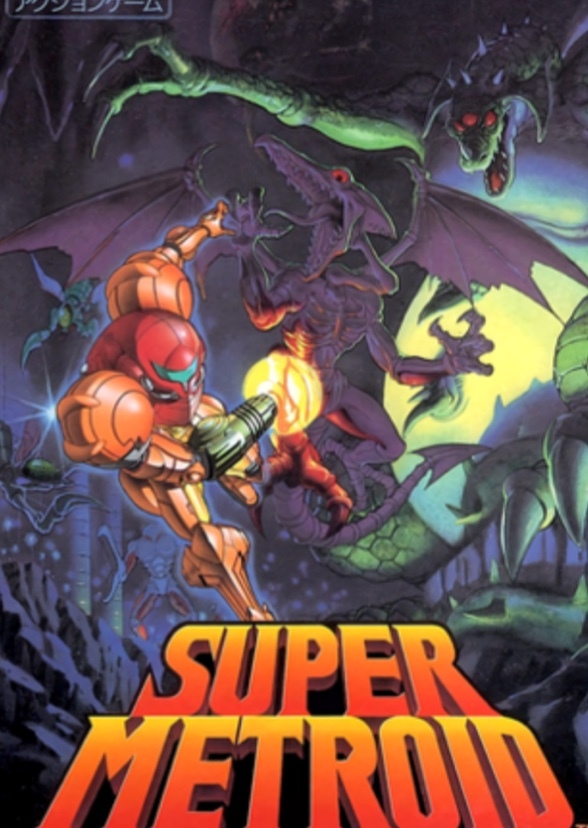
Metroid is a science fiction action game franchise created by Nintendo. The series is primarily produced by the company's first-party developers Nintendo R&D1 and Retro Studios, although some games have been handled by other developers, including Fuse Games, Team Ninja, Next Level Games, and MercurySteam. Metroid follows space-faring bounty hunter Samus Aran, who protects the galaxy from the Space Pirates and their attempts to harness the power of the parasitic Metroid creatures. Metroid combines the platforming of Super Mario Bros. and the adventure of The Legend of Zelda with a dark science fiction atmosphere and greater emphasis on nonlinear gameplay. The series consists of fourteen games that were released on each Nintendo video game console except the Nintendo 64. It is one of Nintendo's most successful franchises, and the games have received varying levels of critical acclaim. As of September 2012, the Metroid series had sold over 17.44 million copies.[1] The series has been represented in other Nintendo media, including the Super Smash Bros. series. Additional media includes soundtracks, comic books, and manga.



