
Sonic Adventure is a 1998 platform game developed by Sonic Team and published by Sega for the Dreamcast. It was the first main Sonic the Hedgehog game to feature 3D gameplay. It follows Sonic the Hedgehog, Miles "Tails" Prower, Knuckles the Echidna, Amy Rose, Big the Cat, and E-102 Gamma in their quests to collect the Chaos Emeralds and stop Doctor Robotnik from unleashing Chaos, an ancient evil. Controlling one of the six characters—each with their own abilities—players complete levels to progress the story. Sonic Adventure retains many elements from prior Sonic games, such as power-ups and the ring-based health system. Players can play minigames such as racing and interact with Chao, a virtual pet. Sonic Team began developing Sonic Adventure in 1997, after the cancellation of the Sega Saturn game Sonic X-treme. Led by director Takashi Iizuka and producer Yuji Naka, the team strove to reinvent Sonic for the 3D era of video games. Adventure features a stronger emphasis on storytelling and role-playing elements in contrast to previous Sonic games, while Yuji Uekawa redesigned the series's characters for their transition to 3D. Sonic Team attempted to demonstrate the technical process of the Dreamcast with realistic graphics and drew inspiration from locations in Peru and Guatemala. The soundtrack was primarily composed by Jun Senoue, who preferred rock music over the electropop of previous Sonic games. Following its reveal at the Tokyo International Forum in August 1998, Sonic Adventure was highly anticipated and was released in Japan in December 1998, North America in September 1999, and Europe in October 1999. It received critical acclaim and became the Dreamcast's bestseller, with 2.5 million copies sold by August 2006. Reviewers considered Adventure a major technical advancement and praised the visuals and gameplay. Though critics noted glitches and camera problems, and reactions to the audio were mixed, they considered Sonic Adventure an exceptional game; some speculated that it could help re-establish Sega as the dominant console manufacturer after the unsuccessful Saturn. Journalists have retrospectively ranked Sonic Adventure among the best Sonic games, and it is recognized as an important release in both the series and the platform genre. Many characters and concepts introduced in Adventure recur in later Sonic games. A sequel, Sonic Adventure 2, was released in 2001. Adventure was ported to the GameCube and Windows in 2003 with altered graphics and more challenges, while a high-definition version was released for the Xbox 360 and PlayStation 3 in 2010 and for Windows in 2011. Reviews for these releases were less positive; critics felt the game had not aged well and ran at an inconsistent frame rate.
Sonic Adventure

More Focus on Platforming
for More Focus on Platforming in Mario & Sonic Adventure
Suggested by tomzillawash3r3
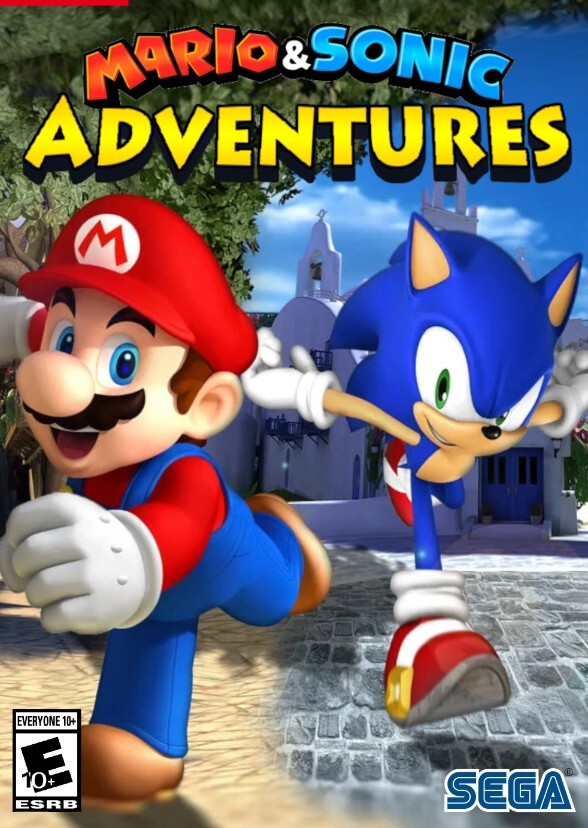
A mysterious rift between dimensions merges the Mushroom Kingdom with Sonic’s world. Bowser and Dr. Eggman join forces, combining Koopa tech with Eggman’s robots to seize control of both worlds. Bowser wants to claim Sonic’s Chaos Emeralds to become unstoppable. Eggman wants to use Mario’s Power Stars to fuel a planet-sized robot. The collision of worlds causes zones/kingdoms to merge into surreal hybrid levels. Mario and Sonic reluctantly team up, along with Luigi, Tails, Peach, Knuckles, and others. The chaos tears through space-time, threatening to merge all Nintendo and SEGA worlds into one collapsing mess.

