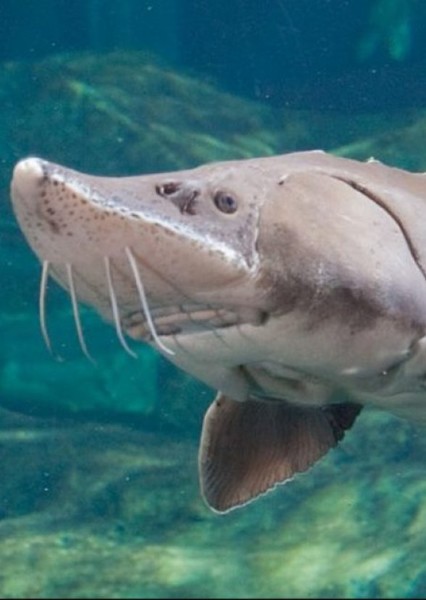
Sturgeon is the common name for the 27 species of fish belonging to the family Acipenseridae. The earliest sturgeon fossils date to the Late Cretaceous, and are descended from other, earlier acipenseriform fish who date back to the Triassic period some 245 to 208 million years ago.[2] The family is grouped into four genera: Acipenser, Huso, Scaphirhynchus and Pseudoscaphirhynchus. Two species (A. naccarii and A. dabryanus) may be extinct in the wild, and one (P. fedtschenkoi) may be entirely extinct.[3] Two closely related species, Polyodon spathula (American paddlefish) and Psephurus gladius (Chinese paddlefish, possibly extinct) are of the same order, Acipenseriformes, but are in the family Polyodontidae and are not considered to be "true" sturgeons. Both sturgeons and paddlefish have been referred to as "primitive fishes" because their morphological characteristics have remained relatively unchanged since the earliest fossil record.[4][5] Sturgeons are native to subtropical, temperate and sub-Arctic rivers, lakes and coastlines of Eurasia and North America.[6]
Sturgeons are long-lived, late-maturing fishes with distinctive characteristics, such as a heterocercal caudal fin similar to those of sharks, and an elongated, spindle-like body that is smooth-skinned, scaleless, and armored with five lateral rows of bony plates called scutes. Several species can grow quite large, typically ranging 7–12 ft (2–3+1⁄2 m) in length. The largest sturgeon on record was a beluga female captured in the Volga estuary in 1827, measuring 7.2 m (24 ft) long and weighing 1,571 kg (3,463 lb). Most sturgeons are anadromous bottom-feeders, which migrate upstream to spawn, but spend most of their lives feeding in river deltas and estuaries. Some species inhabit freshwater environments exclusively, while others primarily inhabit marine environments near coastal areas, and are known to venture into open ocean.
Several species of sturgeon are harvested for their roe, which is processed into the luxury food caviar. This has led to serious overexploitation, which combined with other conservation threats, has brought most of the species to critically endangered status, at the edge of extinction.