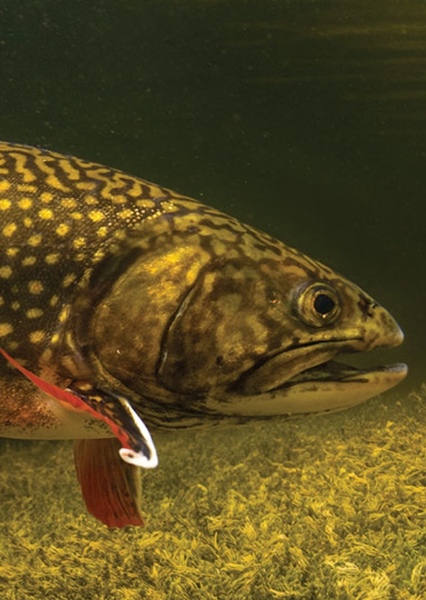
The brook trout (Salvelinus fontinalis) is a species of freshwater fish in the char genus Salvelinus of the salmon family Salmonidae native to Eastern North America in the United States and Canada.[4][2] Two ecological forms of brook trout have been recognized by the US Forest Service.[4] One ecological form is long-lived potamodromous populations in Lake Superior known as coaster trout or coasters. The second ecological form is the short-living predaceous anadromous populations which are found in northern lakes and coastal rivers from Long Island to Hudson Bay, which are referred to as salters.[5] In parts of its range, it is also known as the eastern brook trout, speckled trout, brook char (or charr), squaretail, brookie, or mud trout, among others.[6] Adult coaster brook trout are capable of reaching sizes over 2 feet in length and weigh up to 6.8 kg (15 lb), whereas adult salters average between 6 and 15 inches in length and weigh between 0.5 and 2.3 kg (1 and 5 lb).[7] The brook trout is characterized by its distinctive olive-green body with yellow and blue-rimmed red spots, white and black edged orange fins, and dorsal vermiculation.[8] The diet of the brook trout is restrictive to the season and location of the fish, but will typically consist of terrestrial and aquatic insects, fry, crustaceans, zooplankton, and worms.[4] Throughout history, non-native brook trout have been transplanted beyond its native borders, where it has spread across North America and much of the world.[4] These brook trout have been introduced since the 1800s by means of artificial propagation and aquaculture in hope of promoting fishery resources.[9] Through this transplantation, brook trout have been observed to affect native populations by outcompeting, preying upon, and hybridizing with many native aquatic species.[10][11] This invasive nature via human-mediated introductory has led to their classification in the list of the top 100 globally invasive species.[12] Since the 19th century, isolated native eastern brook trout populations have faced extirpation due to stream pollution, habitat destruction, invasive species, and waterway damming.[13] Although facing these pressures, the brook trout is not listed as an endangered species by the International Union for Conservation of Nature, but native population decline has been observed.[14]
Brook Trout

Cedar Rapids Zoo
for Cedar Rapids Zoo in Make Your Own Zoo
Suggested by GodzillaLover04