
Glyptotherium (from Greek for 'grooved or carved beast') is a genus of glyptodont (an extinct group of large, herbivorous armadillos) that lived from the Early Pliocene, about 4.9 million years ago, to the Early Holocene, around 7,000 years ago, in the United States, Mexico, Guatemala, Costa Rica, Honduras, El Salvador, Panama, Venezuela, and Brazil. The genus was first described in 1903 by American paleontologist Henry Fairfield Osborn with the type species being, G. texanum, based on fossils that had been found in the Pliocene Blancan Beds in Llano Estacado, Texas, USA. The genus has since been discovered in many more fossil sites. Another species, G. cylindricum, was named in 1912 by fossil hunter Barnum Brown on the basis of a partial carapace, teeth, and several additional fossils that had been unearthed from the Pleistocene deposits in Jalisco, Mexico. Glyptodonts were typically large, graviportal, herbivorous armadillos with armored carapaces that were made of hundreds of interconnected osteoderms, armor covering the tails, armored skull roofs, tall skulls, hypsodont teeth, pelves fused to the carapace, an amalgamate vertebral column, short limbs, and small digits. Glyptotherium reached up to 2 meters (6.56 feet) long and 400 kilograms (880 pounds) in weight, making it one of the largest glyptodonts but not as large as its close relative Glyptodon or Doedicurus, the largest known glyptodont. Glyptotherium is morphologically and phylogenetically most similar to Glyptodon, but Glyptotherium differs in several anatomical aspects including size, a shorter carapace, a relatively longer tail, and a slender zygoma, or cheek bone. Glyptodonts evolved first during the Eocene, but greatly diversified in the Miocene and Pliocene, but their diversity diminished into the Pleistocene. Glyptotherium is considered an example of North American megafauna, of which most have become extinct, and may have been wiped out by changing climate or human interference. Glyptotherium was primarily a grazer, but also had a mixed diet of fruits and other plants, that lived on open grasslands. The armor could protect the animal from predators, of which many coexisted with Glyptotherium during its existence, including the "saber-tooth cat" Smilodon, the "bone-crushing dog" Borophagus, and the giant bear Arctotherium.
Glyptotherium

Pleistocene North American
for Pleistocene North American in La Brea (2014)
Suggested by manassestobias
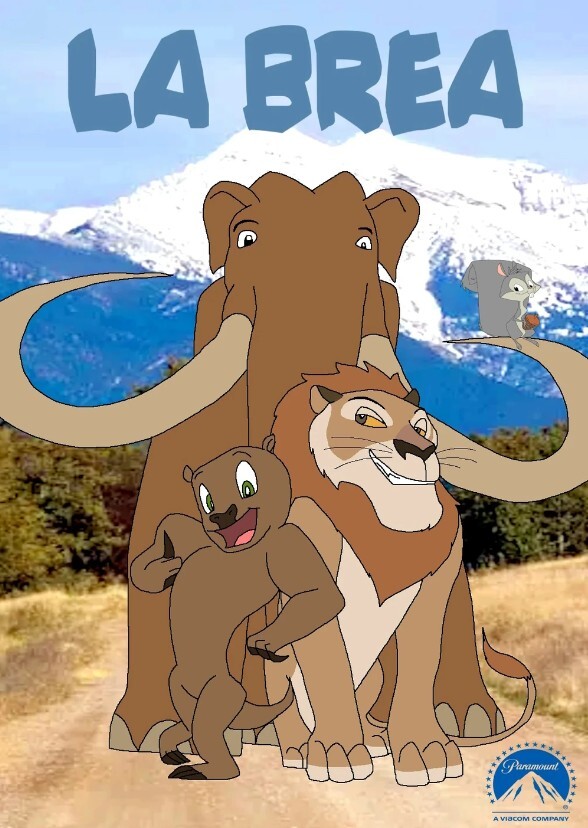
La Brea is a 2014 American animated adventure comedy film produced by Paramount Pictures. Set during the days of the ice age in North America, the film centers around three main characters—Melvin, a no-nonsense Columbian mammoth, Harry, a loudmouthed Shasta ground sloth, and Leonard, a sardonic American cave lion—who come across a wolf puppy and work together to return it to her tribe. Additionally, the film occasionally follows Samson, a speechless "eastern grey squirrel", who is perpetually searching for a place in the ground to bury his acorn.




