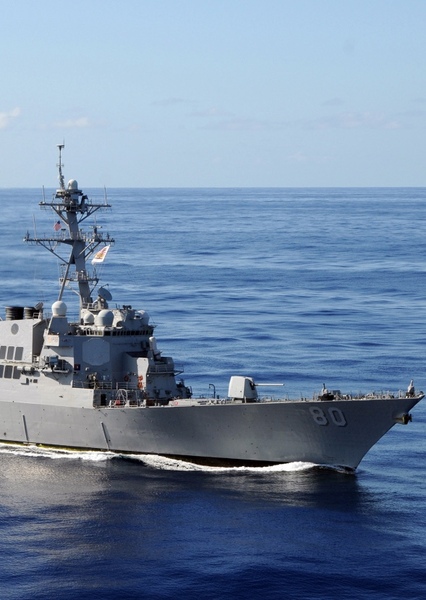
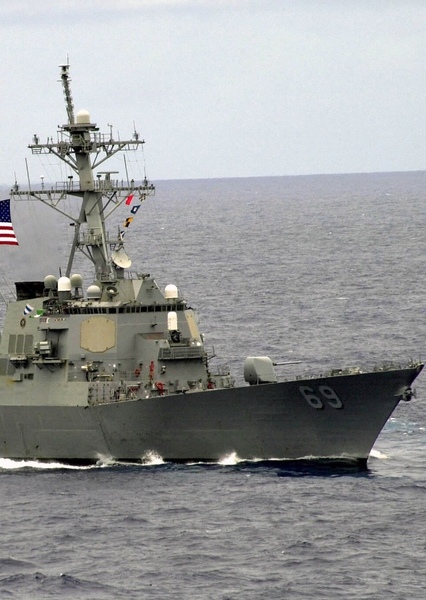
The Arleigh Burke class of guided-missile destroyers (DDGs) is a United States Navy class of destroyers centered around the Aegis Combat System and the SPY-1D multifunction passive electronically scanned array radar. The class is named after Arleigh Burke, an American destroyer admiral in World War II and later Chief of Naval Operations. With an overall length of 505 to 509.5 feet (153.9 to 155.3 m), displacement ranging from 8,300 to 9,700 tons, and weaponry including over 90 missiles, the Arleigh Burke–class destroyers are larger and more heavily armed than many previous classes of guided-missile cruisers.
These warships are multimission destroyers able to conduct antiaircraft warfare with Aegis and surface-to-air missiles; tactical land strikes with Tomahawk missiles; antisubmarine warfare (ASW) with towed array sonar, antisubmarine rockets, and ASW helicopters; and antisurface warfare (ASuW) with ship-to-ship missiles and guns. With upgrades to their AN/SPY-1 radar systems and their associated missile payloads as part of the Aegis Ballistic Missile Defense System, as well as the introduction of the AN/SPY-6 radar system, the class has also evolved capability as mobile antiballistic missile and antisatellite platforms.
The lead ship of the class, USS Arleigh Burke, was commissioned during Admiral Burke's lifetime on 4 July 1991. With the decommissioning of the last Spruance-class destroyer, USS Cushing, on 21 September 2005, the Arleigh Burke–class ships became the U.S. Navy's only active destroyers until the Zumwalt class became active in 2016. The Arleigh Burke class has the longest production run of any U.S. Navy surface combatant. As of January 2025, 74 are active, with 25 more planned to enter service.