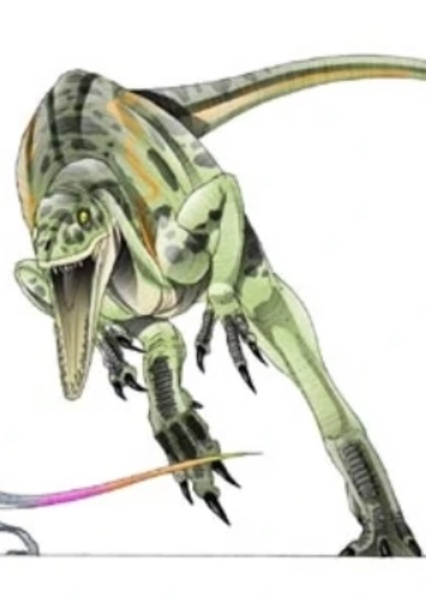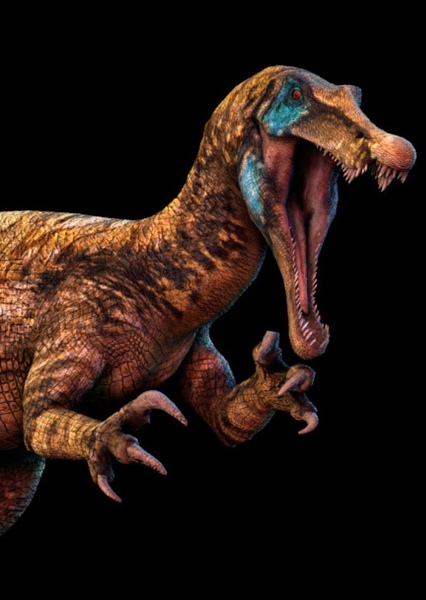
Baryonyx (/ˌbæriˈɒnɪks/) is a genus of theropod dinosaur which lived in the Barremian stage of the Early Cretaceous period, about 130–125 million years ago. The first skeleton was discovered in 1983 in the Weald Clay Formation of Surrey, England, and became the holotype specimen of Baryonyx walkeri, named by palaeontologists Alan J. Charig and Angela C. Milner in 1986. The generic name, Baryonyx, means "heavy claw" and alludes to the animal's very large claw on the first finger; the specific name, walkeri, refers to its discoverer, amateur fossil collector William J. Walker. The holotype specimen is one of the most complete theropod skeletons from the UK (and remains the most complete spinosaurid), and its discovery attracted media attention. Specimens later discovered in other parts of the United Kingdom and Iberia have also been assigned to the genus. The holotype specimen, which may not have been fully grown, was estimated to have been between 7.5 and 10 metres (25 and 33 feet) long and to have weighed between 1.2 and 1.7 metric tons (1.3 and 1.9 short tons; 1.2 and 1.7 long tons). Baryonyx had a long, low, and narrow snout, which has been compared to that of a gharial. The tip of the snout expanded to the sides in the shape of a rosette. Behind this, the upper jaw had a notch which fitted into the lower jaw (which curved upwards in the same area). It had a triangular crest on the top of its nasal bones. Baryonyx had a large number of finely serrated, conical teeth, with the largest teeth in front. The neck formed an S-shape, and the neural spines of its dorsal vertebrae increased in height from front to back. One elongated neural spine indicates it may have had a hump or ridge along the centre of its back. It had robust forelimbs, with the eponymous first-finger claw measuring about 31 centimetres (12 inches) long. Now recognised as a member of the family Spinosauridae, Baryonyx's affinities were obscure when it was discovered. Some researchers have suggested that Suchosaurus cultridens is a senior synonym (being an older name), and that Suchomimus tenerensis belongs in the same genus; subsequent authors have kept them separate. Baryonyx was the first theropod dinosaur demonstrated to have been piscivorous (fish-eating), as evidenced by fish scales in the stomach region of the holotype specimen. It may also have been an active predator of larger prey and a scavenger, since it also contained bones of a juvenile iguanodontid. The creature would have caught and processed its prey primarily with its forelimbs and large claws. Baryonyx may have had semiaquatic habits, and coexisted with other theropod, ornithopod, and sauropod dinosaurs, as well as pterosaurs, crocodiles, turtles and fishes, in a fluvial environment.
Baryonyx

Dinosaurs/Creatures for part one, two & three.
for Dinosaurs/Creatures for part one, two & three. in Jurassic World: Alternate Timeline Part One
Suggested by damo01
Jurassic World Alternate Timeline will be a remake the fourth Jurassic film that would set up an alternate timeline trilogy where the events of the original World trilogy never happened and will play out differently with different characters and the films would be more story driven that are more serious & grounded with more steaks. And there will be no nostalgia beating, no too much kid characters, no too much dumb characters, no logic breaking and no retconning! In part one we get to see how Jurassic World as a park/resort is built up and we see the reasoning behind it of why InGen would want to build another park, along the way we see how they struggle to build up the park/resort as they have to deal with some troublesome dinosaurs.