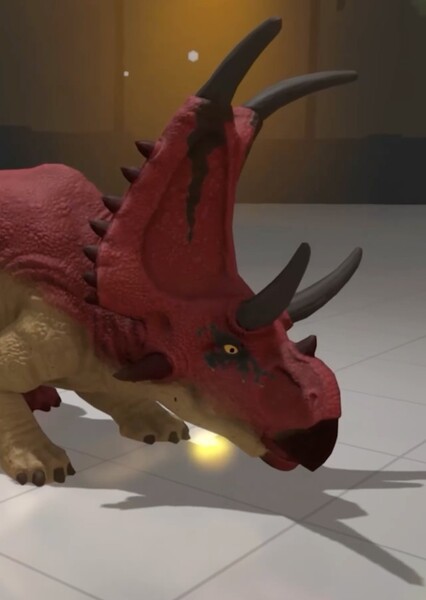
Ceratosaurus /ˌsɛrətoʊˈsɔːrəs/ (from Greek κέρας/κέρατος, keras/keratos meaning "horn" and σαῦρος sauros meaning "lizard") was a carnivorous theropod dinosaur in the Late Jurassic period (Kimmeridgian to Tithonian). This genus was first described in 1884 by American paleontologist Othniel Charles Marsh based on a nearly complete skeleton discovered in Garden Park, Colorado, in rocks belonging to the Morrison Formation. The type species is Ceratosaurus nasicornis. The Garden Park specimen remains the most complete skeleton known from the genus, and only a handful of additional specimens have been described since. Two additional species, Ceratosaurus dentisulcatus and Ceratosaurus magnicornis, have been described in 2000 from two fragmentary skeletons from the Cleveland-Lloyd Quarry of Utah and from the vicinity of Fruita, Colorado. The validity of these additional species has been questioned, however, and all three skeletons possibly represent different growth stages of the same species. In 1999, the discovery of the first juvenile specimen was reported. Since 2000, a partial specimen was excavated and described from the Lourinhã Formation of Portugal, providing evidence for the presence of the genus outside of North America. Fragmentary remains have also been reported from Tanzania, Uruguay, and Switzerland, although their assignment to Ceratosaurus is currently not accepted by most paleontologists. Ceratosaurus was a medium-sized theropod. The original specimen is estimated to be 5.3 m (17 ft) or 5.69 m (18.7 ft) long, while the specimen described as C. dentisulcatus was larger, at around 7 m (23 ft) long. Ceratosaurus was characterized by deep jaws that supported proportionally very long, blade-like teeth, a prominent, ridge-like horn on the midline of the snout, and a pair of horns over the eyes. The forelimbs were very short, but remained fully functional; the hand had four fingers. The tail was deep from top to bottom. A row of small osteoderms (skin bones) was present down the middle of the neck, back, and tail. Additional osteoderms were present at unknown positions on the animal's body. Ceratosaurus gives its name to the Ceratosauria, a clade of theropod dinosaurs that diverged early from the evolutionary lineage leading to modern birds. Within the Ceratosauria, some paleontologists proposed it to be most closely related to Genyodectes from Argentina, which shares the strongly elongated teeth. The geologically older genus Proceratosaurus from England, although originally described as a presumed antecedent of Ceratosaurus, was later found to be unrelated. Ceratosaurus shared its habitat with other large theropod genera including Torvosaurus and Allosaurus, and it has been suggested that these theropods occupied different ecological niches to reduce competition. Ceratosaurus may have preyed upon plant-eating dinosaurs, although some paleontologists suggested that it hunted aquatic prey such as fish. The nasal horn was probably not used as a weapon as was originally suggested by Marsh, but more likely was used solely for display.
Ceratosaurus

Creatures Featured
for Creatures Featured in Jurassic Empire (2025)
Suggested by GodzillaLover04
A Rewrite of Jurassic World Rebirth. 5 years after the events of Jurassic World Dominion, Dinosaurs rule the Earth, and mankind is struggling to survive. However, a virus threatens them back into extinction, a virus known as the DX Virus. It shortens the lifespans of Dinosaurs and infects their brains. The Dinosaur Protection Group (DPG) and the Dinosaur Integration Network (DIN) are on a mission to find a cure, led by Zora Bennett. The mission is to find and extract the DNA of some of the most dangerous and uninfected Prehistoric animals, at least several species, on a globe trotting journey. Doing so can offer life-saving benefits for both the Dinosaurs and Mankind. As the mission becomes more risky, and chaos ensues once again, old and new faces will make a sinister discovery that's been hidden from the public for decades... But no matter what happens, the world will always be... A Jurassic Empire.