
The great white shark (Carcharodon carcharias), also known as the white shark, white pointer, or simply great white, is a species of large mackerel shark which can be found in the coastal surface waters of all the major oceans. It is notable for its size, with larger female individuals growing to 6.1 m (20 ft) in length and 1,905–2,268 kg (4,200–5,000 lb) in weight at maturity.[2][3][4] However, most are smaller; males measure 3.4 to 4.0 m (11 to 13 ft), and females measure 4.6 to 4.9 m (15 to 16 ft) on average.[3][5] According to a 2014 study, the lifespan of great white sharks is estimated to be as long as 70 years or more, well above previous estimates,[6] making it one of the longest lived cartilaginous fishes currently known.[7] According to the same study, male great white sharks take 26 years to reach sexual maturity, while the females take 33 years to be ready to produce offspring.[8] Great white sharks can swim at speeds of 25 km/hr (16 mph)[9] for short bursts and to depths of 1,200 m (3,900 ft).[10] The great white shark has no known natural predators other than, on very rare occasions, the killer whale.[11] It is arguably the world's largest-known extant macropredatory fish, and is one of the primary predators of marine mammals, up to the size of large baleen whales. This shark is also known to prey upon a variety of other marine animals, including fish, and seabirds. It is the only known surviving species of its genus Carcharodon, and is responsible for more recorded human bite incidents than any other shark.[12][13] The species faces numerous ecological challenges which has resulted in international protection. The IUCN lists the great white shark as a Vulnerable species,[1] and it is included in Appendix II of CITES.[14] It is also protected by several national governments, such as Australia (as of 2018).[15] The novel Jaws by Peter Benchley and its subsequent film adaptation by Steven Spielberg depicted the great white shark as a ferocious man-eater. Humans are not the preferred prey of the great white shark,[16] but the great white is nevertheless responsible for the largest number of reported and identified fatal unprovoked shark attacks on humans although this happens very rarely (typically less than 10 times a year globally).[17][18] Due to their need to travel long distances for seasonal migration and extremely demanding diet, it is not logistically feasible to keep great white sharks in captivity; because of this, while attempts have been made to do so in the past, there are no known aquariums in the world believed to house a live specimen.[19]
Great White Shark

Bruce The Great White Shark
for Bruce The Great White Shark in Jaws (2005)
Suggested by leteriusoneal2
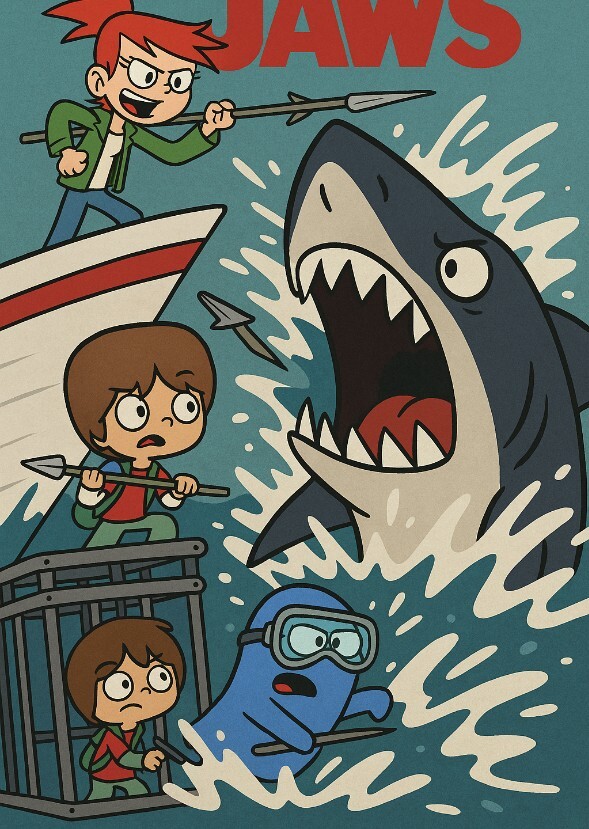
In the quirky coastal town of Oceanville, summer is just beginning, and the residents are gearing up for the annual Founders’ Festival, a celebration that brings in tourists and joy to the town every year. But when a local swimmer mysteriously disappears, suspicions rise—and Mac, a curious and brave young boy, begins to investigate with his overconfident and mischievous imaginary friend, Blooregard "Bloo" Q. Kazoo. Despite warnings from Frankie Foster, a responsible teen working part-time as a lifeguard, the town’s overly proper mayor, Mr. Herriman, insists that the beach remain open to preserve Oceanville's economy. But as more bizarre and cartoonishly gruesome incidents occur along the shoreline, it becomes clear that something sinister lurks beneath the water—a monstrous, dangerous great white shark. To protect the town, Mac, Bloo, Frankie, and two unlikely allies—Wilt, the gentle voice of reason, and Eduardo, a lovable scaredy-cat turned wannabe shark hunter—embark on a daring and hilarious mission to hunt down the sea beast. With a rickety paddleboat, improvised gadgets, and Bloo's questionable leadership, the group faces off against their aquatic foe in an epic, slapstick showdown at sea.




