
A bumblebee (or bumble bee, bumble-bee, or humble-bee) is any of over 250 species in the genus Bombus, part of Apidae, one of the bee families. This genus is the only extant group in the tribe Bombini, though a few extinct related genera (e.g., Calyptapis) are known from fossils. They are found primarily in higher altitudes or latitudes in the Northern Hemisphere, although they are also found in South America, where a few lowland tropical species have been identified. European bumblebees have also been introduced to New Zealand and Tasmania. Female bumblebees can sting repeatedly, but generally ignore humans and other animals. Most bumblebees are social insects that form colonies with a single queen. The colonies are smaller than those of honey bees, growing to as few as 50 individuals in a nest. Cuckoo bumblebees are brood parasitic and do not make nests or form colonies; their queens aggressively invade the nests of other bumblebee species, kill the resident queens and then lay their own eggs, which are cared for by the resident workers. Cuckoo bumblebees were previously classified as a separate genus, but are now usually treated as members of Bombus. Bumblebees have round bodies covered in soft hair (long branched setae) called 'pile', making them appear and feel fuzzy. They have aposematic (warning) coloration, often consisting of contrasting bands of colour, and different species of bumblebee in a region often resemble each other in mutually protective Müllerian mimicry. Harmless insects such as hoverflies often derive protection from resembling bumblebees, in Batesian mimicry, and may be confused with them. Nest-making bumblebees can be distinguished from similarly large, fuzzy cuckoo bumblebees by the form of the female hind leg. In nesting bumblebees, it is modified to form a pollen basket, a bare shiny area surrounded by a fringe of hairs used to transport pollen, whereas in cuckoo bumblebees, the hind leg is hairy all round, and they never carry pollen. Like their relatives the honeybees, bumblebees feed on nectar, using their long hairy tongues to lap up the liquid; the proboscis is folded under the head during flight. Bumblebees gather nectar to add to the stores in the nest, and pollen to feed their young. They forage using colour and spatial relationships to identify flowers to feed from. Some bumblebees steal nectar, making a hole near the base of a flower to access the nectar while avoiding pollen transfer. Bumblebees are important agricultural pollinators, so their decline in Europe, North America, and Asia is a cause for concern. The decline has been caused by habitat loss, the mechanisation of agriculture, and pesticides.
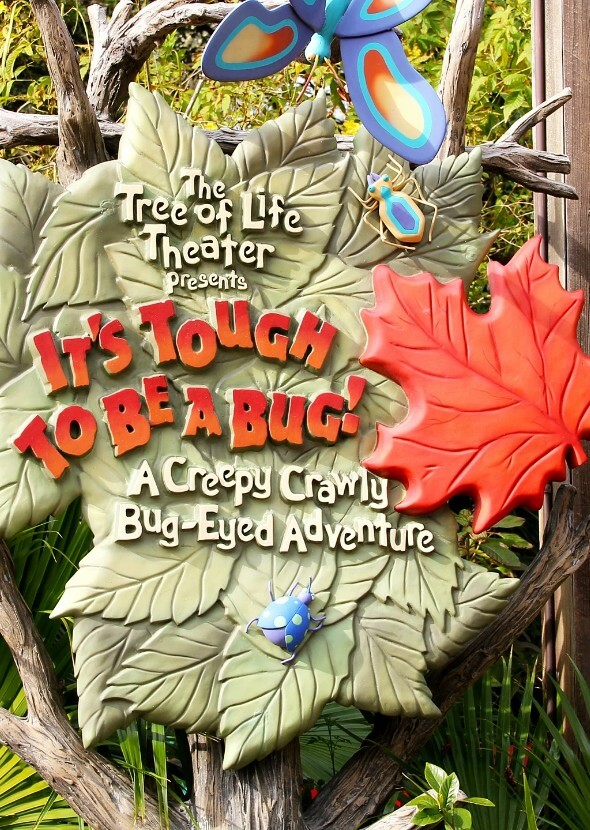
It's Tough to Be a Bug! is a 9-minute-long 3D film based on the 1998 Disney·Pixar film A Bug's Life, using theater lighting, 3-D filming techniques, audio-animatronics and various special effects. Flik, a character from the movie, hosts the show and educates the audience on why bugs should be considered friends. It was the first Pixar attraction to open in a Disney park. The attraction opened in Disney's Animal Kingdom at the Walt Disney World Resort on April 22, 1998, a full seven months before the actual feature debuted in theatres, and is housed within the theme park's icon, the Tree of Life.[2] A second version of the attraction debuted at the opening of Disney California Adventure on February 8, 2001.[3] The version at California Adventure closed permanently on March 19, 2018, and was replaced by Web Slingers: A Spider-Man Adventure, an interactive screen ride based on the Spider-Man films set in the Marvel Cinematic Universe.[1] On September 9, 2023, at the Disney fan event Destination D23, it was announced that a new 3D theater attraction based on the 2016 film "Zootopia" will be opening at the Tree of Life. Though not directly confirmed in the announcement, the new attraction is expected to replace "It's Tough to Be A Bug!" at Animal Kingdom. The closing date has yet to be announced.[4]


