
Died at 90
male
Charles Robert Redford Jr. (August 18, 1936 – September 16, 2025) was an American actor, director and activist. Throughout his career, he won several film awards, including the Academy Award for Best Director for his 1980 film Ordinary People. He also received an honorary Academy Award for Lifetime Achievement in 2002 and was also the founder of the Sundance Film Festival. In 2014, Time magazine named him one of the 100 most influential people in the world, and in 2016 he was honored with a Presidential Medal of Freedom. Appearing on stage in the late 1950s, Redford's television career began in 1960, including an appearance on The Twilight Zone in 1962. He earned an Emmy nomination as Best Supporting Actor for his performance in The Voice of Charlie Pont (1962). His greatest Broadway success was as the stuffy newlywed husband of co-star Elizabeth Ashley's character in Neil Simon's Barefoot in the Park (1963). Redford made his film debut in War Hunt (1962). His role in Inside Daisy Clover (1965) won him a Golden Globe for the best new star. He starred alongside Paul Newman in Butch Cassidy and the Sundance Kid (1969), which was a huge success and made him a major star. He had a critical and box office hit with Jeremiah Johnson (1972), and in 1973 he had the greatest hit of his career, the blockbuster crime caper The Sting, a re-union with Paul Newman, for which he was nominated for an Academy Award; that same year, he also starred opposite Barbra Streisand in The Way We Were. The popular and acclaimed All the President's Men (1976) was a landmark film for Redford. In the 1980s, Redford began his career as a director with Ordinary People (1980), which was one of the most critically and publicly acclaimed films of the decade, winning four Oscars including Best Picture and the Academy Award for Best Director for Redford. He continued acting and starred in Brubaker (1980), as well as playing the male lead in Out of Africa (1985), which was an enormous box office success and won seven Oscars including Best Picture. He released his third film as a director, A River Runs Through It, in 1992. He went on to receive Best Director and Best Picture nominations in 1995 for Quiz Show. He received a second Academy Award—for Lifetime Achievement—in 2002. In 2010, he was made a chevalier of the Légion d'Honneur. He additionally won BAFTA, Directors Guild of America, Golden Globe, and Screen Actors Guild awards.
Robert Redford

Captain America
for Captain America in Iron Man: The Mandarin
Suggested by matthewfenner
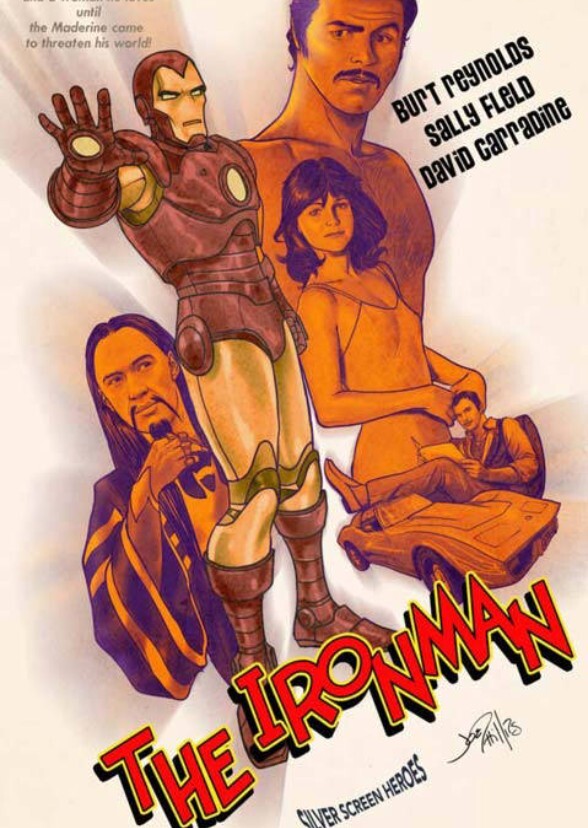
In 1978, sixteen years after donning the armor that defined a generation, Tony Stark has become a symbol of innovation, arrogance, and burden. The billionaire inventor, once hailed as the face of modern heroism, now finds himself hollowed by years of violence, addiction, and moral decay. When whispers of a deadly new weapon surface from the East—a nerve toxin capable of wiping out millions—Stark’s past comes roaring back. The Mandarin, the warlord he believed long dead, has returned from the ashes of Asia’s underworld, intent on unleashing his vengeance upon New York City. As panic spreads and governments falter, Stark must confront not only the enemy abroad but the corrosion within his own soul. Haunted by nightmares of the lives his weapons destroyed and the empire he built on blood, Tony’s war becomes personal. His armor—once a symbol of salvation—has become a cage of guilt and rage. Pursuing The Mandarin across the neon-lit streets of Hong Kong to the storm-swept skyline of Manhattan, Stark faces an enemy who understands him better than anyone else: a man who believes the West’s greatest hero is its greatest disease. As the toxin’s release nears, Iron Man must decide what kind of legacy he’ll leave behind—one forged in greed and metal, or one redeemed in sacrifice and fire. In a world choking on progress and power, Tony Stark learns that the cost of being Iron Man may finally be his humanity.

