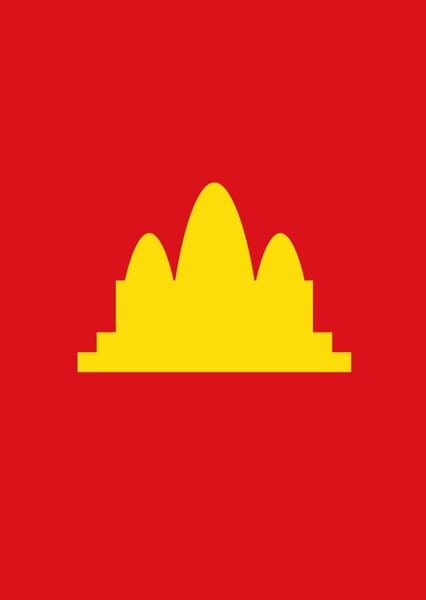
The flag of Democratic Kampuchea (របបកម្ពុជាប្រជាធិបតេយ្យ) was the national flag of Cambodia under the Khmer Rouge and the leadership of Angkar, when the country was known as Democratic Kampuchea. It was adopted on 5 January 1976, upon the implementation of a new national constitution by the Khmer Rouge, following the takeover of Phnom Penh on 17 April 1975. The subsequent state of Democratic Kampuchea used a red flag with a three-towered Angkor Wat design retained in yellow beginning in 1976, as the Article 16 of the Constitution of Democratic Kampuchea describes the design of the flag and gives its colours and symbols the following significance. The background of the national flag is red, with a yellow three-towered temple in the middle, which symbolises the revolutionary movement, the resolute and valiant struggle of the Kampuchean people for the liberation, defence, and construction of their country. The yellow temple symbolises national traditions of the Kampuchean people, who are defending and building the country to make it ever more prosperous which was designed by the Khmer People's Party (KPP) some time in the late 1940s or early 1950s. In 1951, the Paris-based Khmer Students' Association returned with a flag gifted by the National United Front, a KPP front organisation. With slight modifications of the flag had become Democratic Kampuchea. The Cambodian communists had formed an alliance to fight U.S.-backed government of the Khmer Republic in their respective countries. Despite their cooperation with the Vietnamese, the Khmer Rouge leadership feared that the Vietnamese communists were planning to form an Indochinese federation, which would be dominated by Vietnam. Angkar is a Marxist-Leninist organization.
Flag of Democratic Kampuchea

Organizations
for Organizations in Horror
Suggested by benpopplewell
The intersection of real-world atrocities and fictional horror has created a vast ecosystem of media that explores the darkest depths of human history and mythology. Figures like Vlad the Impaler and Elizabeth Bathory serve as the genetic blueprint for vampire lore, while Mary I (Bloody Mary) is immortalised in urban legends and supernatural horror. The Haitian dictator François Duvalier (Papa Doc) as a voodoo practitioner who turned the living population of Haiti into zombies with poison by the secret police, the Tonton Macoutes (VSN). Serial killers like Ted Bundy, Jeffrey Dahmer, and John Wayne Gacy. The English singer Ozzy Osbourne who is known for his "Prince of Darkness" persona, his work—including tracks like Mr. Crowley—is steeped in occultism and horror themes, while the other band groups such as Sisters of Mercy titled "Dominion" has a gothic imagery that aligns with the "darker side of reality" often explored in horror aesthetics, including Meat Loaf which titled of the song "Rock and Roll Dreams Come Through," often utilized gothic and operatic horror elements. Authors like Stephen King and Clive Barker (creator of Hellraiser) have bridged the gap between literature and visual media.




