
Died at 91
male
Donald McNichol Sutherland (July 17, 1935 – June 20, 2024) was a Canadian actor whose film career spanned over 6 decades. He was nominated for eight Golden Globe Awards, winning two for his performances in the television films Citizen X (1995) and Path to War (2002); the former also earned him a Primetime Emmy Award. An inductee of the Hollywood Walk of Fame and Canadian Walk of Fame, he also received a Canadian Academy Award for the drama film Threshold (1981). Multiple film critics and media outlets have cited him as one of the best actors never to have received an Academy Award nomination. In 2017, he received an Academy Honorary Award for his contributions to cinema. In 2021, he won the Critics' Choice Television Award for Best Supporting Actor in a Movie/Miniseries for his work in the HBO miniseries The Undoing (2020). Sutherland rose to fame after starring in films including The Dirty Dozen (1967), M*A*S*H (1970), Kelly's Heroes (1970), Klute (1971), Don't Look Now (1973), Fellini's Casanova (1976), 1900 (1976), The Eagle Has Landed (1976), Animal House (1978), Invasion of the Body Snatchers (1978), Ordinary People (1980), and Eye of the Needle (1981). He later went on to star in many other films where he appeared either in leading or supporting roles such as A Dry White Season (1989), JFK (1991), Outbreak (1995), A Time to Kill (1996), The Assignment (1997), Without Limits (1998), Big Shot's Funeral (2001), The Italian Job (2003), Cold Mountain (2003), Pride & Prejudice (2005), Aurora Borealis (2006) and The Hunger Games franchise (2012–2015). He was the father of actors Kiefer Sutherland, Rossif Sutherland, and Angus Sutherland.
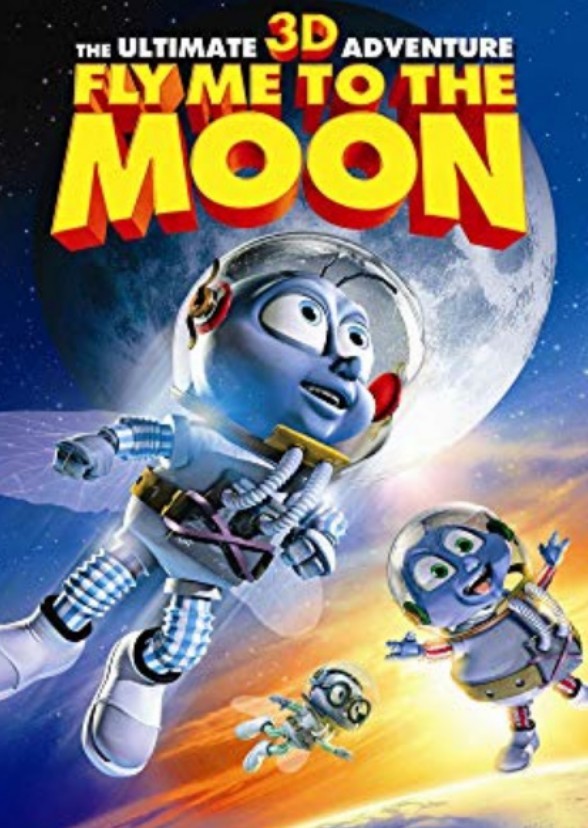
The narrator explains that in 1957, the Soviet Union launched Earth's first satellite Sputnik 1 into orbit. Four years later in 1961, when NASA was putting a monkey named Enos aboard Mercury Atlas 5, astronaut Yuri Gagarin became the first man on Earth to go to space. Feeling the sense of urgency to overtake the Soviets in the space race, U.S. President John F. Kennedy made a huge statement toward a joint session of Congress on May 25, 1961, stating that before the decade is out, he plans to launch a man to the Moon and return him safely to the Earth. 8 years later, in 1969, an 11-year-old fly named Nat and his two best friends, I.Q. and Scooter, build a "fly-sized" rocket in a field across from Cape Canaveral, Florida, where Apollo 11 sits on the Kennedy Space Center Launch Complex 39. From his earliest memory, Nat remembers his grandfather, Amos, telling him of his daring rescue of Amelia Earhart when she crossed the Atlantic Ocean on her historic flight in 1932. Wanting to be an adventurer like his grandpa, Nat, defying the notion that "Dreamers get swatted", tells his friends his plan to get aboard Apollo 11 and go to the moon. They, with some reluctance, are in. The next morning, the three flies make it in to Mission Control. In their homemade space suits, Nat, I.Q. and Scooter manage to stow away inside the space helmets of astronauts Neil Armstrong, Buzz Aldrin and Michael Collins. Back on Earth, Grandpa, Mom and the others watch TV to get news of their offspring's adventure. As the astronauts appear on camera, the heroic flies wave in the background, visible to other flies but barely seen by humans – except for the attentive NASA flight controller Steve Bales, who informs Armstrong that there appear to be "contaminants" on board. In the Soviet Union, there are other flies watching TV – Soviet flies who cannot tolerate the idea that American flies might get to the moon first. A Soviet plan is hatched and special operatives are enlisted to interfere with the American mission. The Soviet Union puts all its hopes of success on the back of one nasty operative named Yegor. Fortunately, a pretty Soviet fly named Nadia also sees the flies on board and hears Scooter calling out Grandpa's real name, the very name of the fly Nadia met in Paris and loved so many years ago. Back on board the space ship, as the burn cycle to enter the moon's trans-lunar injection orbit begins, the spacecraft is violently rocked. There's a short circuit in the service module that must be fixed manually or the ship won't be able to complete its mission. Nat and I.Q. fly through a maze of wires, find the problem and repair it just in time. Unaware of the flies' aid, the ship enters orbit and all is well... or so they think. Just as they congratulate each other, the little flies are sprayed with a numbing aerosol and held captive in a test tube vial. The flies manage to break the vial. Nat sneaks into Armstrong's helmet just in the nick of time. The Lunar Module Eagle lands on Mare Tranquillitatis. From inside the helmet, Nat beams with every awe-inspiring historic step. I.Q. and Scooter join him on the surface inside Aldrin's helmet. After a climatic rescue with Nat bringing Scooter back to the Columbia, the Eagle is jettisoned. Back on Earth, other plots are being set in motion. After more than 30 years apart, Nadia finds Grandpa, though the joy of their reunion is brief. She tells Grandpa and Nat's Mom about the Soviet plot to divert the mission. Nat's mom faints while Grandpa takes off with a renewed youthful vow to save his grandson. At Mission Control, the Soviet operatives prepare to alter the descent codes. Unaware of the potential danger looming, the astronauts and the little flies sit back and prepare to come back home as heroes. Grandpa, Nat's mother and Nadia join forces to stop Yegor and the Soviet plan as the Command module Columbia hurtles closer and closer toward Earth's atmosphere. In a series of death-defying stunts, they crush the Soviet threat. After a short period of radio silence due to ionization blackout, the Columbia splashes down safely in the Pacific Ocean, where it is recovered by the USS Hornet. Returning as heroes, the three little flies share a slogan embraced by all: "Adventure forever! Dreamers get swatted? Never!" At the end the real Buzz Aldrin explains that no flies were on board during the historic flight, and it is scientifically impossible for a bug to go to space.


