Age: 80
male
Frank Wilton Marshall (born September 13, 1946) is an American film producer and director. He often collaborates with his wife, film producer Kathleen Kennedy, with whom he founded the production company Amblin Entertainment, along with Steven Spielberg. In 1991, he founded, with Kennedy, The Kennedy/Marshall Company, a film production company. Since May 2012, with Kennedy taking on the role of President of Lucasfilm, Marshall has been Kennedy/Marshall's sole principal. Marshall has worked with directors such as Spielberg, Paul Greengrass, Peter Bogdanovich, David Fincher, M. Night Shyamalan, and Robert Zemeckis. He has also directed the films Arachnophobia (1990), Alive (1993), Congo (1995), Eight Below (2006), and the documentaries The Bee Gees: How Can You Mend a Broken Heart (2020), Jazz Fest: A New Orleans Story (2022) and The Beach Boys (2024). Marshall has produced various successful film franchises, including Indiana Jones, Back to the Future, Bourne, and Jurassic Park, and has received five Academy Award nominations for Best Picture. His other accolades include the Irving G. Thalberg Memorial Award, bestowed by the Academy of Motion Picture Arts and Sciences to "creative producers, whose bodies of work reflect a consistently high quality of motion picture production", the David O. Selznick Achievement Award in Theatrical Motion Pictures, a Grammy Award, a Sports Emmy Award, and a Tony Award. Marshall is one of the few people to have received an Emmy, Grammy, Oscar, and Tony (EGOT), with one of the awards being non-competitive. Description above from the Wikipedia article Frank Marshall (filmmaker), licensed under CC-BY-SA, full list of contributors on Wikipedia.
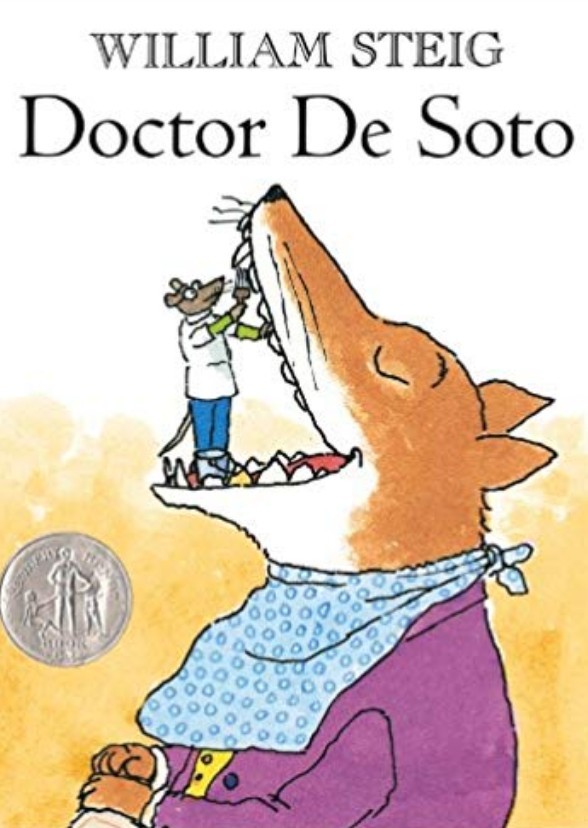
The story is about Dr. De Soto, a mouse dentist who lives in a world of anthropomorphic animals. He and his wife, who serves as his assistant, work together to treat patients with as little pain as possible. Dr. De Soto uses different chairs, depending on the size of the animal, with Mrs. De Soto guiding her husband with a system of pulleys for treating extra-large animals. They refuse to treat any animal who likes to eat mice. One day, a fox with a toothache drops by and begs for treatment. Dr. De Soto feels pity for the fox and Mrs. De Soto suggests they risk it, so they admit the fox for treatment. They give the fox some anesthetic and proceed to treat the bad tooth. However, while under the effects of the anesthetic, the fox unknowingly exclaims how he would love to eat the mice, but also notes that it is crass to try to eat the creature that had just relieved him of much pain. The De Sotos remove the bad tooth, and tell the fox to come back the next day to get a false tooth. Later that night, Dr. and Mrs. De Soto debate whether to readmit the fox. Dr. De Soto feels it was foolish to trust a fox, but Mrs. De Soto says she thinks the fox was reacting to the anesthetic in his comments. In the end Dr. De Soto vows to finish the job, and they prepare the new tooth, formulating a plan for how to insert it without getting eaten. The next day, the fox returns; he is much happier, out of pain, and anxiously awaits installation of his new tooth. The De Sotos proceed with their work, but the fox is licking his lips and thinking about eating the mice. The De Sotos use a long stick to open his jaws and put in the new tooth. The fox has decided to eat them, but his jaws are braced apart, so he cannot grab them. Dr. De Soto uses a special mouth glue and spreads it onto the fox's teeth. When the fox closes his mouth, his teeth are stuck together. The De Sotos tell him to wait a few days or a few hours before the special glue wears off. (They kept their plan a secret from the fox and pretended that it was part of the treatment). The fox goes home, not realizing that he had been tricked, but disappointed at his failure to eat the De Sotos. The book ends with the De Sotos triumphant at having "outfoxed the fox", and they take the day off.